_画板-1-1.png)
By Nicety Machinery Co., Ltd | May 6, 2026
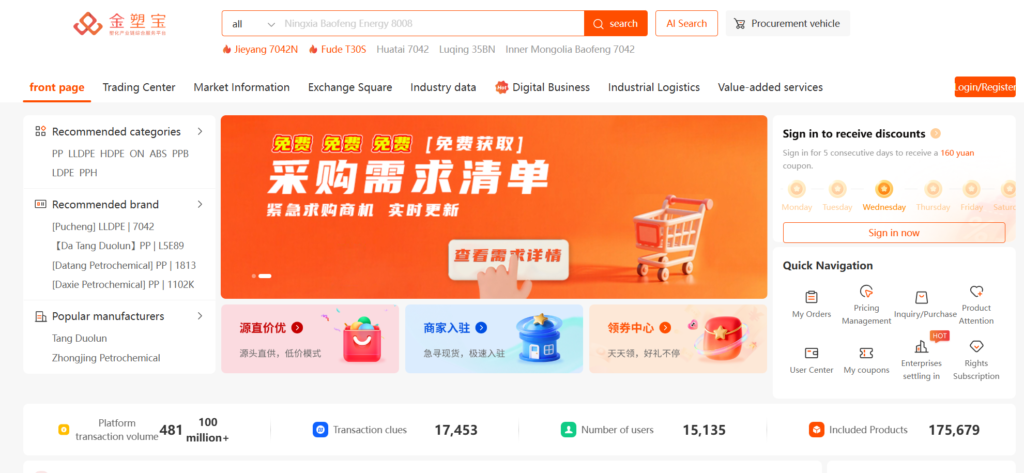
Jinsubao website is still running.
Overview
In mid-April 2026, China’s plastics industry was rocked by the sudden collapse of Jinsubao (金塑宝), a B2B e-commerce platform for polyethylene, polypropylene, and other polymer raw materials that had positioned itself as a one-stop digital procurement hub for the country’s plastics supply chain. Hundreds of companies across North China, East China, and South China found themselves unable to receive goods they had already paid for in full. The platform’s founder and sole controlling shareholder, Huang Xiangyong, was arrested by Tianjin Binhai District police on suspicion of contract fraud. A company spokesperson confirmed the firm is insolvent, with undeliverable contracts totalling approximately ¥1.3 billion RMB (around USD $180 million) affecting an estimated 1,600 businesses. It is one of the largest financial collapses in the history of China’s plastics trade sector.
What Jinsubao Was
Fujian Jinsubao Technology Co., Ltd. was founded on May 26, 2020, with Huang Xiangyong as its legal representative. Registered in Siming District, Xiamen, the company had a registered capital of ¥150 million RMB. It operated the "Jinsubao Plastics Industry Chain Integrated Services Platform," integrating internet technology with the plastics supply chain across software development, internet information services, data processing, blockchain technology services, and plastics product trading.
According to its official website, Jinsubao described itself as a B2F2B (Business-to-Factory-to-Business) comprehensive service platform powered by big data, with more than 30 years of industry background, over 10,000 production enterprises, and more than 2,000 logistics drivers. The platform allowed buyers to purchase polyethylene (PE), polypropylene (PP), and other resins via a dedicated app, with prices marketed as consistently below prevailing market rates.
The company held "high-tech enterprise," "specialized and new SME," and "gazelle enterprise" certifications, and in 2025 was listed among Fujian Province’s first batch of data enterprises. It maintained an A-grade tax credit rating with China’s tax authority. These credentials gave buyers strong reason to view the platform as a credible, institutionally endorsed counterparty.
The Business Model That Made It Attractive — and Dangerous
The platform’s commercial proposition was straightforward: buy polymer raw materials at prices 200 to 300 RMB per ton cheaper than the open market, via an app-based platform, with delivery promised within 30 to 45 days of order placement.
One buyer, a packaging film company owner identified as Mr. Yang (a pseudonym), said he encountered Jinsubao in 2025, attracted by prices around 200 to 300 RMB per ton below the market rate. Initially, the platform operated on a cash-on-delivery basis. Over time, staff began requiring a deposit, and eventually full payment upfront became mandatory.
One buyer described the model plainly: "Jinsubao attracted customers with price advantages — 50 to 80 RMB cheaper per ton — but used a pre-sale model where you order today and receive the goods one to one-and-a-half months later, always paying the full amount upfront."
This deferred-delivery, full-prepayment structure meant that at any given moment, the platform held substantial amounts of customer cash while having not yet procured or dispatched the corresponding inventory. As long as delivery cycles ran normally and purchase volumes were stable, the model could sustain itself. As procurement volumes grew and customers relaxed their scrutiny after successful early deliveries, exposure deepened — invisibly.
How the Collapse Unfolded
Around the Lunar New Year period, many manufacturers placed large advance orders and transferred full payment to Jinsubao to secure inventory. As delivery dates approached, anomalies began to emerge. One buyer recounted: "The delivery date came and went — nothing arrived. Then our sales rep told us to come to the office, and when we got there, we saw a crowd waiting outside. That’s when we realized they couldn’t deliver."
The platform subsequently issued batch delivery commitment letters to some affected customers, but these proved meaningless. As one buyer described: "They wrote a commitment letter and not a single person received any goods — it was all delay tactics."
On April 17, buyers from Beijing, Hebei, Shandong, and other northern provinces gathered at Jinsubao’s Tianjin office in protest — reportedly numbering in the hundreds. On April 20, dozens of buyers from East China converged on the company’s Shanghai office. A Beijing nonwoven fabric factory owner who attended the Tianjin gathering told reporters the scene was calm but tense: "Nobody was crying or making a scene — everyone just wanted to know where the money went and when it would be returned."
The Futures Bet That Broke the Platform
Polyethylene spot prices surged sharply in early 2026. According to data from the business information platform Shengyi She, PE spot prices stood at approximately ¥6,847 per ton on January 25; by April 7, they had risen to approximately ¥9,217 per ton before pulling back slightly.
Multiple buyers cited the same suspected cause for the collapse: speculative losses in the futures market. One buyer relayed the platform’s own account: "The platform said it was two things — they played the futures market and lost, and they also shorted the market after selling inventory to us without restocking." The mechanism described is a circular trap: customer prepayments were deployed into futures positions, with gains intended to fund inventory purchases. When prices moved sharply against the position, there was no capital left to buy the physical goods owed to customers.
Zhong Lihong, party secretary and administrative director of Jinsubao, confirmed to reporters that under losses in both the spot and futures markets, Jinsubao fell into a state where it could no longer operate normally, resulting in the inability to fulfill related purchase and sales contracts. The total amount of contracts that cannot be fulfilled is approximately ¥1.3 billion RMB, directly involving approximately 1,600 companies.
The Human Toll: Hundreds of SMEs, Millions in Losses
Mr. Yang, the packaging film company owner, placed multiple PE orders totalling more than ¥500,000. All show status of "pending shipment." Part of the funds used were borrowed. He said: "Small businesses like ours are affected across the board. We didn’t receive any polyethylene, and this impacts our operations and cash flow significantly."
Another affected party, a trade company owner from Zhejiang with seven employees, had approximately ¥367,000 in outstanding orders on the platform.
A Beijing buyer who attended the Tianjin protest said the mood among the affected companies was not optimistic about recovery: "The amounts involved are too large. I feel it will be very difficult to fully resolve. Most of the affected businesses just hope to recover their principal — not even the profit."
The collapse is notable for the profile of companies caught in it: predominantly small and medium-sized manufacturers — packaging film producers, nonwoven fabric mills, compounders, and converters — that rely on reliable, competitively priced polymer supply to maintain thin operating margins. For these businesses, the loss of several months of raw material funds can be existential.
Founder Arrested, Company Declared Insolvent
On April 25, a Jinsubao company representative confirmed to reporters that Huang Xiangyong had been arrested by Tianjin Binhai District police. As of that date, approximately ¥35 million remained in Huang’s personal accounts. The company is in a state of insolvency — liabilities exceed assets.
Huang Xiangyong faces charges of contract fraud. The investigation has been opened and results are expected to be made public within approximately two months, according to sources at the scene of the Tianjin protest.
A company representative indicated that plans are being developed to establish a new company, a move that some affected buyers have described with suspicion — questioning whether it represents a genuine restructuring or an attempt to separate assets from liabilities.
Warning Signs That Were There All Along
In retrospect, the Jinsubao model contained structural red flags that were obscured by early delivery reliability and attractive pricing:
Full prepayment with extended delivery windows. In normal commodity trading, full prepayment before delivery is a risk signal, not a standard term. The 30-to-45-day delay between payment and delivery created a permanent pool of float that the platform controlled without accountability.
Price-based customer acquisition. Prices consistently 200 to 300 RMB per ton below market are not sustainable through legitimate sourcing. The discount was the hook that kept buyers increasing their exposure.
Credential accumulation without operational transparency. High-tech enterprise status, A-grade tax credit, and multiple certifications addressed regulatory compliance — but none required the platform to demonstrate that customer prepayments were ring-fenced from speculative trading activity.
Rapid volume growth. Buyers described how the normal monthly purchase of "two to three million RMB in goods" became routine — an accumulating concentration of exposure to a single counterparty.
What This Means for Plastics Raw Material Procurement
The Jinsubao collapse is not an isolated incident. It reflects a broader vulnerability in how plastics manufacturers — particularly small and mid-size operations — procure polymer raw materials in price-volatile markets. Digital B2B platforms that aggregate buyers, offer below-market pricing, and operate on prepayment models sit at the intersection of commodity trading and financial speculation in ways that traditional supplier relationships do not.
For processors purchasing PE, PP, and other resins, the event underlines several fundamental procurement disciplines:
Counterparty due diligence matters, not just price. A supplier that holds your cash for 45 days before delivering goods is effectively a short-term financial counterparty, not just a vendor. Their balance sheet, ownership structure, and funding model need to be understood accordingly.
Concentration risk in procurement is a production risk. Running the majority of polymer purchases through a single platform — however convenient and price-competitive — creates a single point of failure that directly threatens production continuity.
Full prepayment for commodity supply chains should be treated as exceptional. Standard industry practice for polymer procurement does not require full upfront payment. Platforms that require it are either working capital constrained or using the float for purposes unrelated to procurement.
Building a More Resilient Procurement and Processing Operation
The downstream impact of supply chain disruption is not limited to the loss of raw material funds — it also means production lines go idle, customers go unserved, and equipment sits unused. For plastics manufacturers and compounders, the most reliable hedge against procurement disruption is a processing operation that can adapt quickly when supply is interrupted, delayed, or needs to be urgently sourced from alternative suppliers at short notice.
This means having material handling and processing equipment that can work with multiple grades, multiple feedstock sources, and variable incoming material quality — rather than being locked to a single supplier’s specification:
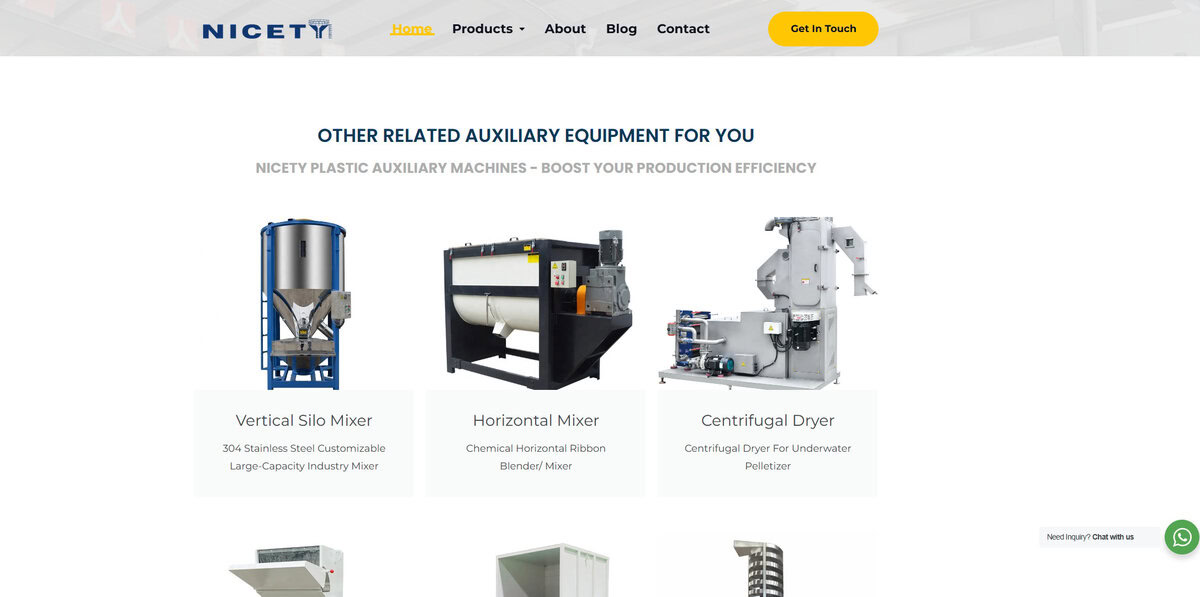
- Flexible mixing and blending: When switching polymer sources or grades mid-cycle, the ability to pre-blend and homogenize incoming material before it enters the main processing line is critical. Nicety Machinery’s High Speed Mixer Machine and Horizontal Mixer provide that capability for both powder and pellet feedstocks.
- Reliable material conveying: Sourcing from multiple suppliers often means handling different pellet sizes, bulk densities, and packaging formats. The Screw Conveyor and Vibrating Spiral Elevator move materials reliably between storage and processing stages, regardless of source variation.
- Drying and moisture control: Alternative-source materials may have different storage histories and moisture profiles. The VOC Deodorizing Drying System manages both drying and volatile content before processing, protecting compound quality when incoming material specifications vary.
- Pelletizing and downstream quality screening: Maintaining consistent output quality regardless of upstream raw material variation starts with robust post-extrusion processing. The Extrusion Pelletizing Line and Linear Vibrating Screener deliver that consistency at the output stage.
- Centrifugal drying for water-cooled lines: For strand pelletizing configurations, the Strand Line Centrifugal Dryer ensures pellets are surface-dry before classification and packing — maintaining product quality across whatever resin grades are being processed.
In a market where digital trading platforms can appear credible and disappear rapidly, the most durable competitive advantage for a plastics manufacturer is a processing operation that is well-equipped, efficiently run, and able to source and process material from multiple channels — not one that is dependent on a single low-cost supply route staying open.
Sources
- Epoch Times (大纪元): Jinsubao Implodes — Over ¥2 Billion in Payments Evaporate, Hundreds of Businesses Seek Redress (April 22, 2026)
- Red Star Capital Bureau / The Paper (红星资本局 / 澎湃新闻): Investigation — Jinsubao Collapse: ¥1.3 Billion in Undeliverable Contracts, Controlling Shareholder Arrested, Company Insolvent (April 26, 2026)
- 163.com / Red Star Capital Bureau: Jinsubao Collapse — ¥1.3 Billion in Undeliverable Contracts, Founder Arrested (April 26, 2026)
- Sina News: Jinsubao Founder Arrested (April 2026)
- Baidu Baike: Fujian Jinsubao Technology Co., Ltd. — Corporate Profile

_画板-1-副本-3-pxeey2xejyohpkvf07tglhvew6ks2ts3pjvhagm60c.png "NICETY MACHINERY Co., LTD")