_画板-1-1.png)
By Nicety Machinery Co., Ltd | June 19, 2026
Covestro’s Hebron, Ohio expansion — coming online in the second half of 2026 — represents North America’s largest single polycarbonate compounding capacity addition in years.
Overview: The Largest PC Compounding Capacity Addition in North America This Year
Covestro’s Hebron, Ohio polycarbonate compounding expansion — a low triple-digit million Euro investment announced in January 2025 — is entering its operational commissioning phase in the second half of 2026. Construction of the new production lines began in 2025, with operations scheduled to start by the end of 2026. The expansion will add multiple new polycarbonate compounding lines and supporting infrastructure to Covestro’s existing Hebron facility, creating 24 new jobs and retaining 145 current positions while significantly expanding the site’s output capacity for customized PC compounds and blends serving automotive, electronics, and healthcare customers across North America.
The Hebron expansion is the largest single polycarbonate compounding capacity addition in North America this year — arriving at a moment when the engineering plastics market is navigating simultaneous raw material cost pressure (PC pricing is stabilizing at a structurally higher base after Q4 2025 corrections), regulatory change (PFAS restrictions, EV platform material transitions), and supply chain restructuring (the Lone Star dual acquisition of RadiciGroup and DOMO concentrating European engineering plastic compounder capacity). Against that backdrop, Covestro’s decision to commit over $100 million to new North American production infrastructure — backed by its new owner, Abu Dhabi National Oil Company (ADNOC) — sends a clear signal about the long-term demand trajectory for specialty PC compounds in the world’s second-largest engineering plastics market.
What Covestro Is Building in Hebron, Ohio — and Why
The Hebron, Ohio facility is Covestro’s primary North American polycarbonate compounding site — the manufacturing location where Makrolon, Bayblend (PC/ABS), and Makroblend (PC/PBT, PC/PET) specialty compounds are produced for direct supply to North American automotive, electronics, and medical device customers.
The expansion will construct multiple new production lines and infrastructure to manufacture customized polycarbonate compounds and blends and significantly expand capacity in the Solutions & Specialties business for the American market. The investment exceeds $100 million and includes new advanced production lines to manufacture high-performance polycarbonate materials.
The Hebron site operates in close coordination with Covestro’s R&D site in Pittsburgh, Pennsylvania — where Covestro separately announced a $40 million investment in R&D capabilities. The proximity of the two Ohio/Pennsylvania sites is operationally significant: new specialty compound grades developed at the Pittsburgh R&D center can be transferred efficiently to Hebron production, shortening the development-to-commercialization timeline for the differentiated PC compound grades that Covestro’s automotive and electronics customers require. In future, both facilities will work even more closely together to drive the technology transfer from lab to industrial production to support major transformation processes, such as the electrification and automation of mobility, sustainable developments and digitalization.
The products manufactured at the expanded Hebron facility span the full breadth of what polycarbonate compounding can achieve:
Flame-retardant PC compounds for electrical and electronics applications — UL94 V-0 rated grades that meet the flammability requirements of power supply housings, connector bodies, and EV charger components. FR PC is one of the fastest-growing PC compound segments globally, driven by the simultaneous growth of AI data center infrastructure (where halogen-free FR PC housings and enclosures are specified) and EV charging equipment.
PC/ABS blends (marketed as Bayblend) — the workhorse material of automotive interior, consumer electronics housing, and commercial equipment applications. PC/ABS combines polycarbonate’s dimensional stability, heat resistance, and impact performance with ABS’s processability and surface quality — producing the balanced property profile that injection molders across North America depend on for high-volume applications.
PC/PBT and PC/PET blends (marketed as Makroblend) — specialty blends that provide chemical resistance to automotive body panels and exterior trim applications that pure PC cannot deliver. As EV exterior body panels increasingly incorporate plastic in structural and cosmetic applications — replacing stamped steel to reduce vehicle weight — chemically resistant PC blend compounds are gaining specification against traditional steel and aluminum.
Medical-grade PC compounds — halogen-free, biocompatibility-documented PC grades for medical device housings, diagnostic equipment components, and hospital equipment. The healthcare segment is one of the most demanding PC compound application categories: material must be validated against sterilization methods (steam autoclaving, gamma radiation, EtO gas), documented for extractable compound content, and traceable across production batches for FDA quality system compliance.
The ADNOC Acquisition Context: New Ownership, Accelerated Investment
The Hebron expansion announcement takes on additional strategic significance in the context of Covestro’s ownership transition. The move comes after the Abu Dhabi National Oil Company (ADNOC) acquired Covestro for €15.9 billion (approximately US$16.2 billion) in October 2024 — one of the largest acquisitions in the history of the specialty chemicals and engineering plastics industry.
ADNOC’s strategic rationale for the Covestro acquisition was explicit: to move downstream from crude oil and natural gas into higher-value polymer chemistry and materials, capturing more of the value chain from petrochemical feedstocks through to specialty engineering compound markets where margins are more insulated from commodity price cycles. The Covestro portfolio — polycarbonates, polyurethanes, isocyanates, and specialty coatings — represents exactly the downstream value-added chemistry that ADNOC sought to acquire.
For the Hebron expansion specifically, ADNOC ownership means Covestro has access to a financially powerful parent with both the capital to fund major infrastructure investment and the strategic incentive to grow downstream polymer compound production. The timing of the Hebron expansion announcement — January 2025, just three months after the ADNOC acquisition closed — suggests that the investment was enabled or accelerated by the new ownership structure.
The "produce in the region for the region" strategy articulated by Covestro’s North American management for the Hebron investment also reflects ADNOC’s understanding of US market dynamics in 2025-2026: tariffs on imported polymer compounds, supply chain diversification pressure from buyers seeking non-Chinese sources, and the regulatory and logistical complexity of supplying healthcare and automotive customers across North America from European production sites — all of which favor local compounding capacity over import substitution.
Polycarbonate Compounding in 2026: The Market Covestro Is Expanding Into
The global plastic compounding market was valued at USD 62.7 billion in 2026 and is projected to reach USD 87.3 billion by 2031, representing a CAGR of 6.8% during the forecast period. Within this broader market, polycarbonate compounds and blends occupy a premium position — serving application categories where raw material cost is a secondary concern to performance consistency, dimensional stability, and regulatory compliance documentation.
Global polycarbonate market was valued at around $16 billion in 2024 and is projected to grow to over $24 billion by 2033 at a CAGR of approximately 4.6%. The compound segment — specialty PC grades formulated with flame retardants, impact modifiers, fillers, and blend partners — commands a significant premium over commodity PC resin, with specialty compound pricing typically 30 to 80% above base resin.
In North America specifically, the PC compound market is being driven by three demand vectors that are accelerating simultaneously in 2026:
Electric vehicle platform transitions. OEM automotive platforms transitioning to EV architectures are changing the material specifications for dozens of interior and exterior components simultaneously. PC/ABS blends for instrument panels and center consoles, chemically resistant PC/PBT for body panels and charging port covers, and halogen-free FR PC for high-voltage cable management and battery management system components are all seeing active specification activity as EV platforms enter volume production.
AI infrastructure and data center construction. The US data center construction boom described in the HFFR article — with US capacity projected to nearly double to 66 GW by 2027 — creates parallel demand for halogen-free FR PC compounds in server rack components, cable management systems, and power distribution housings alongside the HFFR cable compound demand. UL94 V-0 rated PC compounds are the standard material for data center equipment housings in the commercial building and electronics infrastructure markets.
Medical device onshoring and supply chain security. The healthcare industry’s post-COVID emphasis on domestic supply chain security has driven medical device manufacturers to reduce reliance on Asian-sourced components and materials. North American PC compound supply from Hebron — with documented biocompatibility, traceability, and quality system integration — aligns directly with medical device procurement strategies that prioritize domestic or near-domestic sourcing.
Automotive: The Anchor Demand Driver for Specialty PC Compounds
The automotive industry is the largest consumer of compounded plastics, accounting for approximately 35% of total market demand. For polycarbonate specifically, automotive represents an even higher proportion of total compound consumption — particularly in North America, where vehicle platform programs require enormous quantities of validated PC compound grades across interior, exterior, and under-hood applications.
The EV transition is the most consequential current driver of PC compound specification activity. A conventional combustion vehicle contains approximately 1.5 to 2 kg of polycarbonate compounds, primarily in instrument panels (PC/ABS), headlamp lenses (optical PC), and interior trim. An EV contains substantially more PC compound due to the additional applications specific to electric architecture: battery management system housings (halogen-free FR PC), high-voltage junction box covers (FR PC/ABS), onboard charger enclosures (UL94 V-0 PC), and the expanded infotainment and display systems that EV interiors feature.
Covestro’s Makrolon and Bayblend portfolios are deeply embedded in North American automotive supply chains through multi-year material approvals at GM, Ford, Stellantis, and the US manufacturing operations of Toyota, Honda, and Hyundai. The expanded Hebron capacity directly addresses the supply reliability requirement that automotive Tier-1 suppliers impose: a single-supplier polycarbonate compound available only from European production, with 6-week ocean freight lead times, is a supply chain risk that domestic availability eliminates.
The lightweight vehicle design driver reinforces this demand. The automotive industry’s commitment to reducing vehicle weight — both for EV range extension and for combustion vehicle fuel economy — is driving substitution of metal components with engineering plastic alternatives. PC and PC blend compounds, with their combination of high impact strength, dimensional stability, and design freedom, are the primary beneficiary of this metal substitution trend in interior and structural applications.
Electronics and Healthcare: The High-Growth Segments Pulling PC Compound Innovation
Beyond automotive, Covestro explicitly targets electronics and healthcare as the growth segments that justify the Hebron expansion investment. Both are application categories where specialty PC compounds command their highest margins and where North American local supply provides the strongest competitive advantage.
Electronics. The consumer electronics market for PC compounds spans smartphone components (PC/ABS housings, PC optical components for camera modules), laptop and tablet housings (halogen-free FR PC/ABS), wearable device components (medical-grade PC for health monitoring devices), and the rapidly growing market for augmented and mixed reality headset components — where optical clarity, impact resistance, and the ability to mold complex geometries in thin walls are critical compound properties that standard plastics cannot deliver.
The AI data center infrastructure investment wave adds a significant B2B electronics demand layer: server rack components, power supply unit housings, cable management systems, and UPS battery enclosures across the hyperscale data center facilities being commissioned throughout 2026 and 2027 all require UL94-rated halogen-free FR PC compounds. This is a direct commercial overlap between the HFFR compound demand driven by data centers (served by the cable compound market) and the FR engineering plastic compound demand served by Covestro’s expanded Hebron production.
Healthcare. The medical-grade PC compound market is the highest-specification and highest-margin segment in the PC compound portfolio. Medical device manufacturers require PC compound grades with:
- Documented biocompatibility (ISO 10993 testing)
- Sterilization resistance (autoclave, gamma radiation, EtO compatibility)
- Consistent extractable compound profiles (low leachables for patient-contact applications)
- Full production batch traceability
- Quality management system alignment (ISO 13485)
Covestro’s Makrolon medical grades — produced at Hebron with the documentation and traceability infrastructure that FDA quality system requirements demand — are qualified at medical device manufacturers across North America. The onshoring trend in medical device manufacturing, combined with the expansion of diagnostic equipment, monitoring device, and robotic surgery system production in the post-COVID healthcare investment cycle, is creating a sustained demand increase for domestically supplied medical PC compound that the Hebron expansion directly addresses.
The "Produce in the Region for the Region" Strategy — and Why It Matters Now
Covestro’s explicitly articulated "produce in the region for the region" strategy for the Hebron investment is not a marketing phrase — it is a direct response to the commercial realities of the North American engineering plastics market in 2026.
The combination of a 15% global tariff on imported polymer compounds, US-China trade tension driving supply chain diversification away from Asian compound sources, the logistics cost inflation from Middle East shipping disruption, and the supply chain security premium that automotive and medical device customers are attaching to North American-sourced materials has structurally increased the competitive advantage of domestic compounding capacity relative to offshore production with import logistics.
A Covestro customer in Michigan sourcing PC/ABS blend for an EV instrument panel application can receive compound from Hebron within 48 to 72 hours of order placement. The equivalent delivery from Covestro’s European production sites involves a 6-week ocean freight lead time, port logistics, customs clearance, and the tariff cost layered on top of the compound price. In a market where automotive program schedules are compressed by EV platform transition timelines and inventory buffers are thin to minimize working capital, the local supply reliability advantage of Hebron production is a commercial differentiator that the tariff environment has made more financially significant than at any point in recent history.
The Hebron expansion also demonstrates the broader "reshoring" investment pattern visible across the North American engineering plastics compounding industry in 2026. The PolyTek JV in India reflects the same logic applied to the Asian market — combining local manufacturing with international formulation expertise to serve rapidly growing domestic demand. Windmoeller & Hoelscher’s Rhode Island expansion serves the same principle for film extrusion machinery. The pattern is consistent: companies are investing in regional production infrastructure rather than relying on increasingly uncertain global supply chains.
What the Hebron Expansion Means for PC Compound Buyers in North America
For compounders and processors in North America who purchase PC compounds and blends — either directly from Covestro or from distributors and compound converters who use Covestro base resins — the Hebron expansion carries concrete commercial implications:
Increased availability of specialty grades from domestic inventory. The expanded Hebron capacity enables Covestro to stock a broader range of specialty PC compound grades domestically — moving more grades from European import allocation to domestic production. For buyers who have experienced allocation constraints on specific FR PC or medical-grade grades, the additional production capacity reduces the supply risk associated with those grades.
Faster new grade development for North American applications. The proximity between the Pittsburgh R&D site and the Hebron production facility — combined with the new "technology transfer from lab to industrial production" framework explicitly described by Covestro — shortens the development cycle for application-specific compound grades. North American automotive and electronics customers requesting compound modifications or new grades for next-generation platforms can expect faster development iteration than a model requiring European R&D and Ohio production to be coordinated across time zones and with ocean freight logistics.
Pricing and contract structure effects. Expanded domestic supply from a major producer typically has a moderating effect on PC compound pricing for North American buyers who are currently importing or paying import-logistics premiums. The direction and magnitude of this effect will depend on market demand levels when the new capacity comes online — but additional domestic supply is generally constructive for buyer pricing positions in the medium term.
Qualification requirements for new production lines. Buyers with existing Covestro compound grades qualified in their products should confirm with their Covestro account contacts whether the Hebron expansion involves any changes to production equipment or process parameters that require requalification under their quality management systems. New production lines, even for existing grades, may require notification to and approval from automotive OEM customers whose quality approvals are equipment-specific.
Polycarbonate Compounding Processing Challenges — and the Equipment That Solves Them
For compounders producing PC and PC blend compounds — whether at Covestro’s scale or at independent compounders who formulate proprietary PC blends — the auxiliary equipment chain determines whether the extruder’s output meets the precision requirements that automotive, electronics, and medical customers impose. Polycarbonate is one of the most demanding engineering resins to process consistently, and the pre- and post-extruder equipment steps are critical quality determinants.
Drying — the single most critical pre-processing step for PC:
Polycarbonate is strongly hygroscopic. It must be dried to below 0.02% (200 ppm) moisture before compounding or extrusion — otherwise hydrolytic degradation of the carbonate bonds reduces molecular weight, causing a reduction in impact strength and melt viscosity that permanently compromises the compound’s performance. For PC/ABS and PC/PBT blends, both the PC and ABS or PBT components must be dried before blending — adding an additional drying capacity requirement relative to single-resin processing.
Nicety Machinery’s VOC Deodorizing Drying System provides the desiccant-based drying performance required for PC compound production, removing both moisture and the volatile residues from polymerization and compounding that can affect surface appearance and odor specifications in automotive interior and medical applications. For FR PC compounds, the drying system’s VOC removal capability also addresses the volatile flame retardant residues that can affect melt stability and surface quality if not removed before processing. The system’s precise temperature control — maintaining PC within its recommended 120°C drying temperature — prevents thermal degradation in the dryer itself, a risk with PC due to its moderate thermal sensitivity.
High-precision pre-blending for FR additives, impact modifiers, and blend partners:
The High Speed Mixer Machine pre-disperses flame retardant additives, impact modifiers, heat stabilizers, and mold release agents into PC powder or pellet base before the twin-screw compounding extruder. For halogen-free FR PC compounds, where the phosphorus-based flame retardant must be uniformly distributed to achieve consistent UL94 ratings across the pellet batch, high-speed pre-blending is the upstream quality step that determines whether the compound achieves its flame retardant specification at reduced additive loading — minimizing the cost and processing impact of the FR package while maintaining certification compliance.
The Plastic Color Mixer handles precision masterbatch let-down for the colorant and special effect additive packages that automotive PC/ABS and electronics PC compound grades require — ensuring that color target repeatability between production batches meets the automotive color matching standards (GMW, Chrysler, Ford color tolerance specifications) that OEM supply qualifications enforce.
Bulk blending for PC/ABS and PC/PBT blend operations:
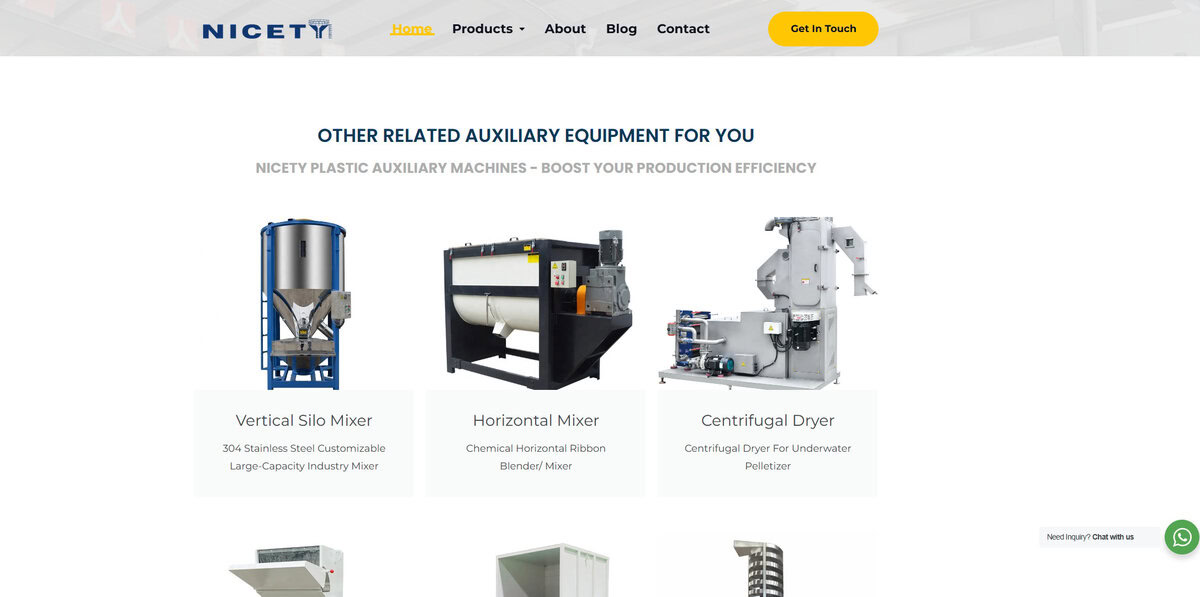
The Horizontal Mixer provides consistent bulk blending of PC and ABS or PBT pellets at defined blend ratios before the compounding extruder. For PC/ABS blend operations, the pellet-to-pellet blend ratio determines the property balance between PC’s impact strength and dimensional stability and ABS’s processability and surface quality — and this ratio must be consistent across batches to maintain the validated compound properties that automotive approvals specify. The Vertical Silo Mixer homogenizes multiple blend batches in the storage silo before production runs, smoothing batch-to-batch variation that would otherwise propagate into compound property inconsistency at the extruder.
Post-extrusion pellet drying after water-bath cooling:
For PC compound lines using strand pelletizing with water-bath cooling, the Strand Line Centrifugal Dryer removes surface water from PC compound pellets immediately after the water bath — before hygroscopic PC pellets begin reabsorbing moisture in the interval between strand cooling and the downstream thermal drying or direct packaging stage. This centrifugal surface drying step is particularly important for medical-grade PC compound destined for packaging in moisture-barrier bags for extended shelf life: pellets that enter the packaging stage with elevated surface moisture will equilibrate during storage, potentially exceeding the moisture specification that medical device injection molders require.
Gentle elevation for optical and precision-grade PC pellets:
The Vibrating Spiral Elevator provides gentle height transitions for PC compound pellets between the pelletizer, dryer, and screener stages — minimizing the pellet surface damage and fines generation that impact the optical clarity and surface quality of clear PC compound grades (used in headlamp lenses, optical media components, and display lightguides). Impact-induced surface defects on clear PC pellets create stress concentrations that show up as optical imperfections in finished injection-molded transparent parts — a quality issue that gentle vibratory elevation prevents at the production stage.
Post-pelletizing size classification:
The Linear Vibrating Screener classifies PC compound pellets to the dimensional specification required by precision automotive, electronics, and medical injection molding customers — removing fines and oversized pellets before packaging. For medical-grade PC compound where batch documentation and material traceability extend to pellet size classification data, the screener’s output is a quality record as well as a processing step: the percentage of pellets within the specification range per batch is a quality indicator that medical device manufacturers increasingly include in their supplier quality audit reviews.
Sources
- Covestro Official Press Release: Covestro Expands Production in Ohio — January 8, 2025
- PRNewswire: Covestro Invests Low Triple-Digit Million Euro in Hebron, Ohio Facility — January 8, 2025
- Columbus Region Economic Development: Covestro Announces Expansion in Hebron to Support Advanced Materials Production — Creating 24 Jobs, $100M+
- The Chemical Engineer: Covestro Announces Nine-Figure Investment into Ohio Polycarbonate Plant — ADNOC Acquisition Context — January 2025
- Interplas Insights: Covestro Expands Its Polycarbonate Production Lines in Ohio — January 2025
- BIC Magazine: Covestro Expands Production in Ohio — Construction 2025, Operations by End of 2026
- AMPP Materials Performance: Covestro Expands Polycarbonate Compounds Production in Ohio
- Kerke Extruder: Global Plastic Compounding Market $62.7 Billion in 2026, Growing at 6.8% CAGR to $87.3 Billion by 2031
- Future Market Insights / OpenPR: Extruders and Compounding Machines Market $82.2 Billion in 2026, Growing to $123.8 Billion by 2036 — Twin Screw Extruders 58% Share — May 2026
- GlobeNewsWire: Plastic Compounding Market Size to Worth USD 159.91 Billion by 2035 — February 2026
- Goldman Sachs Research: US Data Center Power Demand Projected to Nearly Double to 66 GW by 2027 — May 2026

_画板-1-副本-3-pxeey2xejyohpkvf07tglhvew6ks2ts3pjvhagm60c.png "NICETY MACHINERY Co., LTD")