_画板-1-1.png)
By Nicety Machinery | April 22, 2026
Nicety Machinery Co., Ltd -Auxiliary Equipment Manufacturer
Why 2026 Is a Turning Point
For most of the past decade, masterbatch production followed a straightforward logic: use virgin carrier resin, load it with pigment and additives, ensure dispersion, ship. That logic is breaking down in 2026.
Two regulatory tracks are tightening simultaneously:
- EU PPWR (effective August 12, 2026): mandatory minimum post-consumer recycled (PCR) content in single-use PET beverage bottles starts at 25%, rising to 30% by 2030. Food-contact packaging faces its own escalating quotas. Brand owners have no alternative but to source PCR-containing compounds.
- Parallel regulations in the UK, US states, and across Asia-Pacific are pushing in the same direction, creating a synchronized global wave of mandatory recycled-content adoption.
The result: compounders worldwide are being forced to incorporate PCR feedstock at scale — and the inherent color variability, batch inconsistency, and performance instability of recycled materials has transformed masterbatch from a finishing touch into a critical production dependency.
Three Core Challenges in Recycled-Content Masterbatch
Unlike virgin resin, post-consumer recyclate (PCR) is a moving target. Its complexity shows up across three dimensions:
Challenge 1: Unpredictable Base Color
PCR materials typically carry grey, yellow, or brown undertones from thermal oxidation, contamination, and mixed-source collection. Color deviation within a single batch can exceed the correction capacity of standard masterbatch, while batch-to-batch shifts leave brand managers managing what amounts to a color lottery. Effective correction requires spectrophotometric measurement of the recyclate’s exact color coordinates before formulation — there is no universal "fix-it" masterbatch.
Challenge 2: Polymer Compatibility Complexity
Municipal recycling sorting efficiency varies widely. PCR streams entering compounding lines frequently contain mixed polymer types at different molecular weights and degradation stages. Compatibility failure manifests as phase separation, poor surface finish, reduced impact strength, and — most visible to brand owners — uneven color distribution. Compatibilizer masterbatch formulated specifically for a given PCR stream can convert previously hard-to-recycle fractions (e.g., PE/EVOH barrier films, PP/PE mixed rigid packaging) into usable production inputs rather than downcycled waste.
Challenge 3: Multi-Function Additive Complexity
The 2026 market demands more than color. Customers now expect a single "combination masterbatch" delivering color + antioxidant + odor adsorption + UV stabilization + flame retardancy in one pellet. This raises the bar for dispersion uniformity dramatically — multiple active components introduced simultaneously means any single point of poor dispersion can cascade into functional failure across the entire batch.
Global Market Size and Growth
The global masterbatch market was valued at approximately USD 7.0 billion in 2025, projected to reach USD 7.45 billion in 2026 and grow to over USD 10.5 billion by 2033 at a ~5% CAGR.
By segment:
- Black masterbatch: fastest-growing type at 7.3% CAGR (2026–2033), driven by carbon black’s dual role in color masking and UV protection
- Functional/additive masterbatch (antimicrobial, anti-fog, UV stabilizers, flame retardants): outperforming the market average, tied to high-value medical, automotive, and agricultural end-uses
- Recycled-plastic-compatible masterbatch: the fastest-emerging sub-category with meaningful pricing premiums; supply-side capacity is still catching up with demand
Geographically, Asia-Pacific holds the largest share at ~30.7% of global revenue, with China and India the fastest-growing countries. Germany is forecast to grow at 7.2% CAGR through 2036, supported by automotive, packaging, and electrical sectors. The US market is growing at 5.4% CAGR, driven partly by sustainable packaging mandates and medical device applications.
Formulation Strategies: From Color Correction to Functional Integration
White Masterbatch: The First Line of Defense Against Base Color Drift
High-opacity white masterbatch — typically titanium dioxide (TiO2) based — is the primary tool for correcting the yellow and grey tones endemic to PCR streams. The key is precision: too little TiO2 and the base color bleeds through; too much and you add unnecessary weight and cost. Getting the TiO2 loading and dispersion right requires both formulation expertise and equipment capable of reliably achieving that dispersion at production scale.
Black Masterbatch: Forgiving, But Not Without Risks
Carbon black masterbatch offers exceptional opacity and UV protection, making black the most common color choice for recycled-content products in automotive, agricultural, and industrial applications. Its broad masking power forgives much of the batch-to-batch variation in PCR base color — which is exactly why it is so widely adopted. However, carbon black carries its own recycling complication (see below).
Combination Masterbatch: Simplify the Line, Reduce Error Points
Integrating color, antioxidant, and odor adsorption into a single masterbatch eliminates multiple downstream dosing points, simplifies line changeovers, reduces cross-contamination risk between additive streams, and lowers operator training requirements. For converters working with high-PCR formulations, this consolidation is increasingly a competitive differentiator rather than a premium option.
The Hidden Recycling Killer: Carbon Black
Carbon black is ubiquitous in black masterbatch — and therein lies a problem that the industry is only beginning to address systematically.
Modern plastic sorting systems rely on Near-Infrared (NIR) spectroscopy to identify polymer types. Carbon black absorbs all NIR light. Any formulation containing more than 0.03% carbon black becomes invisible to NIR detectors, routing the material into mixed-waste streams and effectively eliminating it from closed-loop recycling.
This means a substantial volume of packaging labeled "recyclable" — in black PE, PP, or PET — is functionally non-recyclable in practice. EU Design for Recycling (DfR) guidelines already recommend against carbon black for any application where NIR-sortability matters. These guidelines are being incorporated into PPWR secondary legislation, with hard constraints expected to take effect around 2028.
For masterbatch suppliers, this represents a clear product development mandate: NIR-transparent alternatives using organic pigments or inorganic substitutes are no longer niche — they are the direction of the market. For compounders, it is a formulation audit and customer communication priority that should be addressed before the regulatory deadline, not after.
The Odor Problem: Why PCR Resin Smells — and What to Do About It
Color inconsistency gets the most attention in recycled-material compounding, but odor is often the issue that stops a PCR-based product from ever reaching the market. Post-consumer recyclate — especially from food packaging, household waste streams, or multi-use agricultural films — carries residual VOC (volatile organic compound) contamination from its prior use. These VOCs survive mechanical recycling and often intensify during the heat of compounding and molding.
For packaging, consumer goods, and especially any product approaching food-contact applications, unacceptable odor levels are a hard rejection criterion. Masterbatch can include odor-adsorbing agents, but upstream treatment of the PCR feedstock itself delivers more durable results.
A VOC Deodorizing Drying System addresses this at the source: it simultaneously dries the PCR pellets to the moisture specifications required for stable extrusion and strips residual volatile compounds through controlled thermal treatment and airflow management. Treating the recyclate before it enters the compounding line — rather than masking odor with additives after the fact — produces finished compounds with consistently lower VOC levels and removes a major barrier to PCR adoption in odor-sensitive applications. This is particularly relevant for masterbatch producers who process PCR-based carrier resins, as odor contamination in the carrier will undermine even the most carefully formulated pigment and additive package.
What Recycled-Content Masterbatch Demands From Pre-Processing Equipment
Recycled-content masterbatch imposes requirements on auxiliary equipment that are fundamentally different from virgin-resin operations:
Pre-Mix Homogeneity Determines Formulation Outcome
Dispersing TiO2, organic pigments, antioxidants, and odor-adsorbing agents uniformly into a PCR carrier resin before the material enters the twin-screw extruder is the single most critical upstream step. Any agglomeration or component segregation that enters the extruder feed zone will survive as a defect in the finished masterbatch pellet — expressed as color specks, streaks, or zones of functional additive depletion.
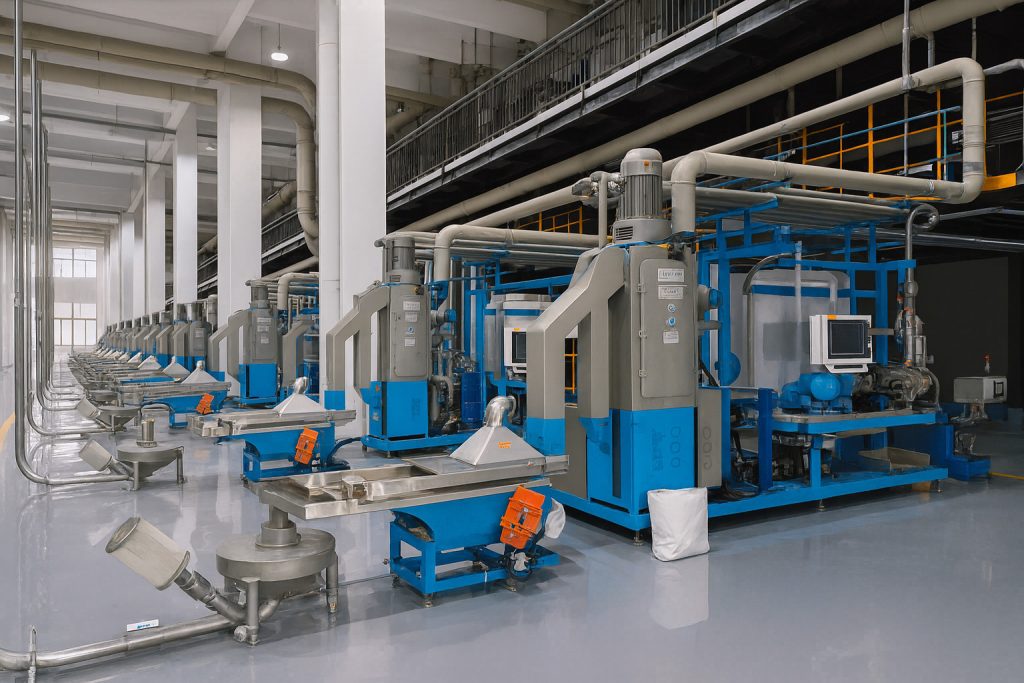
Nicety’s plastic mixer equipment covers the full range of pre-mix requirements for masterbatch production:
- High-Speed Mixer: high-shear intensive mixing to break down pigment agglomerates and achieve micron-level dispersion in the carrier before extrusion; the right choice for combination masterbatch formulations where multiple active components must be uniformly co-dispersed
- Plastic Color Mixer: designed specifically for color blending applications, ensuring batch-to-batch color repeatability in production runs where shade consistency is the primary quality criterion
- Vertical Mixer: efficient gentle blending for pre-dried PCR pellets and additive concentrates where maintaining pellet integrity while achieving homogeneity is the objective
- Horizontal Mixer: suited to larger batch volumes and multi-component recipes where thorough distributive mixing across a wider formulation matrix is required
Batch Stability Requires Consistent Feed
PCR feedstock varies batch to batch — which means the mixing equipment must deliver constant shear intensity and residence time regardless of the incoming material’s melt flow or particle size distribution. Relying on operator-adjusted parameters to compensate for feedstock variability introduces the very inconsistency that recycled-content masterbatch customers are paying to avoid.
Changeover Cleanliness Directly Impacts Cost
Color switching is a routine part of masterbatch production. With PCR carrier resin more expensive than it was 18 months ago — and rising further under PPWR-driven demand pressure — the scrap generated by inadequate purging between color runs has become a meaningful cost line. Equipment that cleans quickly and completely reduces this waste, improving both margin and sustainability metrics simultaneously.
Sources
- Kerke Extruder – Masterbatch for Recycled Plastics: Comprehensive Guide (April 7, 2026)
- Abbey Masterbatch – Closing the Loop: Masterbatch and Recycled Content Goals (February 2026)
- Grand View Research – Global Masterbatch Market Report 2026
- Future Market Insights – Masterbatch Market 2026–2036
- MarketsandMarkets – Black Masterbatch Market 2025–2030
- DGYX – How to Develop Masterbatch for Recycled Plastics
- EU PPWR Official Text – EUR-Lex
- Nicety Machinery – Engineering Plastics & Processing Industry News

_画板-1-副本-3-pxeey2xejyohpkvf07tglhvew6ks2ts3pjvhagm60c.png "NICETY MACHINERY Co., LTD")