_画板-1-1.png.webp)
By Nicety Machinery | April 23, 2026
VOC Deodorizing drying system – Nicety Machinery Co., Ltd
The Shock in Plain Numbers
The 2026 Strait of Hormuz crisis — triggered by the U.S.-Israel military campaign against Iran that began in late February — has produced the largest supply disruption to global energy and petrochemical markets since the 1970s oil crises. For the plastics industry, the numbers are stark:
- Brent crude hit $141.36/bbl at its peak — the highest since 2008
- Naphtha breached $1,000/MT, a level that shatters cost models for naphtha-fed crackers across Asia and Europe
- European LLDPE surged 44% in a single month
- US PE producers are pushing cumulative increases of $0.35/lb within 90 days
- India’s HDPE surged 75%; an estimated 50% of India’s plastic MSMEs have temporarily shut down
- Vietnam’s NSRP declared force majeure on polypropylene through Q2 2026
- CFR propylene hit $1,500/ton in Southeast Asia
ICIS estimated on April 13, 2026, that even after the Strait of Hormuz fully reopens, it will take 12 to 18 months for Middle East polymer exports to fully recover — encompassing ceasefire terms, insurance market normalization, carrier service resumption, force majeure unwinding, and inventory rebuilding across the entire chain.
How the Strait of Hormuz Became Plastics’ Chokepoint
The Strait of Hormuz is not merely an oil transit lane. It is the physical backbone of the global petrochemical supply chain. The numbers that rarely appear in mainstream coverage:
- 193 active petrochemical complexes in the Middle East depend on the Strait for shipping
- These facilities handle 22% of global petrochemical supply — covering ethylene, propylene, butadiene, benzene, toluene, xylenes, methanol, and more
- More than 80% of Middle Eastern polyethylene export capacity depends on the Strait
- A third of global seaborne methanol trade passes through the Strait — methanol being a key feedstock for resins, coatings, and plastics
- A prolonged closure would reduce 24% of global seaborne naphtha supply
Naphtha is the foundational feedstock for polypropylene, polyethylene, PVC, polystyrene, and ABS across Asia and Europe. There is no short-term substitute for it. The downstream cascade from naphtha shortage reaches every segment of the plastics compounding industry within weeks.
By mid-April 2026, Lloyd’s List Intelligence counted more than 600 vessels stranded in the region, including 325 tankers and 114 container ships, with approximately 20,000 seafarers trapped. All major container carriers — Maersk, Hapag-Lloyd, CMA CGM, MSC — remain fully suspended from normal Strait transits.
Regional Impact: Who Gets Hit Hardest
The crisis is not hitting all regions equally. Supply chain exposure to Middle Eastern feedstocks determines the severity of impact.
South Korea — Most Severely Exposed in Asia
South Korea sources 73% of its naphtha and 69% of its crude from the Middle East. The government responded by banning naphtha exports for five months from April 15, prohibiting hoarding of six key petrochemical building blocks including ethylene, propylene, butadiene, benzene, toluene, and xylene. Panic buying of plastic consumer goods has already begun domestically.
India — Acute Industrial Disruption
The government declared an emergency and waived customs duties on 40 petrochemical products until June 30 at a cost of INR 1,800 crore ($215 million). In Gujarat alone, 80% of the region’s 850 detergent MSMEs have shut down, with 30,000 workers idled. Polymer prices are up 60% year-on-year across major grades.
Europe — Structurally Vulnerable
Europe imports a significant share of its PP and is already seeing acute feedstock tightening. ICIS data shows petrochemical price increases at their sharpest pace since 2007 for the region. European PP prices reached $1.57/kg in March 2026 — a 4% rise from December — before the full impact of Hormuz supply cuts had fully propagated. Further increases are expected through Q2.
China — Relatively Insulated, Now a Gatekeeper
China is largely self-sufficient in PP and holds large crude reserves. Crucially, Iran has designated China (alongside Russia and India) as a "friendly nation" permitted to transit the Strait — creating a two-tier blockade where Chinese polymer buyers face a materially different supply environment from buyers in Europe, the US, and most of Southeast Asia. Analysts at the Atlantic Council warn this dynamic could cement new Chinese chokepoints over global petrochemical supply chains if the crisis persists.
United States — Structural Winner
US shale-based feedstock producers are insulated from Hormuz disruption. Dow has pushed PE increases of $0.30/lb and LyondellBasell is up 88% year-to-date in equity markets. US producers have unprecedented pricing power at over 90% utilization rates and are actively looking to capture export share vacated by Middle Eastern suppliers.
Resin-by-Resin Damage Assessment
| Resin | Key Exposure | Current Status |
|---|---|---|
| PP (Polypropylene) | Naphtha/propylene, PDH units | Vietnam force majeure; SE Asia at record highs; $1,500/ton propylene |
| PE (Polyethylene) | Naphtha; >80% of ME export capacity offline | European LLDPE +44%; US pushing $0.35/lb cumulative |
| PVC | Naphtha/ethylene feedstock | Tightening alongside ethylene complex |
| Nylon PA6 | Caprolactam (partially benzene-derived) | Pre-existing April 1 price hike compounded by Hormuz feedstock pressure |
| ABS | Benzene/styrene, both Hormuz-exposed | Flat through Q1 but increasing risk through Q2 |
| PET | PTA/MEG feedstocks, significant ME exposure | Logistics disruptions adding to pre-existing tariff pressure |
The resin price inflation from the Strait of Hormuz crisis is layered on top of the coordinated polyamide price increases that BASF, AdvanSix, and Ascend already implemented in late March and early April 2026 — creating a double-compression event for compounders who use multiple engineering resin types.
The Recovery Timeline: Longer Than You Think
The common assumption — that prices will normalize once the Strait reopens — is wrong, according to ICIS analysis. The recovery involves multiple sequential steps, each with its own lead time:
- Ceasefire and Strait reopening — politically uncertain, timeline unknown
- War-risk insurance market normalization — months after reopening, not days
- Carrier service resumption — weeks to months as vessel positioning restores
- Force majeure unwinding at production facilities — facility-by-facility assessment
- Inventory rebuilding across the full petrochemical chain
- Logistics chain restoration — the final and most diffuse step
ICIS projects a 12-to-18-month full recovery window once the Strait reopens. The recovery will be uneven — availability improving at different stages of the supply chain at different rates. Pricing dynamics will remain elevated throughout.
For compounders and processors managing annual procurement contracts, this means the cost landscape through the end of 2026 and into 2027 is fundamentally different from what was budgeted six months ago.
What Compounders and Processors Should Do Now
1. Lock in available inventory where feedstock-exposed resins are concerned.
The standard "just in time" procurement model is a liability in a structural supply disruption of this scale. PP, PE, and naphtha-derived engineering resins are the priority. Buyers who wait for prices to peak before restocking will face both higher prices and constrained availability.
2. Audit your resin source exposure.
Not all suppliers are equally exposed. US-sourced polyolefins are on a structurally different feedstock basis from Asian or European sources. Dual-sourcing between US and non-Hormuz-exposed suppliers is now a risk management imperative, not a procurement refinement.
3. Maximize yield from every kilogram of resin you do have.
When feedstock costs rise 35–70%, the cost of scrap, rework, and off-spec batches escalates proportionally. Pre-processing efficiency — particularly accurate blending, consistent mixing, and minimizing material waste between production runs — directly protects margin.
Nicety’s plastic mixer range — including the high-speed mixer, horizontal mixer, and vertical mixer — helps compounders achieve consistent pre-mix homogeneity and minimize per-kilogram material loss, a critical advantage when resin costs are at crisis-level highs. Pair with the screw conveyor for precise, loss-free pellet transfer between processing stages.
4. Prioritize odor and quality management for any recycled-content substitution.
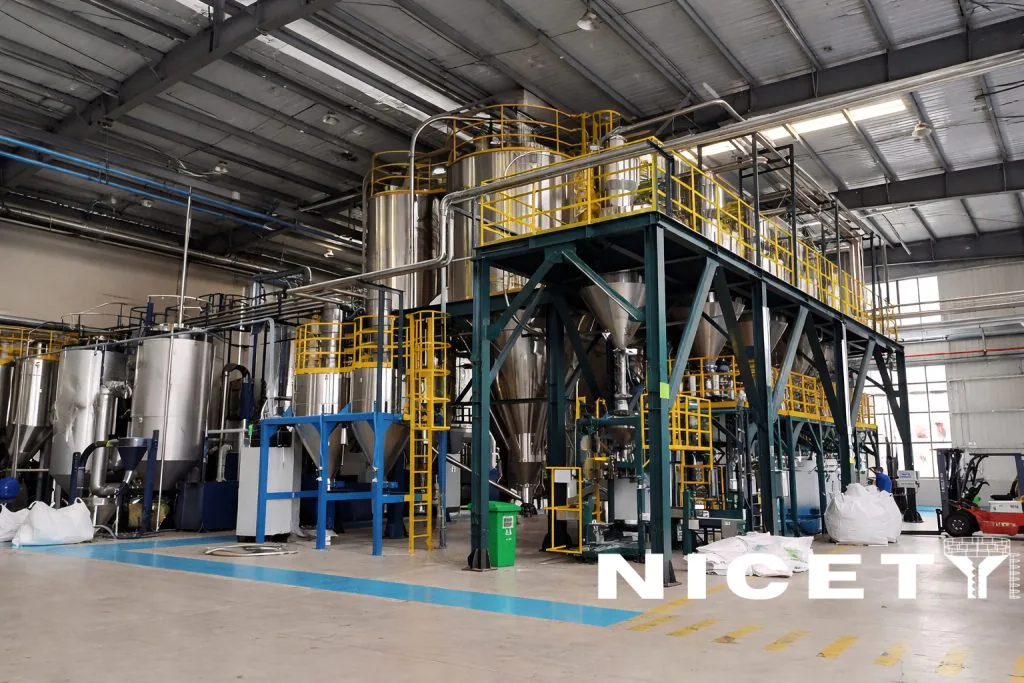
With virgin resin prices spiking, PCR-content substitution becomes economically attractive for grades where it is technically viable. However, PCR resin brings VOC contamination that must be addressed before compounding. A VOC Deodorizing Drying System treats recycled feedstock upstream — removing volatile contaminants and drying to extrusion-ready moisture specifications — ensuring that cost-driven PCR substitution does not create quality or odor problems in finished compounds.
5. Monitor the July tariff deadline.
The US Section 122 stop-gap tariff (15%) expires in July 2026. Policy decisions made at that junction — whether to extend, escalate, or allow to lapse — will intersect with the Hormuz supply shock recovery timeline to produce the second half of 2026’s pricing environment. Build that scenario explicitly into procurement planning.
Sources
- Packaging Europe – Why is the Strait of Hormuz Crisis Pushing Up Plastic Prices? (April 2026)
- CNBC – Strait of Hormuz, Petrochemicals, and Plastics Inflation (March 28, 2026)
- Atlantic Council – Hormuz Crisis: Ripple Effects Across Plastics and Food Supply Chains
- Recycling Magazine – Strait of Hormuz Chokepoint to Shut in Middle East Chemicals and Plastics Exports (March 2026)
- World Economic Forum – Beyond Oil: 9 Commodities Impacted by the Hormuz Crisis (April 2026)
- Syntex America – Polymer Prices Hit All-Time Records: Full Tracker (April 2026)
- The American Prospect – Aftermath: Plastics Clogged in the Persian Gulf (April 14, 2026)
- Plastics Technology – April 2026 Volume Resin Prices: Uncertainty Looms
- Nicety Machinery – Engineering Plastics & Processing Industry News

_画板-1-副本-3-pxeey2xejyohpkvf07tglhvew6ks2ts3pjvhagm60c.png.webp "NICETY MACHINERY Co., LTD")