_画板-1-1.png)
By Nicety Machinery Co., Ltd | April 28, 2026
Advanced polymer compounding across America, Europe, and Asia.
Overview
Sweden-based HEXPOL, one of the world’s largest polymer compounding groups, has merged its Thermoplastics and TPE (thermoplastic elastomer) businesses into a single unified division called HEXPOL Thermoplastics. The reorganization — announced in early March 2026 and reported globally through mid-April — consolidates 14 production sites across America, Europe, and China under a single leadership structure, covering over 20 thermoplastic materials groups spanning engineering resins, polyolefins, TPEs, and specialty compounds. The move is the clearest structural signal yet that the boundary between hard engineering plastics and flexible elastomers is dissolving at the compounding level.
What Changed and Why
HEXPOL brought its Thermoplastics and TPE companies together into a single business area, with the stated goal of making it easier for customers to access material expertise and accelerating R&D, regulatory, and sustainable development projects.
Jan Wikström, President of HEXPOL Thermoplastics, framed the move in operational rather than financial terms: "Our thermoplastics business is growing, but the goal is not just scale. It is about improving material performance and pushing boundaries. We are meeting challenges with proven solutions tailored to application, technology and sustainability targets."
The reorganization does not dissolve any existing company or plant — it integrates the teams and their material development pipelines. HEXPOL Thermoplastics will focus on delivering customer-specific materials and innovations for the future.
The Scale of the Unified Operation
HEXPOL operates 14 thermoplastics sites across America, China, and Europe, including HEXPOL TPE with six sites in Sweden, the UK, Germany, China, and the US; McCann Plastics with two US sites; Piedmont Resin Supply in the US; and RheTech with three US sites.
The company’s portfolio covers 20+ thermoplastic materials groups, including engineering thermoplastics such as PA, PC, ABS, ASA, and PBT and their blends; polyolefins including glass, mineral, and natural fiber reinforced PP and PE; colour masterbatch and performance additives; roto moulding compounds, alloys, and pulverised powders; and thermoplastic elastomers based on TPS, TPO, TPV, TPU, TPC, and soft PVC.
This breadth — from rigid glass-filled nylon to soft medical TPE — is what makes the unified structure strategically significant. A single account contact can now access the full materials chain for a multi-component assembly, rather than navigating separate sales teams for hard and soft materials.
Why Engineering Plastics and Elastomers Are Converging
The drivers behind HEXPOL’s structural decision are the same pressures facing every compounder in 2026. End markets — primarily automotive, energy infrastructure, and medical devices — are increasingly specifying assemblies where hard engineering resins and soft elastomers must bond directly, perform together across wide temperature ranges, and meet sustainability targets simultaneously.
HEXPOL’s thermoplastic materials are used in applications such as mobility, infrastructure, energy, consumer, and medical, with automotive and circularity as a major focus.
In the automotive sector specifically, the companies have long experience working with recycled materials, with the Almaak site in Germany operating in-house recycling to ensure consistency and performance, helping the automotive industry achieve sustainability goals including the EU End-of-Life Vehicle Directive.
On the sustainability and certification side, HEXPOL Thermoplastics integrates environmental, social, and governance considerations into its strategy, tracking progress through internal controls and third-party assessments such as EcoVadis and ISCC PLUS, with product carbon footprint data calculated for many of their materials and European TPE sites achieving TÜV Rheinland certification for their PCF methodology.
The Multi-Component Material Challenge
The operational case for the merger is clearest in multi-component molding — products where a rigid thermoplastic substrate and a soft TPE layer are processed together in a single tool or bonded in a two-shot operation.
Uniting both teams allows the company to offer ready-tested material combinations for multi-component applications. Adding reinforcement such as glass fibre or flame-retardant additives makes bonding a challenge, and achieving adhesion with synchronised materials becomes even more difficult when using more recycled content.
The new HEXPOL Thermoplastics organisation will ensure chemical compatibility and adhesion performance across the combined portfolio — a capability that previously required customers to source and test combinations themselves.
This directly addresses one of the costliest problems in compounding operations: formulating a hard substrate and a soft overmold that actually adhere reliably after processing, particularly when recycled polymer content shifts the surface energy and rheological behavior of both materials.
What This Means for Compounders and Processors Worldwide
HEXPOL’s reorganization sets a structural benchmark that smaller regional compounders will feel. Customers who previously managed separate relationships for their engineering resin and elastomer supply chains now have a model — and increasingly a supplier — that handles both under one roof, with pre-tested compatibility data.
For processors in Asia, Europe, and the Americas running compounding lines that handle both rigid and flexible polymers, this trend reinforces several operational priorities:
Mixing flexibility. Pre-blending operations need to handle both high-density engineering compounds and lower-bulk-density elastomeric materials in sequence or combination. Consistent, contamination-free mixing at the front end of the line is essential for multi-material operations.
Pellet handling and conveying. Engineering plastics and TPE pellets often differ significantly in shape, size, and bulk density. Conveying systems need to handle this variation without separation or bridging.
Drying and VOC control. Many engineering thermoplastics — PA, PC, PBT — are hygroscopic and require pre-drying, while some elastomers require VOC management during processing. Running both through the same facility means integrating both drying and deodorizing capability.
Screening and quality classification. Mixed-material compounding lines generate pellets that must be screened to specification before downstream use. Any off-spec fraction — by size, shape, or density — needs to be identified and removed before packaging.
Auxiliary Equipment for Multi-Material Processing Lines
For facilities processing engineering thermoplastics, TPEs, and rubber compounds — or a combination — the right auxiliary equipment chain determines throughput consistency and product quality. Nicety Machinery’s product range covers the key stages of such lines:
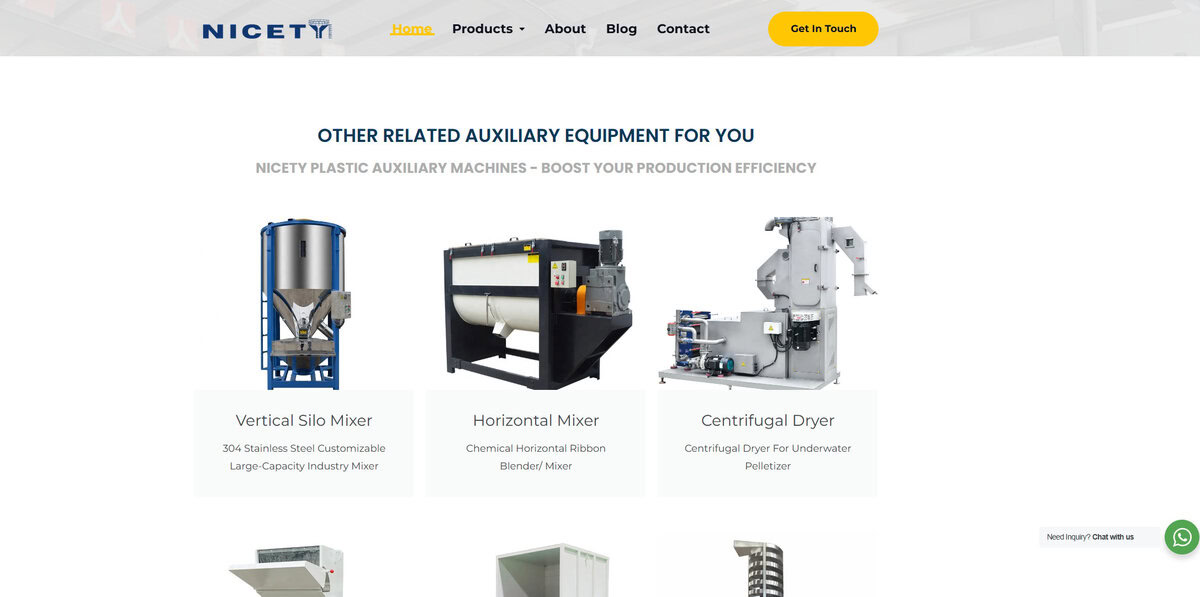
- Pre-blending and mixing: The High Speed Mixer Machine handles high-shear dispersion of fillers, additives, and masterbatch into base resins. For gentler blending of pellets and granules, the Horizontal Mixer and Vertical Silo Mixer provide uniform blend before the compounding extruder.
- Pellet and powder conveying: The Screw Conveyor and Vibrating Spiral Elevator move materials between stages reliably, while the Z Elevator handles height transitions in compact plant layouts.
- Drying and VOC management: The VOC Deodorizing Drying System addresses both moisture removal and volatile organic compound reduction — critical for engineering resins and elastomers processed together on the same site.
- Post-extrusion pelletizing: The Extrusion Pelletizing Line converts compound melt into uniform pellets ready for downstream processing.
- Size classification: The Linear Vibrating Screener removes fines and oversized pellets, ensuring consistent granule sizing for injection molding or extrusion customers.
- Centrifugal drying after water bath: For strand pelletizing lines with water cooling, the Strand Line Centrifugal Dryer removes surface moisture from pellets before screening and packaging.
Sources
- HEXPOL: HEXPOL Organize for Thermoplastics Innovation (Official Release)
- Interplas Insights: HEXPOL brings its Thermoplastics and TPE companies together (April 14, 2026)
- Plastics News: Hexpol merges thermoplastics, TPEs divisions for multi-part know-how (March 9, 2026)
- HEXPOL TPE Product Area Overview
- HEXPOL Group Corporate Website

_画板-1-副本-3-pxeey2xejyohpkvf07tglhvew6ks2ts3pjvhagm60c.png "NICETY MACHINERY Co., LTD")