_画板-1-1.png)
By Nicety Machinery Co., Ltd | June 17, 2026
Chemical recycling through pyrolysis is moving from pilot projects to commercial scale in 2026, creating a new category of recycled polymer feedstock that compounders must learn to process.
Overview: The Transition From Pilot to Commercial Scale
For the past decade, chemical recycling of plastics — particularly pyrolysis, which thermally decomposes plastic waste into oil, syngas, and carbon black in an oxygen-free environment — has been simultaneously described as the future of plastic waste management and dismissed as an unproven technology failing to deliver on its commercial promises. In 2026, that binary debate is becoming obsolete: chemical recycling is moving from pilot projects to industrial-scale operations, and the polymer feedstock it produces is beginning to flow into compounding and extrusion supply chains in meaningful volumes.
A market analysis published on June 2, 2026 — just two weeks ago — by Future Market Insights confirmed that the global waste-derived pyrolysis oil market was valued at $356.2 million in 2025, is expected to reach $374.4 million in 2026, and is forecast to grow to $615.2 million by 2036 at a 5.1% CAGR. Separately, the global chemical recycling of plastics market was estimated at $17.62 billion in 2025 and is expected to reach $19.46 billion in 2026. The plastic pyrolysis market specifically is projected to rise from $1.43 billion in 2026 to $4.90 billion by 2036 at a 13.1% CAGR.
More significant than the market size figures is what is happening operationally: ExxonMobil is targeting 500,000 tonnes of annual pyrolysis recycling capacity by end of 2026. Shell, BASF, and Agilyx are competing for market position in circular polymer feedstock derived from pyrolysis. The European Commission ratified updated rules in February 2026 covering chemically recycled content in PET beverage bottles — creating the regulatory gateway for PPWR-compliant certified circular content from chemical recycling streams. And the global plastic pyrolysis market is transitioning from pilot to industrial scale, with increasing investments from oil majors and waste management companies.
For plastic compounders and extrusion plant operators, this transition creates a new category of polymer feedstock — chemically recycled polymer derived from pyrolysis oil — that will increasingly appear in supply chains alongside virgin resin and mechanical PCR. Understanding what this feedstock is, how it differs from the other two categories, and what processing infrastructure is required to use it consistently is becoming commercially essential.
The Market in Numbers: Two Weeks Old and Already Significant
The pyrolysis and chemical recycling market data published in the past fortnight provides a current snapshot of where the industry stands:
The waste-derived pyrolysis oil market was valued at $356.2 million in 2025, is expected to reach $374.4 million in 2026, and is forecast to grow to $615.2 million by 2036, at a 5.1% CAGR. Industries are accelerating circular economy initiatives and seeking scalable solutions for mixed plastic and tire waste.
The chemical recycling of plastics market size was estimated at $17.62 billion in 2025 and is expected to increase from $19.46 billion in 2026 to $47.60 billion by 2035, growing at a CAGR of 10.45%. In terms of volume, the market is projected to grow from 1.70 million tons in 2026 to 11.90 million tons by 2035.
The global plastic pyrolysis market stood at $1.26 billion in 2025 and is projected to rise to $4.90 billion by 2036, advancing from $1.43 billion in 2026 at a CAGR of 13.1%.
Europe dominated the chemical recycling of plastics market with the largest volume share of 34% in 2025, driven by stringent government policies and environmental initiatives. The growing investments in chemical recycling technologies, like depolymerization, are improving efficiency and quality, positioning Europe as a global leader in sustainable practices.
Fast pyrolysis technology is expected to account for 62.0% market share in 2026 as operators favor systems with higher liquid yield and proven operational efficiency.
For compounders, the volume number is the most relevant: 1.70 million tons in 2026 growing to 11.90 million tons by 2035 represents a seven-fold volume increase in chemically recycled plastic output over nine years. At those volumes, chemically recycled polymer will no longer be a niche feedstock option — it will be a mainstream supply chain category that compounders will need to be able to process competitively.
Who Is Building Commercial Pyrolysis Capacity Right Now
The transition from pilot to commercial scale is visible in the capital commitments of the companies now operating or building pyrolysis facilities:
ExxonMobil is the most aggressive large-scale mover. ExxonMobil aims to roll out pyrolysis recycling technology at plants around the world to reach a goal of recycling 500,000 tons of plastics annually by the end of 2026. Its Baytown, Texas facility is the flagship commercial-scale operation, producing pyrolysis oil that is processed through its existing refining and cracking infrastructure to produce what ExxonMobil markets as certified circular polymer — polyethylene and polypropylene with the same molecular structure as virgin resin but derived from recycled plastic feedstock.
Shell is investing in upgrading technologies that improve pyrolysis oil quality for chemical feedstock applications. Major energy and chemical companies including Shell, BASF, and Agilyx are competing in circular polymer feedstock, investing in upgrading technologies that improve oil quality for chemical feedstock applications. These projects are helping narrow the quality gap between crude pyrolysis oil and petrochemical-grade feedstocks.
BASF operates its ChemCycling program, which uses pyrolysis oil as a feedstock input into its existing steam crackers and polymer production lines — producing what BASF designates as certified circular polymer through mass balance accounting. BASF’s approach integrates chemical recycling into existing petrochemical infrastructure rather than building standalone pyrolysis-to-polymer facilities.
Agilyx focuses specifically on the pyrolysis technology itself — operating commercial-scale facilities in the United States and licensing its technology internationally. Agilyx’s styrene recovery from post-consumer polystyrene waste is one of the more technically mature chemical recycling applications, producing styrene monomer that feeds back into ABS and PS polymer production.
Asia-Pacific operators are deploying modular pyrolysis systems at scale, particularly in markets with high mixed plastic waste availability and growing energy demand. Asia-Pacific has high waste availability and rapid deployment in China and India. Chinese and Indian operators are building fast pyrolysis systems integrated with local waste collection infrastructure — primarily targeting fuel applications initially, but increasingly targeting circular polymer feedstock as regulatory requirements create demand for certified recycled content.
The February 2026 EU Regulatory Gateway: Chemically Recycled PET Is Now Officially Circular
The most consequential regulatory development for chemical recycling in 2026 came in February, when the European Commission ratified updated rules covering chemically recycled content in PET beverage bottles — formally recognizing chemically recycled PET as contributing to PPWR recycled content mandates.
This regulatory step is significant beyond the PET bottle application it initially covers. It establishes the legal and certification framework that can be extended to other polymer types and applications as chemical recycling scale develops. The February 2026 ratification creates:
A regulatory definition of chemically recycled content. For the first time in EU law, chemically recycled polymer — produced through pyrolysis, depolymerization, or gasification pathways — is defined and recognized as contributing to mandatory recycled content requirements. This removes a major commercial uncertainty that had prevented brand owners from committing to chemically recycled polymer: the risk that the content would not count toward their PPWR compliance obligations.
A mass balance accounting framework. The rules establish how chemically recycled content can be tracked through complex petrochemical supply chains using mass balance accounting — the same approach used for certified sustainable palm oil and other commodity supply chains where physical segregation of certified material is impractical. Mass balance allows a polymer producer to allocate a defined quantity of chemically recycled feedstock across a batch of polymer production without physically segregating that material from conventional fossil-based feedstock — as long as the accounting is verified by a recognized certification body.
A certification gateway for compounders. Compounders who purchase certified circular polymer from ExxonMobil, BASF ChemCycling, or equivalent certified producers can now pass through the certified recycled content claim to their downstream compound customers — enabling the compound to count toward PPWR recycled content requirements. This creates a commercial pathway for chemical recycling to supplement mechanical PCR in meeting the mandatory content targets that compounders’ packaging customers must hit.
What Chemical Recycling Actually Produces — and How It Differs From Mechanical PCR
For compounders accustomed to working with mechanical PCR — post-consumer recycled pellets produced through sorting, washing, granulation, and re-pelletizing — understanding what chemical recycling actually produces is essential before evaluating it as a feedstock option.
The pyrolysis process heats plastic waste in an oxygen-free environment at temperatures of 400°C to 800°C, breaking polymer chains down into smaller hydrocarbon molecules — primarily a liquid pyrolysis oil, a gas fraction (syngas), and a solid char residue (containing most of the inorganic contamination from the waste stream). Plastic pyrolysis is a thermochemical recycling process that converts plastic waste into valuable outputs such as pyrolysis oil, syngas, and carbon black in an oxygen-free environment. Unlike mechanical recycling, it can process contaminated and mixed plastics, making it strategically relevant for hard-to-recycle waste streams.
The pyrolysis oil — sometimes called plastic-derived oil or PDO — is then upgraded through conventional refinery hydroprocessing to remove sulfur, chlorine, nitrogen, and other heteroatom contaminants, producing a naphtha-equivalent feedstock that feeds into steam crackers alongside conventional naphtha. The steam cracker then produces ethylene, propylene, butadiene, and aromatics — the same monomers that make virgin PE, PP, SBR, and ABS. These monomers are then polymerized to produce certified circular polymer.
The critical implication for compounders is this: certified circular polymer derived from pyrolysis is, at the molecular level, identical to virgin polymer. It has the same molecular weight distribution, the same rheological properties, the same thermal stability, and the same processing window as virgin resin produced from conventional naphtha. There is no recycled-content quality penalty in the compound formulation or in the processing of the compound — unlike mechanical PCR, which introduces genuine variability in melt flow, contamination profile, color, and odor.
This makes certified circular polymer the technically superior recycled-content option for high-performance compound applications — engineering plastic compounds for automotive and electronics, food-contact film compounds, and medical-grade materials — where the quality variability of mechanical PCR creates formulation and processing challenges that limit its usability.
However, the commercially practical difference matters too: certified circular polymer currently costs significantly more than mechanical PCR, which itself costs more than virgin resin. The premium reflects both the technology cost of pyrolysis and upgrading and the scarcity of certified supply at current market volumes. As capacity scales toward ExxonMobil’s 500,000 tonne target and beyond, that premium is expected to narrow — but in 2026, compounders must evaluate whether the quality advantage justifies the cost premium for each specific application.
The Compounding Implications: Processing Pyrolysis-Derived Polymer Is Not the Same as Virgin Resin
While certified circular polymer is molecularly identical to virgin resin, the practical processing environment for a compounder working with chemically recycled polymer feedstocks differs from a purely virgin-resin operation in several important ways:
Batch-to-batch documentation requirements. Certified circular polymer comes with a chain of custody certification — a documented record from waste collector through pyrolysis operator through refinery through cracker through polymer producer — that the compounder must maintain and pass forward in its own product documentation. This documentation burden is entirely absent from virgin resin procurement and adds an administrative process requirement that compound producers working with certified circular feedstock must systematically manage.
Mixed feedstock line management. In practice, compounders using certified circular polymer will typically blend it with virgin resin — either because they need to hit a specific certified recycled content percentage while staying within cost targets, or because supply availability requires blending to maintain throughput. Managing certified and non-certified polymer in the same compounding line requires batch tracking, blend verification, and documented segregation of certified-content compound from standard compound — a process control discipline that virgin-only operations do not maintain.
Supplier qualification and audit requirements. The mass balance accounting framework for certified circular polymer is verified by third-party certification bodies — ISCC PLUS, REDcert², and RSB are the primary EU-recognized schemes. Compounders purchasing certified circular PE, PP, or PS must verify their supplier’s current certification status and maintain the relevant documentation in their own quality management system. Annual re-certification requirements mean that supplier certification status must be actively monitored, not just checked at initial qualification.
Co-processing with mechanical PCR in the same formulation. Some compounders will use certified circular polymer and mechanical PCR in the same compound — for example, a packaging film compound targeting 30% total recycled content that uses 15% certified circular PE (for consistent quality in the melt) and 15% mechanical PCR PE (to reduce cost). Managing the blending, documentation, and property verification for a dual recycled-content formulation is a more complex process control task than either feedstock category alone.
Mass Balance Accounting: The Certification Challenge That Will Define Market Access
Mass balance is the accounting methodology that enables chemical recycling to contribute to certified recycled content claims at the polymer user level — and understanding it is not optional for compounders who will use or sell certified circular polymer.
The core concept: in a steam cracker processing a mixture of conventional naphtha and upgraded pyrolysis oil, it is not physically possible to separate the ethylene molecules derived from the conventional feedstock from those derived from the recycled feedstock — they are chemically identical and mix completely. Mass balance accounting allows the recycled-content claim to be allocated across the polymer output based on the proportion of recycled feedstock in the total input, verified by an independent auditor.
In practice, this means a polymer producer who processes 10% recycled pyrolysis oil alongside 90% conventional naphtha can allocate the recycled content claim to a specific fraction of its polymer output — either concentrating the claim on a smaller certified batch or distributing it across all output at a 10% claimed recycled content level, depending on the applicable certification scheme rules.
For compounders purchasing certified circular polymer, the practical requirement is:
- Procure from a supplier with current, verified ISCC PLUS, REDcert², or RSB certification
- Maintain batch-level documentation linking the certified polymer quantity purchased to specific production batches of certified compound produced
- Submit to annual audit of the mass balance accounting records by an approved certification body
- Pass through the certified content claim to downstream customers with the appropriate scope certificate
This is a substantive administrative system requirement — not a documentation technicality. Compounders who have not previously operated certified supply chains (sustainable palm oil, FSC timber, organic ingredients) will need to build this capability before they can commercially sell certified circular compound to PPWR-compliant customers.
The Honest Assessment: Where Chemical Recycling Works and Where It Still Struggles
A credible article on chemical recycling in 2026 must acknowledge both the genuine commercial progress and the real constraints that continue to limit the technology’s impact on plastic waste volumes:
Where it works well:
- Hard-to-recycle waste streams — multilayer flexible packaging, contaminated mixed plastics — that mechanical recycling cannot process. Chemical recycling’s ability to process contaminated and mixed plastics is its core technical advantage over mechanical recycling.
- High-value applications requiring virgin-equivalent polymer quality — food contact, medical, electronic components — where mechanical PCR quality variability excludes recycled-content options and certified circular polymer fills the gap.
- ABS, PS, and PET depolymerization — where the specific chemistry of these polymers makes chemical recycling more technically straightforward than for polyolefins.
Where it still struggles:
- Volume at cost. Despite ExxonMobil’s 500,000-tonne target, total global chemical recycling output in 2026 remains a small fraction of global virgin polymer demand. The technology cannot close the 3.5 million tonne EU PCR supply gap by 2030 at current investment and construction rates.
- Energy intensity. Pyrolysis is an energy-intensive process. The carbon footprint of chemically recycled polymer, when calculated on a full lifecycle basis including pyrolysis and upgrading energy, is subject to significant variability depending on the energy source used — a concern that EU sustainability reporting frameworks are increasingly requiring to be disclosed.
- Regulatory recognition. While the February 2026 EU ratification for PET is significant, recognition of chemically recycled polymer across the full PPWR product scope — flexible packaging, rigid packaging, industrial packaging — is still developing. Compounders targeting specific PPWR compliance applications must verify that chemically recycled content from their specific supplier and certification scheme is recognized for their specific application before building product claims around it.
What Compounders and Plant Operators Should Do Right Now
The practical actions available to compounders and extrusion plant operators preparing for the chemical recycling supply chain are specific and near-term:
1. Identify which of your compound grades have applications that justify certified circular polymer premiums. High-performance engineering plastic compounds for automotive, food-contact film compounds for PPWR compliance, and medical-grade compounds where mechanical PCR is excluded by application — these are the compound grades where certified circular polymer’s quality advantage over mechanical PCR justifies its cost premium.
2. Contact your current polymer suppliers about their certified circular product availability. BASF’s ChemCycling products, ExxonMobil Signature Polymers certified circular, and LyondellBasell CirculenRevive are all commercially available today in limited volumes. Understanding availability, lead time, minimum order quantities, and certification documentation requirements allows you to make a realistic procurement plan.
3. Build ISCC PLUS certification into your 2026-2027 quality management investment plan. ISCC PLUS is the most widely recognized certification scheme for chemically recycled polymer in the EU market. Obtaining ISCC PLUS certification for your compounding facility — which requires a documented mass balance system and an independent audit — is the prerequisite for selling certified circular content compound to PPWR-compliant customers.
4. Design your mixing and processing systems for flexible feedstock management. The compounder who can process virgin resin, mechanical PCR, and certified circular polymer through the same line — with documented batch segregation and blend ratio verification — is positioned to serve the full range of customer recycled-content requirements without duplicate capital investment.
5. Monitor EU regulatory development on chemical recycling recognition scope. The February 2026 PET ruling is the first application-specific recognition under PPWR. Watch for subsequent rulings on polyolefin packaging, flexible films, and non-food-contact applications — each ruling expands the market for certified circular polymer in that application segment and creates commercial opportunities for compounders with established certification.
Equipment That Supports Quality Processing of Chemically Recycled Feedstocks
Processing certified circular polymer — whether purchased as finished pellets or incorporated into formulations alongside mechanical PCR — places specific demands on the compounding line that are different from both pure virgin processing and from mechanical PCR processing. The key difference: certified circular polymer requires precision blend ratio control and documented batch management, while its processing properties are those of virgin resin — not the variable, moisture-laden, VOC-heavy feedstock that mechanical PCR represents.
The auxiliary equipment chain must therefore deliver two capabilities simultaneously: the precision blending and documentation capability of a certified-content supply chain, and the drying, deodorizing, and screening performance needed for the mechanical PCR content in the same formulation.
Precision mixing for certified content blend management:
The High Speed Mixer Machine provides the high-shear pre-blending capability required to uniformly incorporate additives, coupling agents, and functional masterbatches into certified circular polymer compound bases — achieving the same formulation quality as virgin resin processing. For compound grades that blend certified circular polymer with mechanical PCR, the high speed mixer is the stage where the two recycled-content streams are brought together with additives into a homogeneous pre-blend before extrusion — the upstream quality gate that determines compound consistency and reject rate downstream.
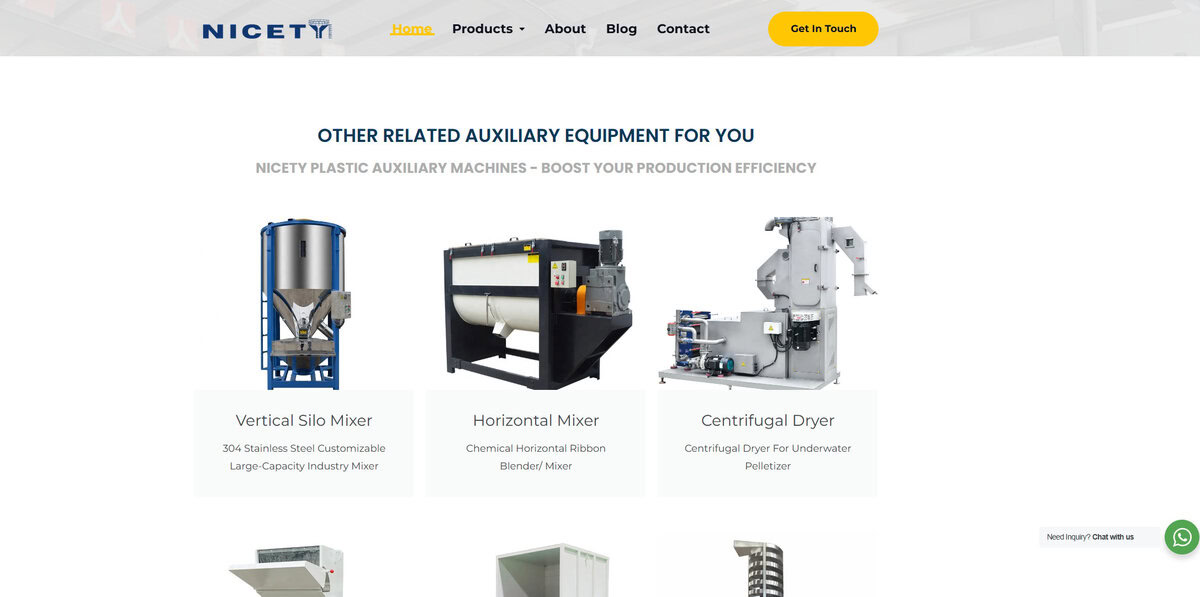
The Horizontal Mixer handles pellet-to-pellet bulk blending of certified circular polymer pellets and mechanical PCR pellets at defined, documented ratios — maintaining the blend accuracy that both certified content claims and compound quality specifications require. For multi-grade compounding facilities managing both certified and non-certified product, the horizontal mixer enables clean changeover and precise ratio control between production runs.
The Vertical Silo Mixer homogenizes blends across multiple input batches in the silo — smoothing the variability between individual deliveries of certified circular polymer or mechanical PCR before the material enters the extruder. For operations where certified polymer is delivered in varying batch sizes and must be blended to a consistent feedstock specification before compounding, silo-level homogenization protects compound consistency across extended production runs.
The Plastic Color Mixer handles precision masterbatch and additive let-down at controlled ratios for certified compound grades — ensuring that stabilizer, UV, and performance additive packages are incorporated at the exact dosage specified for each certified compound grade, maintaining both property performance and the formulation documentation that certified content audit trails require.
VOC deodorizing and drying — critical for the mechanical PCR component:
The VOC Deodorizing Drying System is the most operationally important auxiliary equipment item for compounders processing blends of certified circular polymer and mechanical PCR. The certified circular polymer component — being molecularly equivalent to virgin resin — does not carry the VOC loading or moisture variability of mechanical PCR. But the mechanical PCR component does. The VOC Deodorizing Drying System removes both the moisture that causes processing instability and the volatile organic compounds that cause odor failures in food-contact and automotive applications — enabling the mechanical PCR component to perform to certified compound specification within the same formulation as the virgin-equivalent certified circular polymer. This is the equipment that makes mixed certified-content formulations commercially viable for the high-value applications that justify certified circular polymer premiums.
Post-pelletizing centrifugal drying:
The Strand Line Centrifugal Dryer removes surface water from compound pellets immediately after the water-bath cooling step — protecting hygroscopic engineering compound grades from moisture reabsorption in the interval between pelletizing and the downstream thermal drying stage. For certified circular polymer-based engineering compound grades — PA, PC, PBT — where the certified content comes at a significant cost premium over standard grades, pellet quality protection from the first moment of post-extrusion handling is a direct financial protection measure.
Gentle elevation for certified-grade compound pellets:
The Vibrating Spiral Elevator lifts compound pellets from the pelletizer or centrifugal dryer level to the downstream screener and packaging stages through vibration rather than impact — protecting pellet surface quality and minimizing fines generation. For certified circular compound grades supplying automotive and electronics customers where surface cleanliness and absence of fines are supply agreement specifications, the vibrating spiral elevator’s gentle handling approach protects the quality of compound that has been produced from carefully blended, documented certified feedstock. The Z Elevator provides the equivalent gentle inclined conveying option for compact plant layouts.
Post-pelletizing classification:
The Linear Vibrating Screener classifies certified compound pellets to the dimensional specification required by high-performance injection molding and extrusion customers — removing fines and oversized pellets before packaging. For certified circular compound supplied under PPWR-recognized recycled content claims, consistent pellet specification is part of the quality declaration that customers rely on when building their own product compliance documentation. The screener is the final equipment step that ensures every bag of certified compound meets both the chemical specification and the physical specification that the certification chain guarantees.
Sources
- Future Market Insights / PR Newswire: Global Waste-Derived Pyrolysis Oil Market Report 2026 — Shell, BASF, Agilyx — June 2, 2026
- Meticulous Research / OpenPR: Global Plastic Pyrolysis Market $1.43 Billion in 2026, CAGR 13.1% to 2036 — Published 2 Weeks Ago
- GlobeNewsWire: Chemical Recycling of Plastics Market $19.46 Billion in 2026, Growing to $47.60 Billion by 2035 — January 2026
- Polyestertime: Plastic Pyrolysis — Powerful Green Breakthrough, Market Transitioning to Industrial Scale — March 30, 2026
- C&EN (American Chemical Society): Amid Controversy, Chemical Companies Bet on Plastics Pyrolysis — ExxonMobil 500,000 Tonne Target
- Resource Recycling: Five Trends Shaping PCR Packaging to 2031 — Chemical Recycling Regulatory Gateway — April 29, 2026
- Waste Management World: PCR Supply Shortfall 3.5 Million Tonnes by 2030 — Chemical Recycling as Supplementary Supply
- ISCC (International Sustainability and Carbon Certification): ISCC PLUS Certification for Chemically Recycled Content
- ProPublica: The Delusion of Advanced Plastic Recycling Using Pyrolysis — Counterpoint Analysis
- Plastics Engineering (SPE): NASA Advances Flame-Resistant Polymers for Microgravity and High-Oxygen Aerospace Environments — April 21, 2026
- ExxonMobil: Signature Polymers Certified Circular Polymer Portfolio
- BASF ChemCycling: Chemical Recycling Program Overview

_画板-1-副本-3-pxeey2xejyohpkvf07tglhvew6ks2ts3pjvhagm60c.png "NICETY MACHINERY Co., LTD")