_画板-1-1.png)
By Nicety Machinery Co., Ltd | June 19, 2026
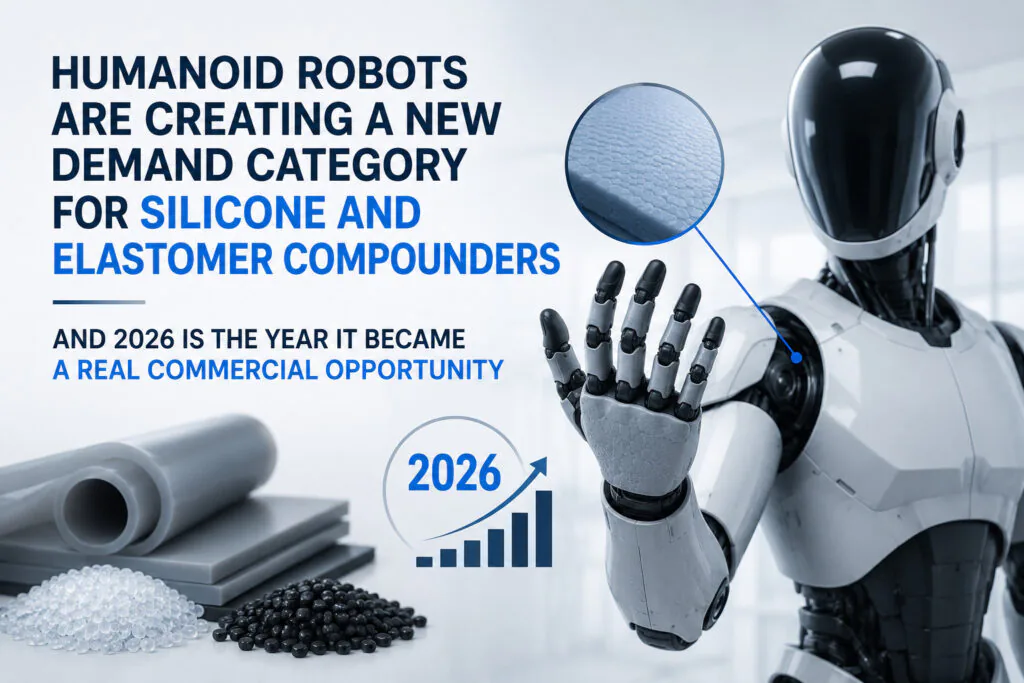
Humanoid robot joints, seals, and synthetic skins are creating a new and rapidly growing application category for silicone and specialty elastomer compounders.
Overview: From Trade-Show Demos to Production-Line Deployment
For most of the past decade, humanoid robots were a research curiosity and a trade-show spectacle — impressive demonstrations with little connection to actual industrial material demand. That has changed decisively in 2026. Over the last 12 months, activity has shifted from trade-show demonstrations to structured pilots on production sites, supported by larger, more deliberate investment from both venture-backed startups and established OEMs. Cumulative industry funding surpassed $9.8 billion in 2025, and capital continues to flow into the sector at an accelerating pace.
By 2026, revenue from humanoid robotics-related businesses is expected to grow exponentially, at least doubling — a consensus view reflecting the accelerating pace of the global humanoid robotics industry, according to a Citi survey of the sector’s supply chain. Automotive manufacturing is the first segment to scale, anchored by deployments including BYD-UBTECH (100-200 units, the world’s largest commercial humanoid deployment), GXO-Agility Robotics (100 units contracted through 2026), BMW-Figure AI (15-30 units at Spartanburg), and Mercedes-Apptronik (10-20 units for tote delivery).
What is less widely discussed outside the robotics and materials industries is what this manufacturing scale-up means for the rubber and silicone compounding supply chain. A humanoid robot is, in material terms, a machine with dozens of joints, actuators, sensors, and a synthetic skin — and every one of those components requires elastomeric seals, gaskets, dampers, or surface coverings engineered to a level of precision and performance that conventional industrial rubber goods rarely require. As humanoid production volumes move from hundreds of units to thousands and eventually tens of thousands per year, the rubber and silicone compound demand from this single application category is becoming a genuine commercial opportunity — and a genuine technical challenge — for compounders worldwide.
The Numbers: 2026 as the Inflection Point for Humanoid Robot Manufacturing
The scale of the humanoid robotics manufacturing ramp-up in 2026 is best understood through specific production commitments rather than aggregate market forecasts. Leading domestic Chinese humanoid firms have secured cumulative orders worth RMB 800 million (approximately $112 million) in 2025, with 2026 shipments expected to jump from 500 units to 2,000 units — a four-fold increase in a single year.
In February 2026, Austin-based Apptronik raised $520 million in a funding round backed by Google and Mercedes-Benz, with participation from B Capital and the Qatar Investment Authority, valuing the company at approximately $5 billion. Apptronik’s Apollo robot is already in pilot deployment at Mercedes-Benz manufacturing facilities for tote delivery and material handling — a genuine industrial production application, not a demonstration.
The broader market trajectory described by industry analysts envisions a three-wave adoption pattern: Wave 1 covers industrial applications from 2025 to 2030, encompassing automotive manufacturing, logistics, and warehousing at price points of $80,000 to $250,000 per unit. Wave 2 targets consumer, developer, and education markets from 2027 to 2033 at dramatically lower price points of $5,000 to $25,000, enabled by Chinese supply chain integration and cost compression — with Unitree’s R1 at $5,600 representing the breakthrough price point for this segment. Wave 3 addresses medical and elder care applications from 2030 onward.
The silicone elastomers market specifically — which underpins much of humanoid robot sealing, skin, and thermal management applications — is expected to grow by $3.86 billion from 2026 to 2030, expanding at a CAGR of 6.3%, with demand for lightweight silicone elastomer solutions in the automotive sector and biocompatible solutions in medical robotics identified as primary growth drivers alongside the humanoid robotics application itself.
For elastomer compounders, the relevant signal is not the long-term forecast — it is the near-term production ramp. Wave 1 industrial deployment, happening now through 2030, is where rubber and silicone compound demand is being created today, in real purchase orders from real Tier-1 robotics manufacturers and their component suppliers.
Where Rubber and Silicone Actually Go on a Humanoid Robot
Understanding the elastomer compounding opportunity in humanoid robotics requires understanding where, specifically, rubber and silicone components are used in the robot’s physical structure. Humanoid robots use rubber seals to keep out moisture and contaminants, with examples including enclosure gaskets around torso electronics and module seals for cameras and machine vision systems. Gaskets are also used with battery compartments, microphones, and speakers.
Joint and rotary seals. Wrist, ankle, and neck rotary joint seals may be visible, but cable or hydraulic line seals are mission-critical. Like other types of electromechanical systems, humanoid robots produce heat and noise that these seals must manage while maintaining airtight and watertight integrity through millions of repetitive flex cycles.
EMI shielding and environmental sealing. Humanoid robots that operate near cell phones, industrial machinery, and Wi-Fi signals are susceptible to disruptions from external sources. For EMI shielding plus environmental sealing, electrically conductive silicones are used — typically silicone elastomer compounds loaded with conductive fillers such as silver-plated particles, nickel-graphite, or conductive carbon, formed into gaskets that block electromagnetic interference while maintaining the flexibility needed for enclosure sealing.
Thermal insulation and vibration damping. Thermal insulation made from polyurethane, silicone, or EVA foam is molded to fit inside legs and torsos — managing the heat generated by motors, actuators, and battery systems in a compact structural envelope. Rubber tracks, tires, and elastomeric mounts and bushings made of neoprene and polyurethane isolate motors, cameras, and sensors from structural vibrations during locomotion and manipulation tasks.
Synthetic skin. Humanoid cobots use soft silicone skins and covers — the most visually distinctive and increasingly the most technically sophisticated elastomer application on a humanoid robot, discussed in more detail below.
Battery compartment and connector sealing. As humanoid robots adopt high-energy-density battery systems for extended operating time, battery compartment seals must meet the same fire safety and environmental sealing standards that automotive EV battery compounds require — directly connecting the humanoid robotics elastomer demand to the HFFR and battery sealing compound categories already growing rapidly in the automotive sector.
Freudenberg and the Established Sealing Industry’s Pivot to Humanoids
The clearest evidence that humanoid robotics has become a genuine commercial materials opportunity — rather than a speculative future application — is the response from the established industrial sealing and elastomer supply industry.
Freudenberg Sealing Technologies, a specialist in high-performance seals with deep experience in industrial robotics, is increasingly applying its long-standing sealing expertise to humanoid robots. The company combines an in-depth knowledge of materials with state-of-the-art production technologies, allowing it to develop precise solutions for a wide range of applications in a short time frame.
Freudenberg’s existing experience with collaborative robot arms, SCARA robots, delta robots, six-axis robots, and automated guided vehicles provides a natural pathway to humanoid-specific seal development — extending all the way to finger joints, where the compactness and articulation requirements are most demanding. As humanoids grow in use, seals will play a key role in their operation, especially for built-in hydraulic or pneumatic actuators that serve as the robot’s "muscles" and initiate their movements.
Freudenberg’s Ingress Protection Seals for Robots (ISPR) solutions illustrate the specific technical requirements that humanoid sealing applications impose: protection against harmful environmental influences, combined with the low-friction, long-duration durability needed to support the high cycle counts that robotic joints accumulate over operational lifetimes measured in years rather than the single-shift duty cycles of many conventional industrial seal applications.
The significance of Freudenberg’s pivot — a company with decades of automotive and industrial sealing expertise — is that it validates humanoid robotics as a serious application category worthy of dedicated material and product development investment, rather than treating it as a niche extension of existing industrial robot sealing business.
The Elastomer Selection Problem: Why "Generic EPDM or NBR" No Longer Works
A detailed technical analysis published just six days ago by elastomer specialist Wayne Rubber crystallizes the core compounding challenge that humanoid and industrial robotics now present to elastomer suppliers: the correct elastomer specification for each robotic sealing application is different, and none of them is the generic "EPDM or NBR" material list that most specifiers default to.
The article illustrates the point through specific, demanding application scenarios. A six-axis welding robot in an automotive body shop cycles through hundreds of thousands of joint articulations per year while exposed to welding spatter, cutting fluid mist, and the heat from nearby weld zones — requiring an elastomer compound that resists both thermal degradation and chemical attack while maintaining seal integrity through extreme cycle counts. A food-grade delta robot on a confectionery line must comply with FDA food-contact requirements on every rubber component that could reach the product stream, survive aggressive caustic CIP washing between production runs, and do all of this in a 3-3.5g acceleration field at 150 picks per minute — an extraordinary combination of food safety, chemical resistance, and high-speed mechanical durability requirements. A cleanroom cobot in a pharmaceutical filling line must seal its joint housings without any extractable siloxane compound that could contaminate sterile product — ruling out standard silicone elastomers entirely for that specific application despite silicone’s otherwise excellent sealing properties.
The harmonic drive grease compatibility issue is a particularly specific and instructive example. The fluorinated PTFE-thickened greases used in harmonic drives — the precision gear reduction mechanism used extensively in robotic joints — are chemically aggressive to standard elastomers. Standard NBR and EPDM show significant volume swell in PTFE-thickened fluorinated grease, and their seal lip properties degrade with sustained contact. FKM (fluoroelastomer) provides the best resistance to fluorinated harmonic drive greases among common elastomers — meaning that robotics joint seal compounders increasingly need FKM compounding capability, not just the standard NBR and EPDM portfolio that covers most conventional industrial sealing applications.
For elastomer compounders, this technical specificity is the commercial opportunity. Robotics customers — particularly humanoid robot manufacturers building products with multi-year warranty expectations and demanding duty cycles — cannot use off-the-shelf generic compound grades. They require application-engineered elastomer formulations validated against the specific chemical, thermal, and mechanical environment of each joint, seal, and gasket location on the robot. This is precisely the kind of high-value, technically differentiated compounding work that commands premium pricing and builds durable customer relationships — in contrast to commodity rubber compound markets where price competition dominates.
Silicone Skin and Synthetic Touch: The Highest-Value Elastomer Application
Beyond structural seals and gaskets, the most technically sophisticated and rapidly developing elastomer application in humanoid robotics is synthetic skin — the silicone material systems that give humanoid robots tactile sensing capability and, in social and service robot applications, lifelike outer surfaces.
Research-grade silicone elastomers — commercial products including Dragon Skin and Ecoflex formulations from established silicone suppliers — have become the standard material system for academic and early-commercial humanoid skin and soft robotics development. An artificial skin can utilize various silicone elastomers to replicate the layers of human skin and incorporate an embedded electrode matrix for mutual capacitance sensing — meaning the silicone compound itself must be formulated to function as both a structural skin material and an integrated component of the robot’s tactile sensing system.
XELA Robotics, a specialist in advanced 3D tactile sensors that exhibited at CES 2026, has developed its uSkin sensor technology with three main layers: an outer shell that creates a smooth surface and protects the sensors, and a middle layer of soft elastomer that ensures the sensor is highly resilient to overloading and makes the skin system very durable and able to conform to the object being grasped. This multi-layer elastomer construction — combining different durometer silicone compounds for the protective outer surface versus the compliant sensing layer — represents a more complex compounding challenge than a single-formulation seal or gasket.
For compounders with silicone formulation expertise, the synthetic skin application category represents both the highest technical barrier to entry and the highest value-add opportunity in the humanoid robotics elastomer market. Unlike a seal or gasket, where the elastomer’s function is primarily mechanical and chemical resistance, a robotic skin compound must simultaneously deliver tactile-appropriate softness and compliance, the durability to withstand repeated contact and grasping cycles, dielectric properties compatible with embedded capacitive or piezoresistive sensing elements, and — for humanoid robots intended for social or consumer-facing applications — visual and tactile properties that approximate human skin.
Harmonic Drive Seals: A Specific, Demanding New Compound Niche
The harmonic drive seal application identified by Wayne Rubber’s technical analysis deserves specific attention because it illustrates how a single, highly specific robotics component creates an entirely new compounding specification requirement.
Harmonic drives are precision strain-wave gear mechanisms used extensively in robotic joints because they provide high gear reduction ratios in a compact, lightweight package with minimal backlash — properties that are essential for the precise, repeatable joint movements that humanoid robots require. Each humanoid robot may contain a dozen or more harmonic drive mechanisms across its shoulder, elbow, wrist, hip, knee, and ankle joints.
Every harmonic drive requires seals to retain the specialized fluorinated grease that lubricates the flexspline and circular spline components, while excluding dust, moisture, and contaminants from the precision gear mechanism. As noted above, the fluorinated grease chemistry is incompatible with standard NBR and EPDM compounds — meaning robotics manufacturers building products at scale need a reliable supply of FKM-based seal compounds specifically formulated and validated for harmonic drive grease compatibility.
The recommended practice — requesting harmonic drive grease compatibility data through ASTM D471 immersion testing in the specific grease formulation at 70 to 80°C before specifying any elastomeric joint seal for harmonic drive applications — reflects an emerging quality assurance standard for this application category. Compounders who can provide this validated compatibility data, rather than generic FKM product literature, are positioned to win specification approval from robotics manufacturers building products with multi-year reliability requirements.
As humanoid robot production scales from hundreds to thousands of units annually, and each unit requires a dozen or more harmonic drive seals, the volume of FKM compound demand specifically tied to this application category — while still small in absolute terms compared to automotive or industrial rubber markets — is a defined, technically differentiated, and rapidly growing niche that few compounders have yet positioned themselves to serve systematically.
Component Bottlenecks: Why Material Supply Is Already a Constraint
Industry analysis of the humanoid robotics supply chain identifies material and component bottlenecks as a defining constraint on the pace of commercial scale-up. Despite accelerating market momentum, humanoid robots still face major engineering and manufacturing constraints. Key bottlenecks include battery energy density and thermal management limitations, which restrict operating time and increase downtime, alongside challenges scaling high-precision components such as screws, bearings, and high-performance actuators.
While elastomer and silicone components are not typically cited as the primary bottleneck in current industry analysis — the constraint discussion focuses more heavily on actuators, sensors, and AI compute — the rapid production ramp described across multiple manufacturers (500 to 2,000 unit jumps in a single year, hundred-unit deployment contracts at BYD-UBTECH and GXO-Agility Robotics) means that elastomer compound supply chains that have not been built out in advance risk becoming a constraint as volumes scale further.
This is the pattern that has played out repeatedly across other fast-growing technology supply chains: the components that are not the headline technology — batteries, chips, actuators — but are nonetheless functionally essential, become unexpected bottlenecks precisely because supply chain investment lags the demand curve of the headline technology. Elastomer and silicone compounders who establish robotics-qualified compound grades, validated test data, and reliable production capacity now — ahead of the volume surge that industry forecasts describe for 2027 through 2030 — are positioned to avoid being the bottleneck that constrains their robotics manufacturer customers’ production ramp, and to capture the commercial relationship value of being a qualified, reliable supplier when that volume surge arrives.
What This Means for Rubber and Silicone Compounders Right Now
For compounders evaluating whether to invest in developing robotics-application elastomer and silicone compound capability, the practical considerations are:
The application-engineering requirement is real, not marketing language. The harmonic drive grease compatibility issue, the cleanroom siloxane extractable requirement, and the EMI shielding conductive silicone formulation all represent genuine technical specification requirements — not generic industrial rubber compound capability. Compounders entering this market need to invest in the specific formulation and testing capability that robotics customers require, including ASTM D471 grease immersion testing, extractable compound analysis for cleanroom and medical applications, and EMI shielding effectiveness testing for conductive silicone gaskets.
FKM and specialty silicone capability is a differentiator. Most rubber compounders have strong NBR, EPDM, and standard silicone capability — the workhorse materials of conventional industrial rubber goods. FKM compounding, multi-durometer silicone skin systems, and conductive silicone EMI shielding compounds require more specialized formulation expertise and, in some cases, different processing equipment. Compounders who develop this capability ahead of broader market demand are positioned for premium-margin business as the application category grows.
Early customer relationships matter more than current volume. Current humanoid robot production volumes — hundreds to low thousands of units per major manufacturer — translate into relatively modest absolute elastomer compound volume today. But the manufacturers building production relationships now, with compounders who can deliver validated, application-specific compound grades, are establishing the supplier qualifications that will carry through as production scales toward the tens of thousands of units per year that industry forecasts project for the 2027-2030 window.
The skill set overlaps with automotive and medical elastomer compounding. Compounders already serving automotive sealing (harsh chemical and thermal environments), medical device elastomers (biocompatibility and extractable requirements), and EMI shielding compounds (consumer electronics and telecommunications applications) already possess much of the technical foundation needed to serve humanoid robotics customers. The robotics application is, in many respects, a new market for existing technical capability rather than an entirely new compounding discipline.
Processing Equipment for Precision Silicone and Specialty Elastomer Compounding
Robotics-grade silicone and specialty elastomer compounds — whether for joint seals, EMI shielding gaskets, harmonic drive FKM seals, or multi-layer synthetic skin systems — demand a higher level of formulation precision and process consistency than conventional industrial rubber goods. The compounding equipment chain that prepares these formulations before molding or extrusion directly determines whether the finished compound meets the validated, application-specific performance data that robotics customers increasingly require.
Precision pre-blending for filled and functional silicone compounds:
Nicety Machinery’s High Speed Mixer Machine provides the high-shear pre-dispersion capability required for conductive silicone EMI shielding compounds, where silver-plated particles, nickel-graphite, or conductive carbon fillers must be uniformly distributed throughout the silicone matrix to achieve consistent shielding effectiveness across every gasket produced. Inconsistent filler dispersion in a conductive silicone compound creates localized regions of reduced shielding performance — a defect that is difficult to detect by visual inspection but that directly compromises the EMI protection the gasket is designed to provide in a robot’s electronics enclosure. For FKM and specialty fluoroelastomer compounds developed for harmonic drive seal applications, precise pre-blending of curing agents and processing aids at the correct loading is similarly critical to achieving the validated grease compatibility and seal performance that robotics manufacturers require.
The Plastic Color Mixer delivers the precision masterbatch and additive let-down capability needed for multi-durometer silicone skin systems, where different layers of the skin assembly require different colorant, filler, and softness-modifying additive packages at tightly controlled ratios to achieve the consistent layer-to-layer properties that tactile sensing performance depends on.
Consistent bulk blending for multi-grade robotics compound production:
The Horizontal Mixer and Vertical Silo Mixer provide the batch-to-batch homogenization that robotics compound customers’ quality validation processes require. A robotics manufacturer that has validated a specific FKM seal compound against ASTM D471 grease compatibility data needs every subsequent production batch of that compound to match the validated formulation precisely — batch-to-batch consistency is not a quality preference in this application category, it is a specification requirement tied directly to the customer’s own product validation and warranty commitments.
VOC and moisture management for cleanroom and medical-adjacent applications:
The VOC Deodorizing Drying System addresses a requirement that is particularly significant for the robotics elastomer application category: extractable and volatile compound control. Cleanroom cobot applications require sealing compounds without any extractable siloxane compound that could contaminate sterile product — a requirement that depends on minimizing volatile and low-molecular-weight siloxane content in the finished silicone compound. The VOC Deodorizing Drying System’s volatile compound removal capability supports the production of low-extractable silicone compound grades suitable for cleanroom, pharmaceutical, and medical-adjacent robotics applications, where standard silicone formulations may not meet the extractable compound specification that these end markets require.
Pellet and compound handling for consistent downstream processing:
For silicone and specialty elastomer compounds supplied to robotics component manufacturers in pelletized or granulated form for injection molding processing, the Strand Line Centrifugal Dryer and Vibrating Spiral Elevator protect compound quality through the post-extrusion handling stages — removing surface moisture and providing gentle, fines-minimizing material elevation that preserves the surface cleanliness and dimensional consistency that precision robotics seal and gasket molding requires. The Linear Vibrating Screener provides the final dimensional classification step, ensuring that every batch of robotics-grade compound shipped meets the consistent particle or pellet specification that downstream precision molding processes depend on for repeatable part quality.
Sources
- Wayne Rubber: Elastomer Selection Guide for Industrial Robots and Cobots — June 13, 2026
- The Robot Report: Humanoid Robots Can Benefit from High-Performance Seals, Says Freudenberg — May 2025
- Freudenberg Sealing Technologies: Freudenberg Sealing Technologies Propels Humanoid and Industrial Robots
- Elasto Proxy: Humanoid Robots Need Rubber and Plastic Parts — January 2026
- Elasto Proxy: Robots and Rubber Products — Overview of Elastomer Applications in Robotics
- The Global Humanoid Robots Market 2026-2036: Apptronik Funding, BYD-UBTECH, GXO-Agility, BMW-Figure AI, Mercedes-Apptronik Deployments
- IDTechEx: Humanoid Robots 2026-2036 — Technologies, Markets, and Opportunities
- iTiger: Citi Survey — Humanoid Robotics Revenue Expected to Double in 2026, Component Supply Chain Demand Surge
- Accio: Silicone Elastomers Market — $3.86 Billion Growth 2026-2030, CAGR 6.3%
- XELA Robotics: CES 2026 uSkin Tactile Sensor Technology Press Release — January 5, 2026
- arXiv: Soft is Safe — Human-Robot Interaction for Soft Robots, Silicone Elastomer Materials Review
- Daydream: Opportunities for Materials in the Growing Humanoid Robots Market 2026 — April 28, 2026

_画板-1-副本-3-pxeey2xejyohpkvf07tglhvew6ks2ts3pjvhagm60c.png "NICETY MACHINERY Co., LTD")