_画板-1-1.png)
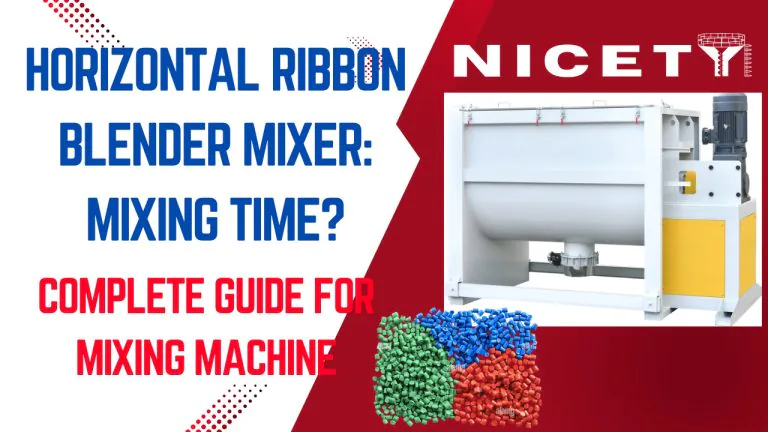
When your mixing time feels too short—or too long—it’s hard to trust the consistency. So how long should it really take to mix plastic materials?
Mixing plastic materials in a horizontal ribbon blender typically takes between 5 to 15 minutes, depending on the material, batch size, and blending uniformity requirements.

If your production line relies on accurate and consistent blending, then knowing how long mixing should take—and why it takes that long—is essential. I’ve spent years working with horizontal ribbon blenders in the engineering plastics field, and I want to give you a clear, simple guide to help you troubleshoot and optimize your process.
What is the relationship between the mixing time of a horizontal ribbon blender and its capacity?
Many users assume a bigger blender needs more mixing time1. Others think the time stays the same regardless of size. Neither is completely true.
Mixing time is affected by the blender’s capacity, but not in a straight line—larger machines often need only slightly more time, thanks to higher mechanical efficiency.

The design of a horizontal ribbon blender2 allows it to mix efficiently at full or partial loads. A 500L mixer might take around 8 minutes to reach uniformity, while a 2000L mixer might take 10–12 minutes for the same material. Why doesn’t the time quadruple with capacity? The answer lies in the way the ribbon agitator pushes material both radially and laterally. This action reduces dead zones, so larger volumes still receive uniform movement.
However, things change if you underfill or overfill. Less than 40% of rated capacity means the ribbon won’t grab the material properly. More than 80% means the materials don’t have enough room to flow. Both situations increase the time needed to mix thoroughly.
Here’s a rough reference:
| Mixer Capacity | Typical Batch Volume | Average Mixing Time |
|---|---|---|
| 200L | 100–160L | 6–8 minutes |
| 500L | 250–400L | 8–10 minutes |
| 1000L | 500–800L | 10–12 minutes |
| 2000L | 1000–1600L | 12–15 minutes |
Note: Times vary with material type, moisture, density, and temperature.
What are the standards for plastic mixing completion3? How is it tested?
You can’t rely on your eyes. Two batches can look the same but perform very differently in the extrusion or molding machine.
Mixing completion is judged by sample testing—either by color dispersion, component uniformity, or final product performance testing.
%(plastic mixing standards testing)plastic mixing standards testing
When mixing masterbatch or color additives, many processors test small samples by extruding or molding them and checking for streaking, color variation, or property inconsistency. For example, in color masterbatch, we test for even tone and absence of agglomerates. In filled engineering plastics, we check for consistent MFI (melt flow index) or tensile strength across samples.
Another common method is chemical composition sampling4. If we’re adding flame retardants or impact modifiers, we take samples from different points in the blender and analyze their chemical makeup. If the difference between samples is less than 3%, mixing is generally considered acceptable.
Some production lines also use inline IR sensors or digital load cells to detect variations during downstream processing—if feed material isn’t uniform, it shows in product weight or properties.
What details should be paid attention to in the mixing process of engineering plastics?
Mixing engineering plastics5 isn’t like blending powders in the food industry. The stakes are higher, and mistakes cost more.
Key concerns during mixing include temperature rise6, friction heat, batch homogeneity7, proper feed sequence, and avoiding overmixing8 that can damage additives.

Engineering plastics—like ABS, PC, PA6, and TPU—come with additives, stabilizers, or fibers that can degrade if handled roughly. Friction from long mixing times can raise the temperature inside the blender, which softens or melts pellets. Once this happens, material sticks to the wall, gets unevenly distributed, or even forms lumps.
To prevent that, I always make sure the materials are dry before feeding. Moisture worsens heat buildup and affects blending quality. It’s also important to load heavy and fine materials last. This avoids segregation during blending, where heavier components sink too fast and disrupt uniformity.
Watch out for these problems during mixing:
| Problem | Cause | Solution |
|---|---|---|
| Uneven color | Additive not dispersed evenly | Increase mixing time slightly |
| Pellet softening | Overmixing or internal heat buildup | Reduce time or feed temperature |
| Material segregation | Wrong loading sequence | Pre-blend or adjust feed order |
| Additive clumping | High humidity or poor sequence | Dry materials, mix longer |
If I’m working with heat-sensitive plastics, I monitor surface temperatures inside the blender using infrared gun. Some mixers also come with jacketed cooling options, but that’s rare in general-use horizontal ribbon blenders.

Conclusion
Mixing plastic materials in a horizontal ribbon blender takes 5–15 minutes, but depends heavily on capacity, materials, and process control.
-
This resource will provide insights into how mixing time is influenced by capacity, helping you make informed decisions. ↩
-
Explore this link to understand the mechanics and efficiency of horizontal ribbon blenders, crucial for optimizing mixing processes. ↩
-
Understanding mixing completion is crucial for ensuring product quality and consistency in plastic manufacturing. ↩
-
Exploring chemical composition sampling can provide insights into quality control and the effectiveness of additives in plastics. ↩
-
Explore this link to understand the various types of engineering plastics and their unique properties. ↩
-
This resource will provide insights into the critical role temperature plays in the mixing process. ↩
-
Learn why achieving batch homogeneity is essential for product quality and consistency. ↩
-
Discover the potential risks of overmixing and how to avoid them for better results. ↩

_画板-1-副本-3-pxeey2xejyohpkvf07tglhvew6ks2ts3pjvhagm60c.png "NICETY MACHINERY Co., LTD")