_画板-1-1.png)
Discarded appliances contain valuable plastics, but poor separation can turn these resources into contaminated, odorous, and unstable pellets that demanding buyers will reject.
I recycle appliance plastics efficiently by combining safe dismantling, polymer sorting, controlled washing, drying, melt filtration, compounding, VOC removal, and strict quality testing. Each polymer stream must follow its own process instead of entering one mixed recycling line.
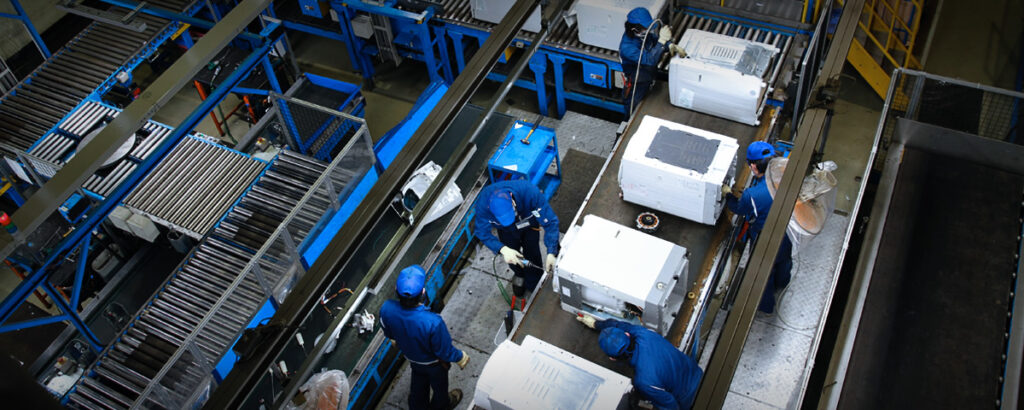
I have learned that a recycling factory does not earn more simply by processing more waste. It earns more by recovering cleaner polymers with stable properties and a clear end use. I will explain how I build that result from the discarded appliance to the finished pellet.
Why Is Appliance Recycling Attracting Renewed Attention in Japan?
Japan already has an established recycling system, but resource security has made every discarded air conditioner, refrigerator, and electronic device more strategically important.
Japan’s renewed interest comes from three connected goals: recovering plastics, securing valuable metals and rare-earth elements, and building domestic supply chains that are less exposed to geopolitical disruption.
What has changed in Japan?
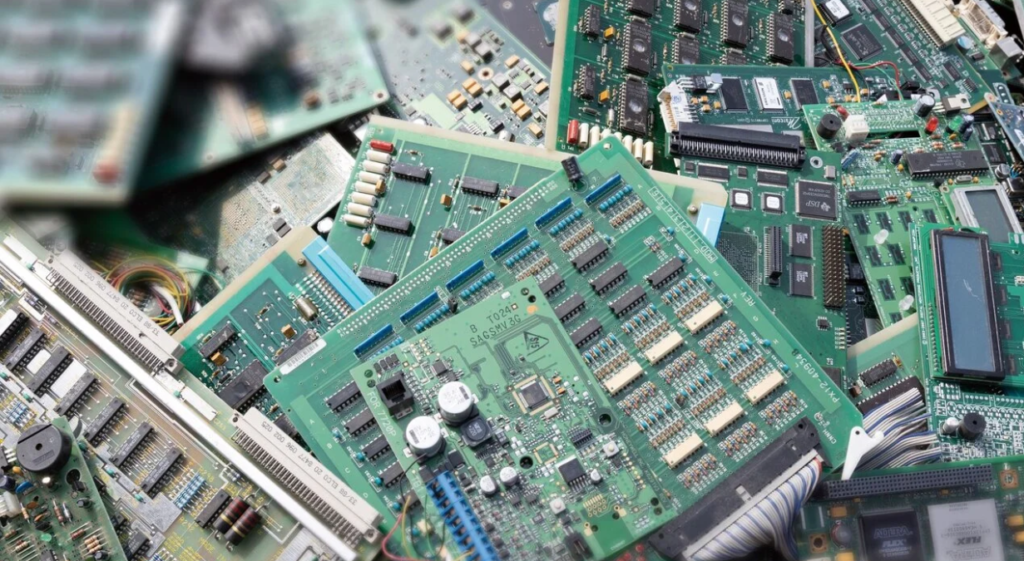
Japan’s Home Appliance Recycling Law is not new. It covers air conditioners, televisions, refrigerators and freezers, washing machines, and clothes dryers. Japan also has a separate system for small electrical and electronic appliances.
The recent change is the economic and strategic value placed on the materials inside these products.
According to the Association for Electric Home Appliances, Japan accepted about 14.76 million units in the four major appliance categories during fiscal 2025. About 14.40 million units were processed. The recovered material weight reached about 492,000 metric tons, and the overall material recycling rate reached about 88%.
In June 2026, Mitsubishi Electric announced a closed-loop system for recovering rare-earth magnets from discarded household air conditioners. The project targets neodymium, praseodymium, dysprosium, and terbium.
In April 2026, Daikin, Shin-Etsu Chemical, Hitachi, and Tokyo Eco Recycle also announced a system for recovering rare-earth magnets from commercial air-conditioner compressors. The partners plan to use AI recognition, robotic dismantling, demagnetization, and digital traceability.
These projects explain why appliance recycling is receiving more attention. Japan is no longer treating an old appliance only as waste. It is treating the appliance as an urban mine.
Which valuable resources can an appliance contain?
| Recovered resource | Typical appliance source | Recycling value |
|---|---|---|
| Iron and steel | Frames, drums, housings, compressors | High-volume structural metal |
| Copper | Motors, wiring, coils, compressors | High-value conductive metal |
| Aluminum | Heat exchangers, frames, motor parts | Lightweight recycled metal |
| Gold, silver, and palladium | Printed circuit boards and contacts | High-value precious metals in small amounts |
| Neodymium and praseodymium | Selected permanent magnets | Important magnet materials |
| Dysprosium and terbium | Some high-performance magnets | Strategic heavy rare-earth elements |
| ABS, PP, PS, and other plastics | Housings, tubs, liners, fans, drawers | Feedstock for recycled plastic compounds |
Not every motor contains rare-earth magnets. I must identify the motor design before estimating recovery value. I also keep metal recovery separate from plastic preparation because each material needs a different process and quality system.
A March 2026 Reuters report described Japan’s wider push to recover valuable materials from electronic waste. I do not confuse the report’s electronic-device recycling figure with the well-established four-appliance program. The two systems cover different waste streams.
What Types of Plastics Can Be Recycled and Reused from Home Appliances?
A mixed appliance-plastic pile may look uniform, but it can contain polymers with completely different melting temperatures, densities, additives, and aging histories.
The main recyclable appliance plastics are PP, ABS, HIPS, PC/ABS, PC, PE, PA, PET, and PBT. PVC, POM, polyurethane foam, thermosets, and flame-retardant grades require separate handling.
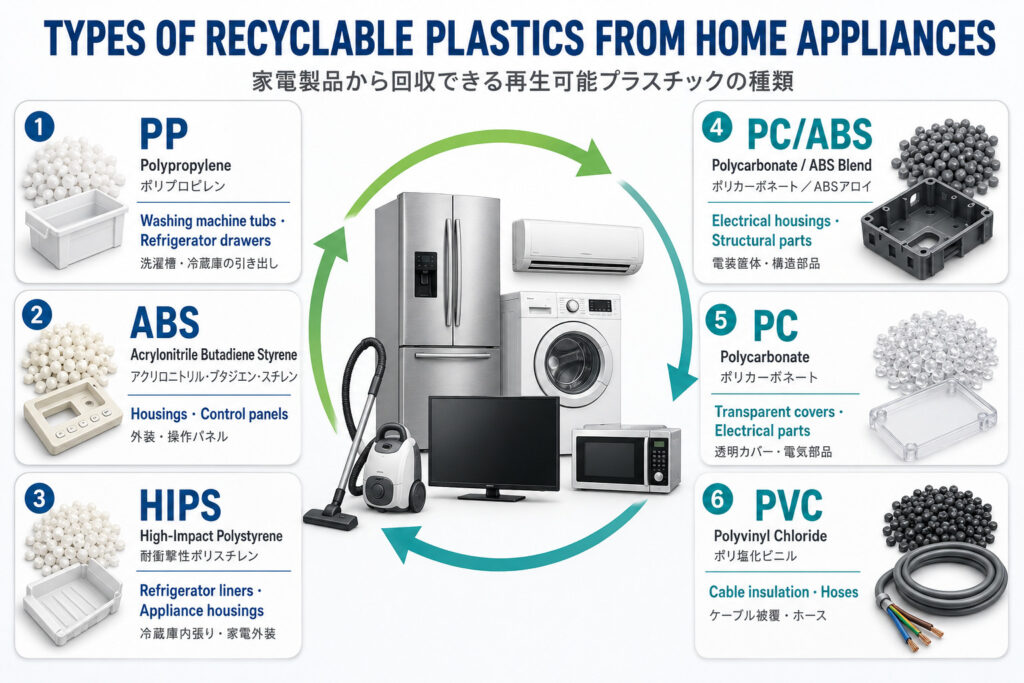
A European Commission Joint Research Centre report identifies ABS, PP, and PS as the main polymers recovered from general WEEE after pretreatment and sorting. The reported shares were 25.4% ABS, 24.3% PP, and 17.3% PS. I treat these as a useful WEEE reference, not as a fixed composition for every appliance batch.
Which polymers do I commonly find?
| Polymer | Main characteristics | Typical appliance parts | Possible recycled applications | Main recycling concern |
|---|---|---|---|---|
| PP | Low density, good chemical resistance, fatigue resistance | Washing-machine tubs, drawers, covers, fan parts | Appliance parts, storage boxes, pallets, automotive trim | Odor, oxidation, paint, fillers, PE contamination |
| ABS | Strong, impact resistant, easy to mold, good surface quality | Control panels, vacuum-cleaner bodies, appliance housings | Electrical housings, luggage, furniture parts, non-safety automotive parts | Aging, paint, flame retardants, styrene-related VOCs |
| HIPS | Toughened polystyrene with good processability | Refrigerator liners, television backs, interior panels | Housings, trays, profiles, general molded products | Brittle aging, ABS contamination, residual styrene odor |
| GPPS/PS | Rigid, easy to mold, relatively brittle | Transparent or rigid internal parts | Frames, trays, office products | Brittleness and odor |
| PC/ABS | Strong, heat resistant, dimensionally stable | Heat-resistant electrical housings and control components | Electrical enclosures and engineering compounds | Difficult identification, moisture, additives, flame retardants |
| PC | High impact strength and heat resistance | Transparent guards, covers, selected electrical parts | Engineering components and blended compounds | Hydrolysis during extrusion, yellowing, drying requirement |
| HDPE/LDPE | Low density, chemical resistance, flexible or rigid by grade | Tubes, insulation, containers, flexible parts | Containers, pipes, non-critical molded products | Oil, wax, detergent, PE-grade mixing |
| PA6/PA66 | Strong, wear resistant, heat resistant, hygroscopic | Gears, fan parts, bearings, connectors | Technical compounds and reinforced components | Moisture, glass fiber, thermal history |
| PET/PBT | Good dimensional and electrical properties | Films, insulation, connectors, electrical components | Fibers, straps, engineering compounds | Moisture and hydrolysis |
| POM | Low friction and good dimensional stability | Gears, latches, moving mechanisms | Limited controlled-loop applications | Formaldehyde risk if overheated |
| PVC | Flexible or rigid, naturally flame resistant | Cable insulation, seals, hoses | Specialized PVC products | Chlorine, plasticizers, contamination of other polymers |
| PUR foam | Lightweight thermal insulation | Refrigerator and freezer insulation | Specialized recovery routes | It is a thermoset and cannot enter normal melt pelletizing |
| Epoxy and thermosets | Heat resistant and cross-linked | Circuit boards, encapsulated parts | Specialized chemical or filler recovery | They do not remelt like thermoplastics |
How can recycled appliance plastics be reused?
I define the end use before I design the recycling line. This decision controls the required purity, odor level, color, impact strength, moisture, and filtration level.
Clean PP from washing-machine parts may return to appliance components after stabilization and property adjustment. Recycled ABS can be used in housings, office equipment, luggage, or automotive interior parts when its impact strength and restricted-substance results meet the buyer’s requirements.
HIPS can return to rigid housings and panels. PC/ABS can enter new engineering compounds when I control the blend ratio, moisture, flame-retardant history, and impact properties.
Some manufacturers already use closed-loop appliance plastics. Panasonic has reported techniques for characterizing recycled PP, PS, and ABS and adjusting the materials with antioxidants or virgin resin so they can return to appliance parts.
I never describe a polymer as “recyclable” without stating the intended application. A material that is acceptable for a pallet may fail an electrical-housing, odor-sensitive, food-contact, or flame-retardant specification.
What Processes and Equipment Are Involved in Home Appliance Recycling?
A poorly planned line can spread refrigerant oil, metals, foam, glass, and hazardous additives through the entire plastic fraction.
A complete process normally includes receiving, depollution, dismantling, shredding, metal separation, plastic sorting, washing, density separation, drying, extrusion, filtration, pelletizing, homogenization, deodorization, and testing.
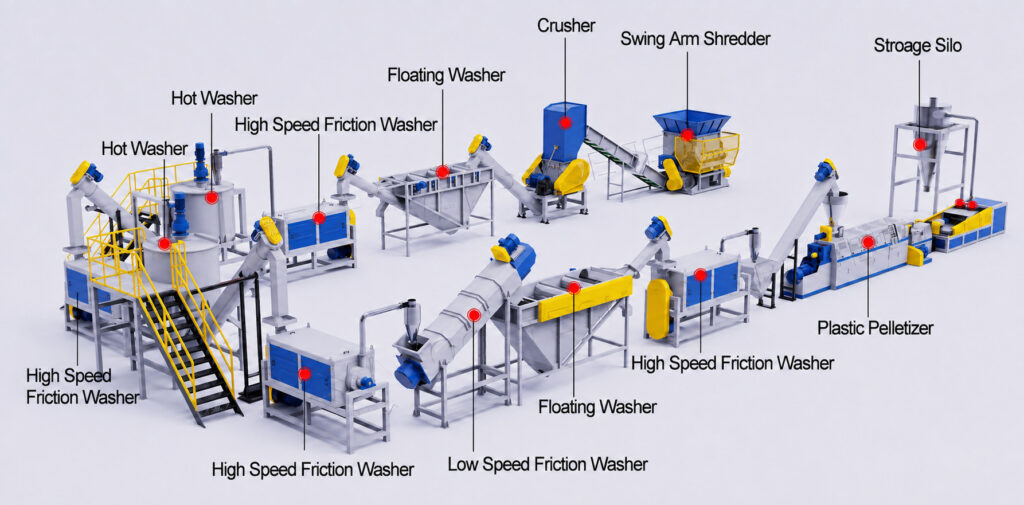
I divide the process into two areas. The first area depollutes and dismantles the appliance. The second area upgrades the recovered plastic into usable flakes or pellets.
Nicety Machinery’s strongest role is in the plastic preparation, modification, pelletizing, conveying, drying, mixing, screening, and VOC-control stages. I can review the broader range of plastic recycling machinery when planning this part of the factory.
What does the production flow look like?
| Stage | Main task | Typical equipment | Critical control point |
|---|---|---|---|
| Receiving | Identify and record incoming appliances | Scale, inspection area, traceability system | Appliance type, source, age, contamination |
| Depollution | Remove hazardous or controlled materials | Refrigerant recovery, oil drainage, battery removal | No hazardous component enters the shredder |
| Manual dismantling | Recover valuable components and clean plastic parts | Workstations and hand tools | Polymer labels and part origin remain traceable |
| Primary size reduction | Break large housings and plastic parts | Plastic shredder | Avoid excessive fines and heat |
| Granulation | Produce controlled flake size | Plastic crusher | Uniform flake size and metal protection |
| Metal separation | Remove ferrous and non-ferrous metals | Magnets and eddy-current separators | Protect washers and extruders |
| Air separation | Remove foam, dust, labels, and light fractions | Air classifier and cyclone | Control dust and fire risk |
| Polymer sorting | Separate PP, ABS, HIPS, PC/ABS, and other grades | NIR, XRF, XRT, density, electrostatic sorting | Polymer purity and restricted substances |
| Washing | Remove oil, dust, labels, adhesives, and residues | Pre-washer, friction washer, hot washer | Chemistry, temperature, residence time |
| Rinsing | Remove loosened dirt and washing chemicals | Cascade rinse tanks | Final pH, conductivity, and foam |
| Dewatering | Remove surface water | Centrifugal dryer | Moisture entering thermal drying |
| Thermal drying | Reach the moisture target | Hot-air or dehumidifying dryer | Polymer-specific temperature |
| Extrusion | Melt, mix, degas, and filter the polymer | Pelletizing line | Melt temperature, vacuum, pressure |
| Pellet classification | Remove fines and oversized pellets | Linear vibrating screener | Pellet-size distribution |
| Homogenization | Reduce variation between batches | Vertical silo mixer | Lot consistency |
| VOC treatment | Reduce absorbed and generated odor compounds | VOC deodorizing and drying system | Temperature, time, airflow, emissions |
| Final handling | Store and feed material without recontamination | Central feeding system | Sealed transfer and lot traceability |
I do not expect every factory to install all stages immediately. I first study the incoming material and the customer’s finished-pellet specification. I then identify the process step that limits value or throughput.
Why Must Appliances Be Depolluted Before Shredding?
Shredding an appliance too early can release refrigerants, oils, batteries, mercury-containing parts, capacitors, glass, and flame-retardant dust into every recovered fraction.
I remove hazardous materials and valuable components before shredding. This protects workers, prevents cross-contamination, reduces equipment damage, and keeps cleaner plastic parts available for high-value recycling.
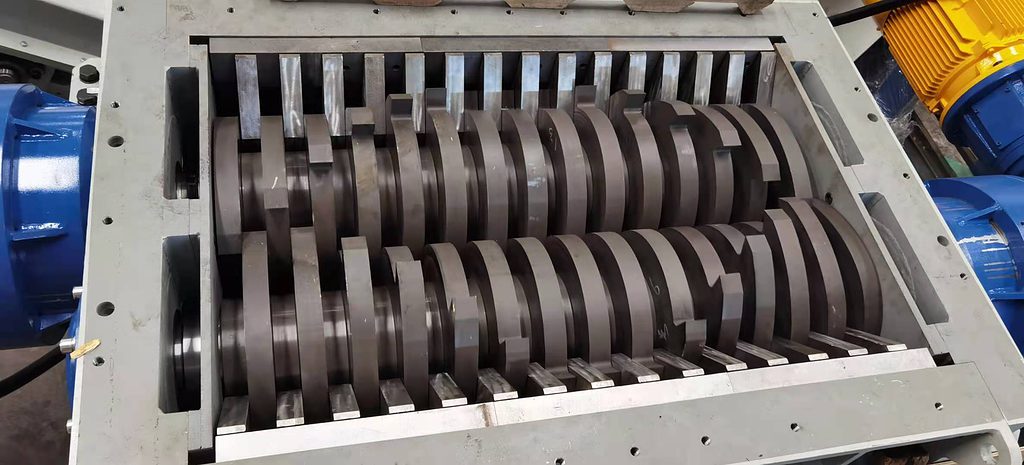
The correct depollution procedure depends on the appliance and local law. Refrigerators, freezers, and air conditioners require controlled refrigerant recovery. Compressor oil must also be drained and managed. Some insulation foams may contain controlled blowing agents.
I remove batteries from cordless appliances. I also remove printed circuit boards, lamps, capacitors, displays, and other regulated components when required. Large motors, compressors, copper coils, and clean metal structures should be recovered before mixed shredding when the economics support manual or automated dismantling.
The Japanese appliance-recycling process demonstrates this order clearly. Manufacturers first recover major parts and controlled substances. They then use shredding, magnetic separation, non-ferrous separation, air separation, cleaning, and plastic recovery.
Which parts should I remove first?
| Part or substance | Why I remove it | Risk if it enters the plastic stream |
|---|---|---|
| Refrigerant | Controlled gas and environmental risk | Worker exposure and illegal emissions |
| Compressor oil | Valuable or controlled liquid | Strong odor and oily plastic |
| Batteries | Fire and chemical risk | Shredder fire and metal contamination |
| Printed circuit boards | Precious metals and regulated substances | Heavy-metal and thermoset contamination |
| Mercury-containing parts | Hazardous substance | Dust and product contamination |
| Copper coils and motors | High-value metal | Equipment damage and metal in pellets |
| Glass and displays | Separate recycling route | Abrasion and high ash |
| PUR insulation foam | Thermoset material | Low-density contamination and dust |
| Brominated plastic parts | Possible restricted substances | Non-compliant recycled pellets |
I design the dismantling area around traceability. A plastic part with a clear polymer mark and known appliance source is more valuable than the same part after it has become anonymous mixed shred.
How Should Household Appliance Plastics Be Classified and Sorted?
Water separation alone cannot produce high-purity engineering plastics because ABS, HIPS, PC/ABS, PVC, and flame-retardant grades can have overlapping densities.
I combine source sorting, polymer markings, optical identification, X-ray screening, density separation, electrostatic methods, and laboratory checks. No single sorting technology can solve every appliance-plastic mixture.

How does density separation help?
The following densities are approximate values for common unfilled grades. Fillers, glass fiber, flame retardants, moisture, and recycled content can change them.
| Polymer | Approximate density in g/cm³ | Expected behavior in water |
|---|---|---|
| PP | 0.90–0.91 | Floats |
| LDPE | 0.91–0.94 | Floats |
| HDPE | 0.94–0.97 | Floats |
| HIPS | 1.03–1.06 | Sinks |
| ABS | 1.04–1.08 | Sinks |
| PC/ABS | 1.10–1.18 | Sinks |
| PA6 | 1.12–1.15 | Sinks |
| PC | 1.19–1.22 | Sinks |
| PBT | 1.30–1.33 | Sinks |
| PVC | 1.30–1.45 | Sinks |
| POM | 1.39–1.43 | Sinks |
A water tank can make a useful first split. It separates PP and PE from many engineering plastics. It cannot reliably separate ABS from HIPS because their density ranges overlap. A 2024 study of density-based WEEE-plastic sorting also shows why density sorting must be evaluated against the actual waste composition.
I may use calibrated salt solutions or staged density media for further separation. I still test the effect of fillers and flame retardants before selecting each cut point.
Which sorting methods should I combine?
Source and appliance-type sorting: I keep refrigerator, television, air-conditioner, and washing-machine plastics separate when their compositions differ.
Manual part identification: I use molded resin codes and supplier information before size reduction whenever possible.
NIR or hyperspectral sorting: I identify many clean, light-colored polymers by their optical response.
XRF or XRT screening: I detect bromine, chlorine, metals, or high-density flame-retardant fractions.
Float-sink separation: I divide low-density polyolefins from denser engineering plastics.
Froth flotation: I change surface behavior to separate polymers with similar densities when the process is justified.
Triboelectric or electrostatic separation: I separate dry, clean plastic particles based on electrical charging behavior.
Laboratory confirmation: I use FTIR, DSC, TGA, ash testing, melt-flow testing, and mechanical tests to verify each finished stream.
Black plastic can be difficult for conventional NIR equipment because carbon black absorbs the signal. I may need mid-infrared, Raman, laser-based identification, X-ray methods, part traceability, or another validated technology.
How should flame-retardant plastics be handled?
Old appliance plastics may contain brominated flame retardants. I do not mix a suspected stream with clean ABS or HIPS to dilute the bromine level.
The EU WEEE Directive requires separate treatment of plastics containing brominated flame retardants. Other markets have their own chemical and waste rules.
I use XRF as a fast bromine screen. I then arrange compound-specific laboratory analysis when regulatory compliance requires it. A VOC deodorization system does not remove brominated flame retardants, heavy metals, or persistent organic pollutants.
How Should Appliance Plastics Be Washed and Cleaned?
Inadequate washing leaves oil, adhesive, detergent, paint, dust, and odor precursors, while aggressive washing can damage the polymer and create expensive wastewater.
I use staged washing with dry cleaning, pre-washing, friction, controlled hot washing, density separation, repeated rinsing, dewatering, and polymer-specific drying. I verify cleanliness instead of relying on appearance.

What contaminants must I remove?
Appliance plastics are usually less contaminated by food than household packaging. However, they can contain refrigerant oil, grease, dust, labels, adhesive, paint, foam, rubber, metal particles, detergent, and long-term household odors.
The required cleaning process depends on the part. A clean PP washing-machine tub does not need the same treatment as an oily compressor cover or a painted ABS housing.
| Contaminant | Main removal method | Verification method |
|---|---|---|
| Dust and loose foam | Air classification and dry screening | Fines percentage |
| Ferrous metal | Magnetic separation | Metal detector |
| Aluminum and copper | Eddy-current and manual separation | Metal-content test |
| Oil and grease | Controlled hot wash with suitable surfactant | Surface oil or extractables test |
| Adhesive and labels | Friction washing and temperature-controlled chemistry | Visual and gravimetric inspection |
| Paint and coatings | Mechanical or specialized chemical process | Ash, color, and surface inspection |
| Detergent residue | Multiple fresh-water rinses | pH, conductivity, and foam test |
| Fine sand and glass | Settling, screening, and density separation | Ash and abrasive-particle test |
| Odor compounds | Source control, washing, degassing, and VOC treatment | Sensory and GC-MS testing |
| Other polymers | Optical, density, or electrostatic sorting | FTIR and DSC |
What is the correct cleaning sequence?
I first remove loose dust, foam, metal, and oversized contamination. This reduces wear in the wet line.
I then granulate the plastic to a controlled size. Uniform flakes receive more consistent friction, heat, and residence time. Very fine particles can carry more contamination and are harder to dewater, so I limit unnecessary fines.
A pre-wash loosens surface dirt. A friction washer then uses water and mechanical action to remove labels, dust, and weakly attached contamination.
I use hot washing only when the material and contamination require it. Higher temperature can improve oil and adhesive removal. It can also soften labels, affect paint, absorb into hygroscopic polymers, or damage sensitive grades. I test the washing chemistry on the real feedstock before fixing the recipe.
The European Commission’s JRC describes cold or hot water, detergents, and alkali as possible methods for removing surface contamination from plastic waste. It also stresses that mechanical recycling has limited ability to remove substances already embedded inside the polymer matrix.
How do I prevent detergent residue?
I use cascade rinsing and keep the dirtiest water away from the final rinse. I monitor the pH and conductivity of the final rinse against the incoming clean water.
I also use a simple foam test. Persistent foam can show that surfactant remains on the flakes. The acceptable limit must match the customer’s process because there is no universal conductivity value for every water source and polymer.
Detergent residue can create gas, deposits, unstable extrusion, odor, and surface defects. More detergent is not always better. I select the lowest effective dosage and give the rinsing section enough capacity.
How do polymers react differently during cleaning?
| Polymer | Washing and drying point |
|---|---|
| PP and PE | They usually tolerate water well, but oils and fragrances can be absorbed into the polymer |
| ABS and HIPS | I avoid untested solvents and excessive heat that may cause stress cracking, discoloration, or deformation |
| PC and PC/ABS | I control alkaline exposure and dry thoroughly before extrusion |
| PA | It absorbs moisture quickly and needs dehumidifying drying |
| PET and PBT | They require low final moisture to prevent hydrolysis |
| PVC | I keep it separate and avoid uncontrolled heat |
| POM | I keep it separate and prevent overheating |
| Flame-retardant grades | I identify legal status before washing or reheating |
After wet processing, a centrifugal dryer removes surface water. Hygroscopic engineering plastics may then require a dehumidifying dryer. Mechanical dewatering and thermal drying are different steps, and I do not treat one as a replacement for the other.
How Should Color, Aging, and Material Degradation Be Sorted?
A polymer can be chemically correct but still be unsuitable because years of heat, ultraviolet light, detergent, stress, and repeated processing have damaged it.
I separate color and aging quality after surface cleaning. I combine optical inspection with melt flow, impact, color, oxidation, ash, and thermal tests to build reliable quality grades.

Color sorting should normally follow effective cleaning because dirt and coatings can hide the real surface. I separate light, natural, gray, and dark fractions when the buyer requires stable color.
A color sorter can reject yellowed, stained, burnt, or wrongly colored flakes. However, color alone does not prove polymer identity or mechanical strength.
There is also no universal machine that can completely sort plastics by “age.” I treat aging as a quality-classification problem.
Which signs show that a plastic has aged?
| Aging indicator | What it may show | Useful test |
|---|---|---|
| Yellowing or fading | UV or thermal exposure | Colorimeter and yellowness index |
| Cracks and brittleness | Oxidation or mechanical fatigue | Impact and tensile testing |
| Large MFI change | Chain scission, cross-linking, or mixed grades | Melt-flow index |
| Higher carbonyl signal | Polymer oxidation | FTIR carbonyl index |
| Lower oxidation stability | Depleted antioxidants | OIT testing |
| Unexpected residue | Fillers, dirt, glass, or flame retardants | Ash and TGA |
| Unstable melting behavior | Polymer mixing or degradation | DSC |
| Burnt or chemical smell | Thermal damage or absorbed contamination | Odor panel and GC-MS |
I build at least two quality grades when the feedstock varies. The higher grade may return to appliance or engineering applications. The lower grade may enter less demanding products.
This method protects the premium fraction from the weakest material. It also gives me clearer pricing and fewer customer complaints.
How Should Recycled Appliance Plastics Be Pelletized and Modified?
Clean flakes still need controlled melting, filtration, degassing, property correction, pelletizing, drying, and homogenization before they become reliable industrial raw material.
I pelletize each compatible polymer family under a defined temperature and moisture window. I then use filtration, vacuum degassing, additives, screening, and homogenization to produce a consistent compound.
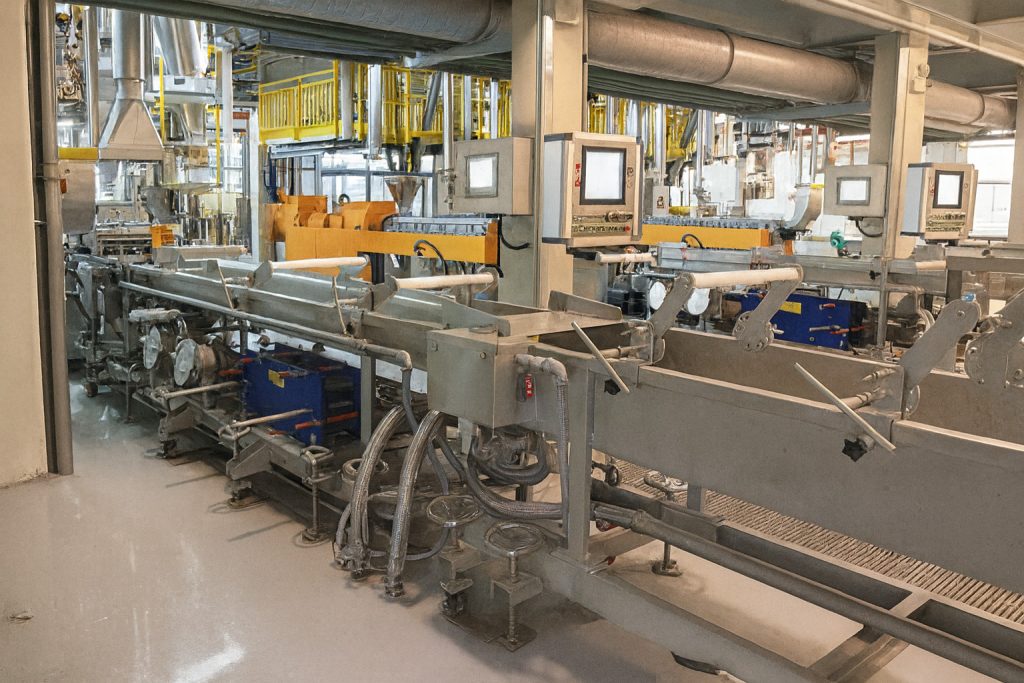
I do not expect an extruder or compatibilizer to repair poor upstream sorting. Excessive PVC, silicone, rubber, thermoset, metal, or incompatible polymer can still destroy the batch.
What does a reliable pelletizing line include?
I dry the flakes to a polymer-specific moisture level.
I use controlled feeding to keep the extruder load stable.
I add antioxidants, impact modifiers, compatibilizers, color masterbatch, or fillers only after laboratory formulation.
I control melt temperature and residence time.
I use vacuum degassing to remove moisture and volatile compounds from the melt.
I use a screen changer to remove remaining solid contamination.
I select strand, water-ring, or underwater pelletizing based on the material and throughput.
I remove pellet surface water.
I use a vibrating screener to remove fines and oversized pellets.
I homogenize the finished batch before packaging.
Nicety’s extrusion pelletizing equipment can integrate feeding, extrusion, screen changing, pelletizing, dewatering, and collection. For a complete project, I still confirm the polymer, contamination level, capacity, pellet shape, power supply, and final specification before selecting a machine.
Which processing risks change by polymer?
| Material | Main extrusion risk | Typical correction |
|---|---|---|
| Recycled PP | Oxidation, odor, changing filler content | Antioxidant, filtration, degassing, homogenization |
| Recycled ABS | Thermal degradation and property loss | Controlled temperature, impact testing, vacuum |
| Recycled HIPS | Styrene odor and brittleness | Low residence time, degassing, impact adjustment |
| PC/ABS | Moisture and unstable blend ratio | Dehumidifying drying and controlled formulation |
| PC | Hydrolysis and yellowing | Very low moisture and controlled temperature |
| PA | Moisture and fiber variation | Dehumidifying drying and gentle fiber handling |
| PET/PBT | Hydrolysis and viscosity loss | Low moisture and short, controlled residence |
| PVC | HCl release under overheating | Dedicated low-temperature PVC equipment |
| POM | Formaldehyde release under overheating | Dedicated process and strict temperature control |
A plastic mixer can pre-blend resin, additives, masterbatch, and controlled regrind. A high-speed mixer can support additive dispersion and temperature-controlled compounding preparation. I choose the mixer from the material form, batch size, required uniformity, and sensitivity to shear.
Which Recycled Appliance Plastics Need VOC Deodorization?
Washing removes surface contamination, but it cannot always remove volatile molecules absorbed inside the polymer or produced during aging and extrusion.
Recycled PP, PE, ABS, HIPS, PS, and PC/ABS often benefit most from VOC deodorization. PA, PET, PBT, PVC, POM, and flame-retardant plastics require more specialized evaluation.
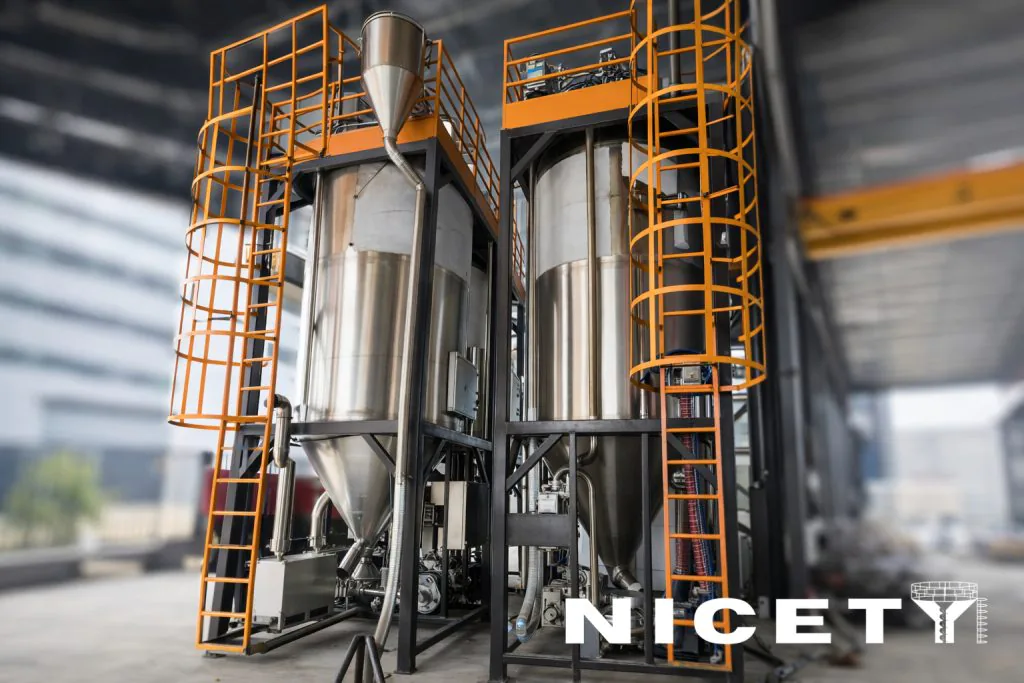
I consider VOC treatment when a technically acceptable pellet still has an oily, detergent, chemical, styrene-like, musty, or burnt odor. I also consider it when the customer will use the material in an indoor product.
Research on recycled plastics shows that VOCs may come from previous product use, absorbed contamination, additives, polymer oxidation, microbial activity, printing, washing chemicals, or thermal degradation. A recent study of recycled PP and HDPE also used thermal desorption and gas chromatography to characterize volatile compounds.
Which materials receive the highest priority?
| Material stream | Common odor or VOC concern | My treatment decision |
|---|---|---|
| PCR-PP appliance plastics | Detergent, oil, aldehydes, ketones, additive degradation | High priority when used indoors |
| Recycled PE | Oil, wax, household chemicals, absorbed fragrance | High priority for odor-sensitive products |
| Recycled ABS | Styrene-related and mixed chemical odors | High priority after controlled extrusion |
| Recycled HIPS/PS | Styrene, ethylbenzene, oxidation odors | High priority |
| PC/ABS | Mixed resin, additive, coating, and thermal-history odors | Often beneficial after testing |
| PA | Moisture and processing-related odor | Drying comes first; VOC treatment is conditional |
| PET/PBT | Moisture, acetaldehyde, or previous-use contamination | Conditional and temperature-sensitive |
| PVC | Plasticizer odor and possible HCl risk | Dedicated low-temperature evaluation only |
| POM | Formaldehyde risk if overheated | Dedicated evaluation only |
| Suspected BFR plastic | Possible restricted flame retardants | Chemical screening first; deodorization is not compliance treatment |
| PUR and thermosets | Complex thermal behavior | Not suitable for normal pellet deodorization |
I do not send unknown PVC, POM, or flame-retardant material into a standard high-temperature deodorization cycle. I first confirm the polymer and additives.
What can VOC deodorization remove?
A controlled system can reduce many volatile and semi-volatile odor compounds that can diffuse out of the polymer at the selected treatment temperature.
It cannot remove metal, glass, paint particles, excessive ash, an incompatible polymer, or most restricted substances. It cannot reverse severe oxidation or restore lost molecular weight.
The Nicety VOC deodorizing and drying system is therefore a finishing step in a complete quality process. It does not replace dismantling, sorting, washing, filtration, or safe chemical management.
How Does Nicety’s VOC Deodorizing, Drying, and Homogenizing System Work?
A strong odor can remain inside otherwise clean pellets, and short contact with hot air may remove only surface moisture without reaching the polymer’s internal VOCs.
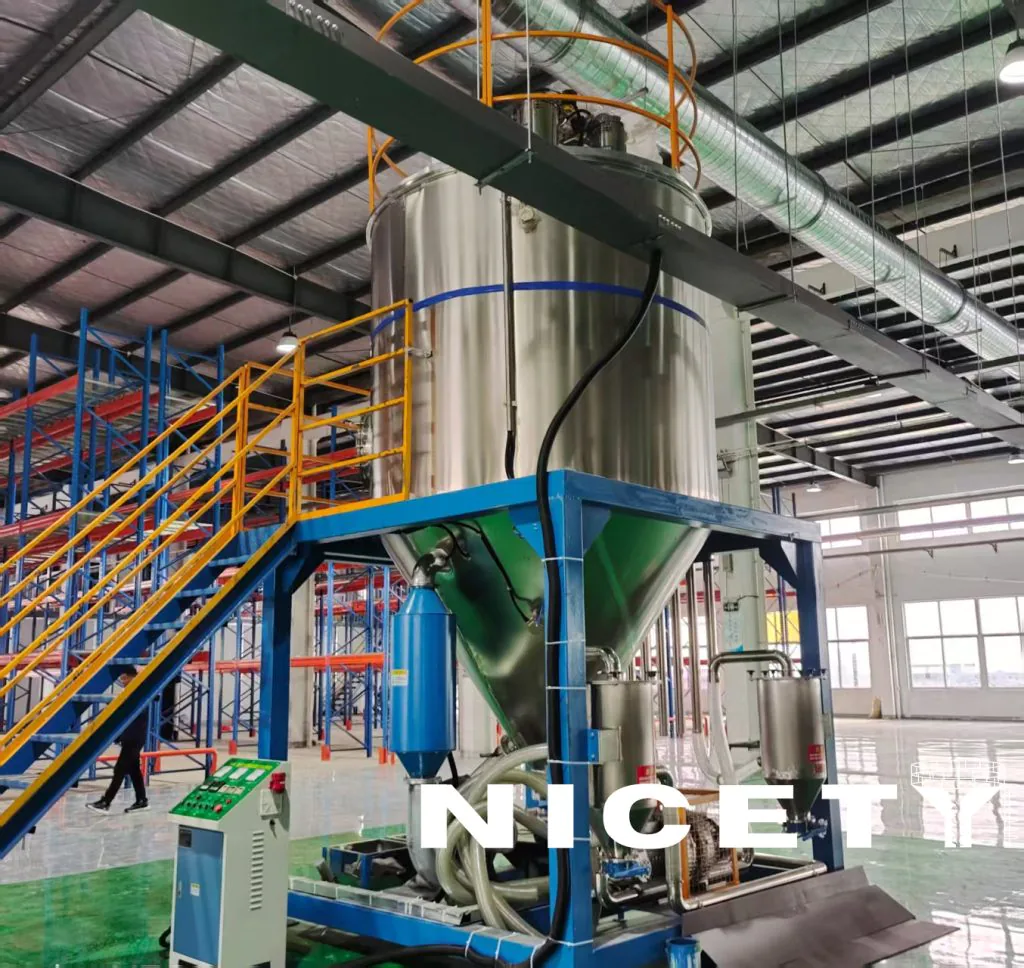
Nicety’s system heats the material inside a sealed silo and continuously circulates the pellets. Controlled temperature, long residence time, airflow, and homogenization release VOCs while also drying and balancing the batch.
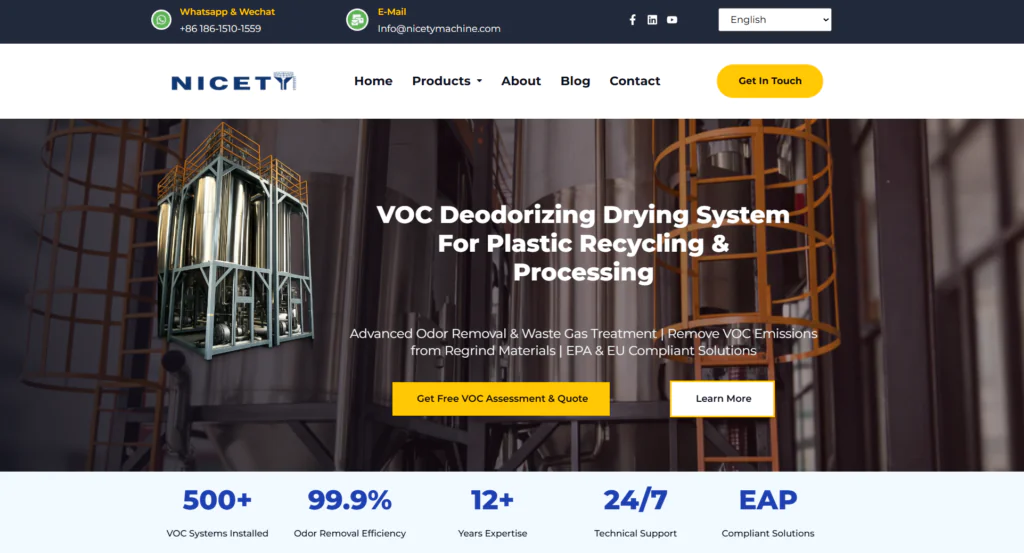
The simple idea is easy to understand. VOC molecules move more easily when the polymer temperature rises. Dry carrier air and continuous circulation help move released compounds away from the pellet surface. The treatment continues long enough for compounds inside the pellets to diffuse outward.
Nicety’s system combines this principle with sealed conveying, controlled heating, silo circulation, exhaust treatment, and batch homogenization.
What happens inside the system?
| Step | What the system does | Why it matters |
|---|---|---|
| Screening | Removes dust and abnormal particles before treatment | Keeps the silo and airflow cleaner |
| Sealed loading | Transfers pellets into the treatment silo | Reduces dust and uncontrolled odor leakage |
| Controlled heating | Raises the internal material temperature | Promotes VOC diffusion without melting pellets |
| Continuous circulation | Repeatedly turns and redistributes the material | Reduces hot spots and untreated zones |
| Dry-air contact | Carries moisture and released VOCs away | Supports drying and deodorization |
| Exhaust collection | Sends extracted gases to the selected treatment unit | Prevents direct odor release |
| Controlled cooling | Lowers the material temperature before storage | Prevents condensation and blocking |
| Homogenization | Mixes pellets from different positions in the batch | Improves color, odor, and property consistency |
| Sealed discharge | Sends treated pellets to packaging or downstream use | Reduces recontamination |
I regard temperature uniformity as more important than heater nameplate power. A small group of overheated pellets can discolor or degrade even when the average silo temperature appears acceptable.
How do I select temperature and time?
I start from the polymer’s softening point, drying requirement, oxidation risk, additive package, and odor chemistry. I then run controlled trials.
For recycled PP, possible test points can include 110°C for ten hours, 130°C for six hours, and 130°C for ten hours. These are trial conditions, not universal production recipes. I compare color, odor, MFI, impact strength, and VOC results before approving the production setting.
The current Nicety VOC system page presents a reference 5-ton system using about 400 kWh during a ten-hour cycle. Actual consumption depends on ambient temperature, insulation, starting moisture, material temperature, airflow, cooling method, and production layout.
I calculate energy per accepted ton, not only energy per cycle. A cheaper cycle is not economical if the pellets still fail the customer’s odor test.
Why is homogenization important?
A recycling batch rarely has identical odor and properties from top to bottom. The first material collected may come from a different feedstock lot than the final material.
Continuous circulation reduces this variation. It can also combine deodorization, drying, and batch blending in one controlled operation.
This is especially useful before a customer uses the pellets in injection molding, extrusion, compounding, or another sensitive process. The buyer receives a more consistent lot instead of several small quality zones hidden in one bag.
How Can a Factory Verify VOC Deodorization Performance?
A factory may become used to its own odor, so operator judgment alone cannot prove that a recycled pellet will satisfy a customer.
I combine a trained odor panel, heated-bag testing, process simulation, TVOC screening, and laboratory GC-MS analysis. I always compare untreated and treated samples from the same lot.
Which tests should I use?
| Test | Purpose | Suggested frequency |
|---|---|---|
| Room-temperature odor check | Fast production screening | Every batch |
| Sealed heated-bag test | Simulates odor release during storage or use | Every batch |
| Small injection-molding trial | Shows odor and defects under real processing heat | By lot or formula |
| Portable TVOC reading | Tracks relative process changes | Daily or by batch |
| Headspace GC-MS | Identifies and measures volatile compounds | Validation and periodic audit |
| GC-olfactometry | Connects chemical peaks with perceived odor | Advanced problem solving |
| MFI test | Checks whether heating changed melt behavior | Before and after trials |
| Color measurement | Detects yellowing or thermal damage | Before and after trials |
| Impact and tensile tests | Confirms retained mechanical properties | By customer specification |
| Moisture test | Separates drying performance from odor performance | Every treated batch |
I use the same sample-conditioning method every time. Temperature, sample mass, bag volume, conditioning time, and panel procedure must remain consistent.
A “no smell” statement is too subjective for a major project. I prefer to define an odor score or target VOC reduction with the buyer. I then ask an independent laboratory to test representative samples.
Why can odor return after treatment?
Odor may return because the treatment only removed surface compounds. It can also return when VOCs continue diffusing from the pellet core.
Other causes include recontamination during cooling, dirty silos, open bags, moisture absorption, mixed untreated pellets, or new degradation during the customer’s molding process.
I prevent this by giving the material enough residence time, cooling it in a controlled system, using sealed transfer, cleaning the storage system, and repeating the heated-bag test after storage.
How Should a Factory Owner Plan the Investment?
Buying individual machines without a defined material specification can create a line that produces many pellets but very few profitable, repeatable grades.
I begin with the target market, feedstock map, mass balance, quality limits, and trial results. I then invest in the process step that controls saleable yield and customer acceptance.
As a factory owner, I first ask what product I intend to sell. “Recycled appliance plastic” is too broad. I need a specification such as black recycled PP with a defined MFI, ash content, impact strength, odor score, and bromine limit.
I then collect representative samples from each appliance source. I record the polymer mix, metal content, foam, dirt, moisture, color, hazardous fraction, and recoverable yield.
Which production indicators should I track?
| KPI | Why I track it |
|---|---|
| Saleable polymer yield | Shows the real value recovered from incoming waste |
| Polymer purity | Predicts processing and property stability |
| Metal and non-plastic content | Protects equipment and product quality |
| Ash content | Tracks fillers and inorganic contamination |
| Moisture | Prevents hydrolysis, bubbles, and unstable extrusion |
| MFI | Measures batch processability |
| Impact strength | Shows aging and contamination effects |
| Color variation | Controls visible product quality |
| Odor score and TVOC | Controls indoor and consumer acceptance |
| Bromine and chlorine | Supports safe and legal stream management |
| Energy per accepted ton | Shows real operating efficiency |
| Water per accepted ton | Tracks washing efficiency |
| Filter consumption | Reveals contamination and operating cost |
| Downtime | Shows whether the line is practical |
| Customer rejection rate | Measures the final commercial result |
A factory with limited capital should normally prioritize depollution, sorting, metal removal, and stable washing before advanced compounding. These stages protect every later investment.
When the flakes are clean but the pellets remain inconsistent, I add better feeding, mixing, filtration, degassing, screening, and homogenization. When odor is the final barrier, I evaluate the Nicety VOC deodorizing, drying, and homogenizing system.
A centralized feeding system becomes valuable when the factory operates several silos, dryers, mixers, extruders, or injection-molding machines. It reduces manual handling and helps prevent the wrong material from entering the wrong machine.
What Are the Most Common Questions About Deodorizing Recycled Appliance Plastics?
Odor problems often lead factories to change additives or extrusion temperatures without identifying the original contamination source.
I solve odor systematically. I identify the polymer and odor source, improve sorting and washing, optimize extrusion degassing, apply post-pellet deodorization, and verify the result.
Can washing alone remove all odors?
No. Washing removes surface contamination. It is useful for oil, dust, detergent, adhesive, and other materials on the plastic surface.
Some VOC molecules have already diffused into the polymer. Other odor compounds form when the material oxidizes or passes through the extruder. These compounds may require vacuum degassing and thermal deodorization.
Should deodorization happen before or after pelletizing?
I can treat flakes before extrusion when the contamination load is high. However, post-pellet treatment has important advantages.
Extrusion can create new VOCs through heat and shear. Treating finished pellets can remove part of this final VOC load and homogenize the saleable batch. The best line may use strong upstream cleaning, melt degassing, and post-pellet treatment together.
Can a VOC system eliminate flame retardants?
No. A VOC system does not remove brominated flame retardants, heavy metals, or persistent organic pollutants from the polymer.
I screen suspected WEEE plastics before deodorization. I send restricted fractions to a compliant recovery or disposal route.
Can deodorization make recycled plastic food-grade?
No. Odor reduction does not create food-contact approval.
Food-contact recycled plastic requires a suitable input stream, validated decontamination, migration testing, quality controls, and approval under the rules of the target market. Appliance plastics should not be presented as food-grade simply because they have no obvious smell.
Can deodorization damage the polymer?
Yes, if I use excessive temperature, oxygen exposure, or residence time.
I control the material temperature and compare MFI, color, impact strength, and odor before and after each trial. The safest recipe is the lowest temperature and shortest time that consistently reaches the required odor result.
Why does recycled ABS or HIPS have a styrene-like smell?
ABS and HIPS contain styrenic components. Residual monomers, thermal degradation products, previous-use contamination, paint, and additives can contribute to the smell.
I first remove contaminated parts and coatings. I then use controlled extrusion, effective vacuum degassing, short melt residence time, and post-pellet VOC treatment when required.
Why can recycled PP smell even after good washing?
PP can absorb oil, fragrance, detergent, and household chemicals during use. Oxidation can also produce aldehydes, ketones, and other odor-active compounds.
The flakes may appear clean while the pellet still releases odor when heated. I use a heated-bag test or molding trial because room-temperature inspection may miss this problem.
Does a stronger vacuum always solve pellet odor?
No. Melt vacuum is important, but its effectiveness depends on vent design, melt surface renewal, temperature, residence time, throughput, and vacuum stability.
Some compounds do not leave the melt fast enough during extrusion. A long-residence VOC deodorizing system can treat the finished pellets without melting them again.
Can deodorant masterbatch replace VOC removal?
A deodorant additive can absorb or mask part of the remaining odor. It may help with final adjustment.
It does not remove the source of contamination. It can also change the formulation, cost, migration behavior, or long-term odor performance. I use it only after sorting, washing, and processing are under control.
How much sample material is needed for a deodorization trial?
A small laboratory test can screen temperature and time. A production-scale trial is more reliable because it shows real circulation, heat transfer, airflow, and cooling behavior.
Nicety normally recommends enough representative material to operate the trial system correctly. For an industrial trial, about one metric ton per material is a practical starting point. I confirm the quantity from the selected test unit.
How long does VOC deodorization take?
The time depends on the polymer, pellet size, starting VOC level, target odor, temperature, airflow, and silo design.
A full treatment and cooling cycle may take about 8 to 12 hours for some recycled materials. I do not promise a fixed result without testing the customer’s material.
How should I select activated carbon or exhaust treatment?
I first identify the expected VOCs, concentration, airflow, humidity, dust level, and legal emission limit.
Activated carbon can capture many organic vapors, but its life depends on the actual loading. Some exhaust streams may require condensation, filtration, oxidation, or another treatment. I size the exhaust system as part of the process, not as an afterthought.
What information does Nicety need to design a system?
I normally request:
- Polymer type and composition
- Flake or pellet form
- Bulk density
- Starting moisture
- Odor description and likely source
- Existing VOC or GC-MS report
- Required capacity
- Available treatment time
- Required inlet and outlet temperature
- Target odor or TVOC result
- Current washing and extrusion flow
- Factory power supply
- Available floor height and layout
- Local exhaust and emission requirements
This information allows Nicety Machinery to select the silo capacity, heating power, circulation method, conveying layout, cooling stage, control logic, and exhaust-treatment option.
Conclusion
Efficient appliance-plastic recycling requires safe dismantling, accurate sorting, controlled cleaning, stable pelletizing, verified VOC removal, and a finished specification linked to a real market.
Sources
- Association for Electric Home Appliances — Japan’s Latest Home Appliance Recycling Results
- Mitsubishi Electric — Closed-Loop Rare-Earth Magnet Recycling from Household Air Conditioners, June 2026
- Daikin — Rare-Earth Magnet Recycling from Commercial Air-Conditioner Compressors, April 2026
- Reuters — Itochu and ERI Form Japanese Electronics-Recycling Venture, March 2026
- Japan Ministry of the Environment — Law for the Promotion of Recycling of Small Home Appliances
- Japan Partnership for Circular Economy — Recycling Plastics from Small Household Appliances
- Panasonic — Closed-Loop Use of Recycled PP, PS, and ABS
- European Commission Joint Research Centre — EU-Wide End-of-Waste Criteria for Plastic Waste
- Resources, Conservation and Recycling — Evaluation of Density-Based Sorting of WEEE Plastics
- European Union — Consolidated WEEE Directive
- UN Environment Programme — Flame Retardants and Persistent Organic Pollutants
- Polymers — Thermal Desorption for Characterizing VOCs in Recycled Plastics
- PubMed — VOCs Causing Undesirable Odors in Recycled PP-HDPE Resin

_画板-1-副本-3-pxeey2xejyohpkvf07tglhvew6ks2ts3pjvhagm60c.png "NICETY MACHINERY Co., LTD")