_画板-1-1.png)
By Nicety Plastic Machinery Co., Ltd | April 14, 2026
Overview
A new market analysis published this week projects the global plastic injection molding machine auxiliary equipment sector will grow from $7.79 billion in 2025 to $14.41 billion by 2033, a compound annual growth rate (CAGR) of nearly 8%. The report, released by Market Research Intellect via OpenPR on April 8, 2026, covers dryers, temperature controllers, mold temperature machines, material handling systems, and cooling units — the peripheral equipment that keeps injection molding lines running.
The findings confirm what processors in Europe and North America are already experiencing on the shop floor: demand for reliable, automated auxiliary equipment is accelerating faster than the injection molding machine market itself.
Market Size and Growth Trajectory
The auxiliary equipment segment is outpacing broader plastics machinery benchmarks. For context:
- The overall plastic processing machinery market is valued at $27.5 billion in 2026, growing at a CAGR of 4.65% through 2035.
- The plastic processing auxiliary equipment sub-market specifically sits at $7.66 billion in 2026, on a trajectory to reach $9.21 billion by 2030 (CAGR 4.7%), per Research and Markets data.
- The injection molding-focused auxiliary equipment slice, tracked separately by Market Research Intellect, carries a higher CAGR of 7.99% — reflecting the premium placed on uptime, precision, and energy efficiency in modern molding cells.
The gap between those growth rates signals that buyers are investing proportionally more in peripheral systems than in primary machines — a meaningful structural shift.
What Is Driving Demand
Three forces are compressing investment timelines across Europe and the Americas:
1. Energy cost pressure. Strict carbon taxation in the EU and rising electricity costs in North America are pushing processors to upgrade legacy drying, cooling, and temperature control equipment. All-electric and hybrid injection molding machines demand matched auxiliary systems to deliver their efficiency gains.
2. Automation and Industry 4.0. Processors are building integrated cells where dryers, conveyors, blenders, and granulators communicate in real time. Fragmented, standalone auxiliary equipment is being replaced by networked systems that feed data into manufacturing execution systems.
3. Recycled and sustainable resins. Post-consumer recyclate (PCR) and bio-based polymers behave differently from virgin resins — they require tighter moisture control, more precise temperature management, and better material handling. That is driving replacement and upgrade cycles for dryers and mold temperature controllers in particular.
Europe and North America in Focus
Europe is forecast to record the highest CAGR of 4.2% among major regions for plastic processing machinery from 2025 to 2030, driven by sustainability mandates, expansion in medical packaging, and stricter single-use plastic regulations. Investment in machinery capable of processing recyclable and biodegradable plastics is accelerating across Germany, Italy, and Eastern Europe.
North America currently holds a 36.4% share of the global plastic processing machinery market and is growing steadily. The U.S. market benefits from high automation adoption, a strong medical device sector, and reshoring activity under "China Plus One" supply chain restructuring. Packaging and food-and-beverage remain the two largest end-user segments pulling demand.
Key Equipment Categories
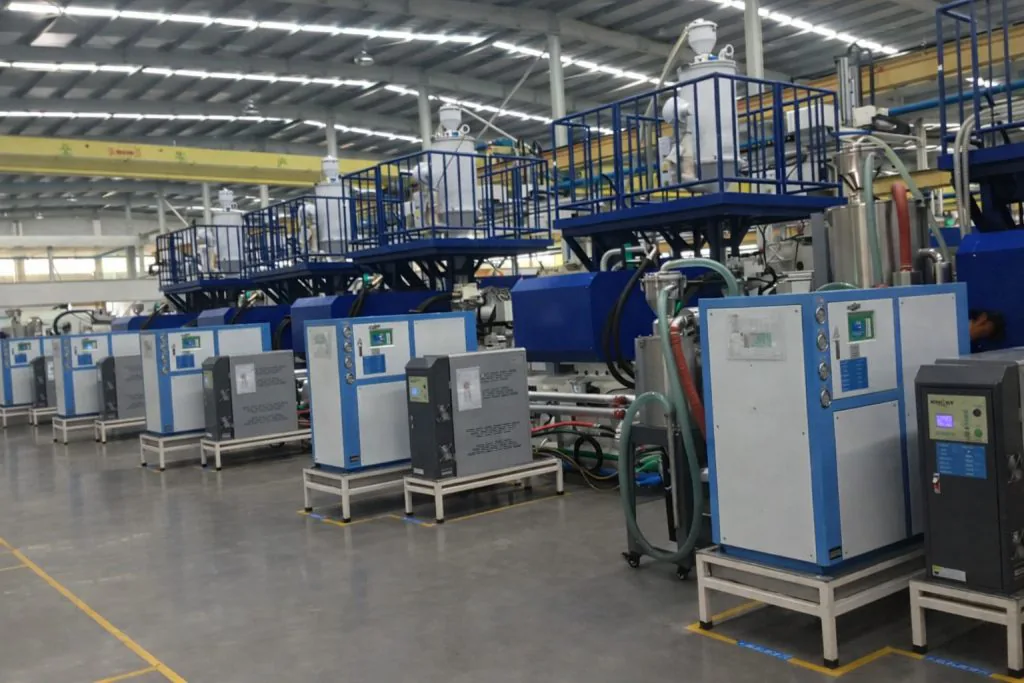
The auxiliary equipment market encompasses several distinct product lines. Based on current market data, injection molding technique applications dominate the overall auxiliary equipment segment, with conveying and blending equipment representing the fastest growth segments.
Core categories include:
- Dryers and dehumidifiers — critical for hygroscopic resins like PET, PA, and PC
- Material handling and conveying systems — centralized feeding, vacuum loaders, screw conveyors
- Temperature controllers and chillers — mold temperature management for cycle consistency
- Granulators and size reduction equipment — in-line regrind and scrap recovery
- Blenders and mixers — masterbatch and additive dosing at the press
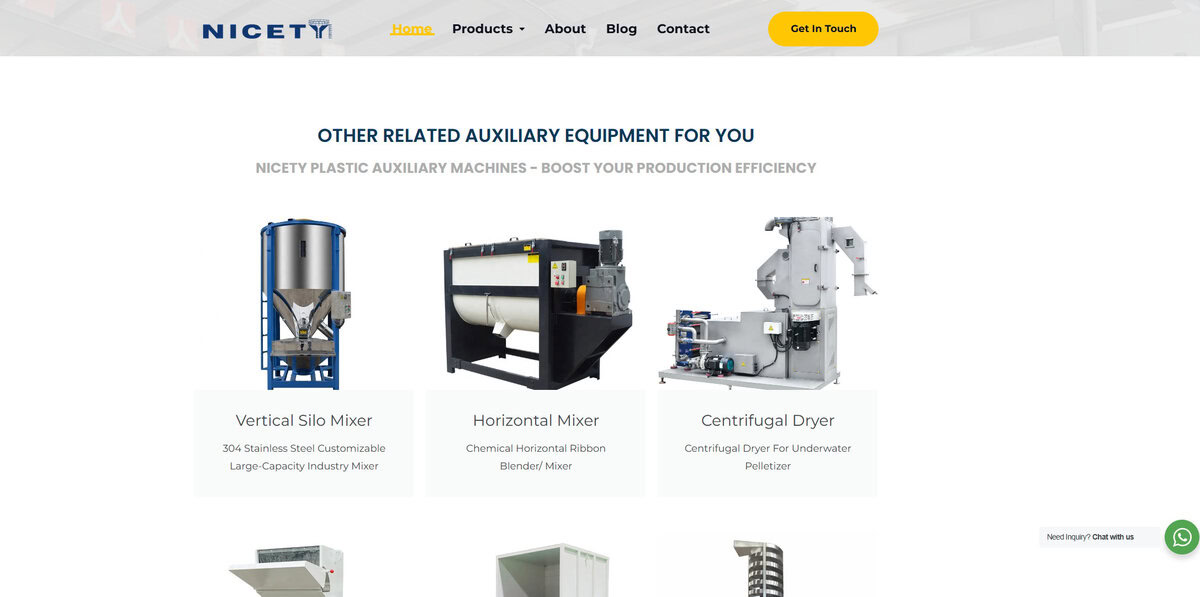
Nicety Machinery supplies several of these categories directly, including industrial mixers, screw conveyors, centrifugal dryers, and vibrating screeners — equipment positioned squarely in the segments the market report highlights as high-growth.
What This Means for Processors
The near-doubling of auxiliary equipment market value by 2033 is not driven by price inflation alone — it reflects real volume growth as processors in Europe and North America upgrade aging peripheral equipment, integrate smart monitoring, and adapt lines for sustainable resins.
For plant managers evaluating capital expenditure in 2026, the message from market data is clear: auxiliary equipment upgrades now carry measurable ROI through energy savings, scrap reduction, and cycle time gains. Delaying those upgrades while running incompatible legacy peripherals alongside newer primary machines is an increasingly costly trade-off.
Processors looking to assess their current material handling or mixing configurations can contact Nicety Machinery directly — the company’s sales team responds within one business day.
Sources
- Plastic Injection Molding Machine Auxiliary Equipment Market 2026–2033 — OpenPR / Market Research Intellect
- Plastic Processing Auxiliary Equipment Market Global Report 2026 — Research and Markets
- Plastic Processing Machinery Market Size & Trends 2026–2035 — GlobeNewswire / Precedence Research
- Plastic Processing Machinery Market 2026–2030 — Technavio
- SABIC Sells Engineering Thermoplastics Business to Mutares for $450M — Nicety Machine
- Plastic Injection Molding Machines Market to Reach $14.28 Billion by 2035 — Yahoo Finance / Astute Analytica

_画板-1-副本-3-pxeey2xejyohpkvf07tglhvew6ks2ts3pjvhagm60c.png "NICETY MACHINERY Co., LTD")