_画板-1-1.png)
By Nicety Machinery Co., Ltd | May 19, 2026
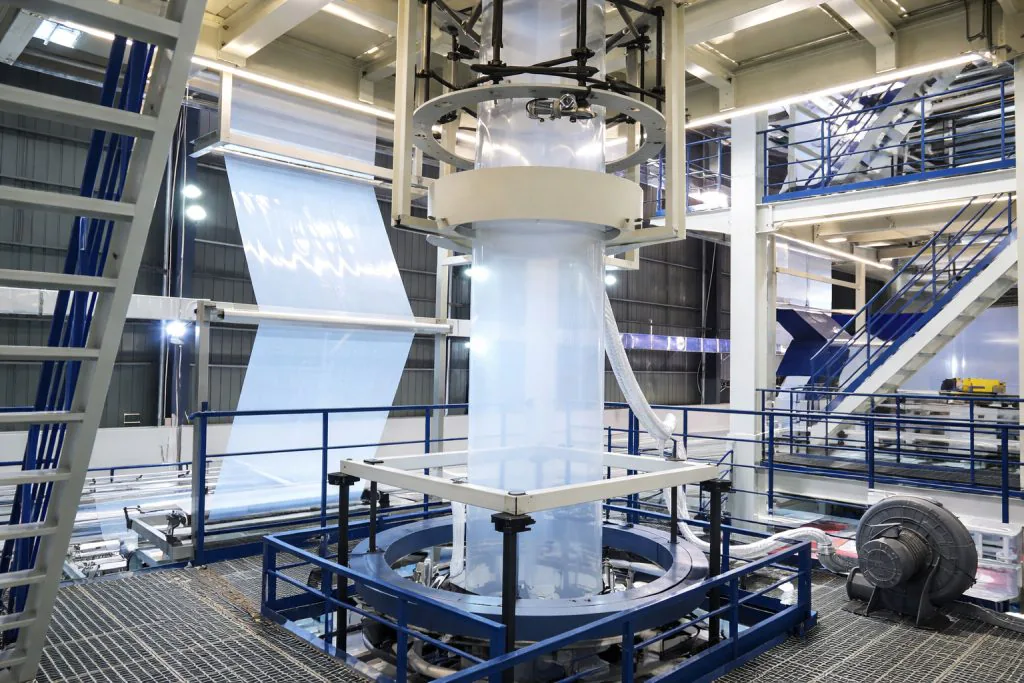
Film extrusion lines for flexible packaging — the market W&H has served for 150 years — are expanding capacity in North America despite global supply chain headwinds.
Overview
On May 1, 2026, Windmoeller & Hoelscher Corporation (W&H) officially completed a major two-year expansion of its North American headquarters in Lincoln, Rhode Island, marking the milestone with a ribbon-cutting ceremony attended by U.S. Congressman Gabe Amo, Rhode Island Secretary of Commerce Stefan Pryor, state senators, town officials, and senior leadership from W&H’s German parent. The project more than doubled the facility’s warehouse capacity and significantly expanded office space — a concrete physical commitment to North American extrusion markets at a moment when global supply chains are under severe strain, resin prices are surging, and machinery customers need faster parts access than ever before.
W&H is a 150-year-old, family-owned German company headquartered in Lengerich, and the world’s leading supplier of film extrusion lines, printing presses, and converting equipment for flexible packaging production. Its North American business — operating from Lincoln, Rhode Island since 1977 — generated record sales of $300 million in 2024, contributing to $1.2 billion in global revenue. The Rhode Island expansion is its most significant North American investment in decades.
What W&H Just Built — and Why It Matters Beyond Flexible Packaging
The completed expansion at W&H’s Lincoln facility encompasses two phases executed over two years. The first phase added 12,000 square feet of warehouse space and 5,600 square feet of office space. The second phase renovated the existing 8,400 square feet of office area. Together, the project more than doubles the facility’s footprint and transforms the Lincoln site from a regional service outpost into a full-scale North American operational hub.
The warehouse expansion is specifically designed to expand storage capacity for spare parts serving both W&H and its subsidiary Garant, enabling more efficient order fulfillment for packaging machinery customers. Over 70% of W&H parts orders in North America are shipped overnight from Rhode Island inventory — a service capability that is only possible with sufficient physical storage at the right geographic location.
W&H installed photovoltaic panels expected to generate most of the facility’s electricity needs, including powering the HVAC system. The project received support from federal funding and a grant from the Rhode Island Renewable Energy Fund.
The Numbers Behind the Expansion
The scale of W&H’s North American business puts the investment in context:
- $300 million in North American sales in 2024 — a record for the company’s US operations
- $1.2 billion in global revenue for the W&H Group in 2024
- Almost 100 employees at the Lincoln, Rhode Island facility — a 20% workforce increase over the past two years
- 1,600+ patents granted worldwide, reflecting the company’s technology development depth in blown film, cast film, printing, and converting systems
- 150 years of continuous operation as a family-owned company — founded in 1869 in Lengerich, Germany
Andrew Wheeler, President of W&H Corporation, framed the investment in operational terms: "This expansion reflects our unyielding commitment to serving customers across the United States and Canada. Our business is built on relationships and service, and this investment allows us to continue growing our team while delivering the level of support our customers rely on."
Rhode Island Secretary of Commerce Stefan Pryor welcomed the expansion at the ceremony: "W&H’s decision to double its warehouse and office space and expand its North American presence here in Rhode Island reflects the strength of our business environment."
Why a German Machine Builder Is Betting on North American Extrusion Right Now
The timing of W&H’s completion is not incidental. The ribbon-cutting happened on May 1, 2026 — squarely in the middle of the most significant resin price and supply chain disruption the North American plastics industry has experienced in years. Domestic PE prices settled 30 cents per pound higher in April contracts. PP is being called a "sleeping giant" by LyondellBasell, with 70% of global virgin PP supply disrupted by the Iran conflict. Asian film extrusion capacity is cutting run rates.
In that environment, North American film converters and packaging manufacturers are running their lines harder — processing more domestic resin at record prices, seeking supply security through domestic sourcing, and scrutinizing equipment reliability with new urgency. Every hour of unplanned downtime on a blown film or cast film line in 2026 wastes expensive polymer. Every equipment failure that requires international parts sourcing adds weeks of lead time in a congested logistics environment.
W&H’s Rhode Island facility is the answer to that operational reality. The company’s core value proposition in the North American market is not just equipment sales — it is 24/7 service and maintenance support, backed by a multi-million-dollar parts warehouse stocked for overnight delivery. When film converters are running at high utilization rates processing record-cost resin, the parts warehouse in Rhode Island becomes the most important asset W&H offers.
The expansion was also reinforced by W&H’s participation at Chinaplas 2026 in Shanghai in April, where the company presented its latest extrusion, printing and converting technology solutions with a focus on performance and recyclability, and held an open house at its Shanghai Technology Center together with ExxonMobil. W&H is pursuing both markets simultaneously — Asia for growth, North America for consolidation.
The Spare Parts Angle: 70% of Orders Shipped Overnight
The statistic that stands out in W&H’s expansion announcement is not the headline square footage figure — it is the overnight delivery rate. More than 70% of orders ship overnight from the Rhode Island facility’s inventory. That is an extraordinary service commitment for heavy industrial machinery components, and it defines the competitive positioning of W&H’s North American operation.
For operators of W&H blown film lines — VAREX II, OPTIMEX, FILMEX — and cast film lines and converting equipment, the overnight parts capability is the difference between a production stoppage of hours and a stoppage of days or weeks. In a market where film converters are processing record-price PE and PP resin through lines running at near-full capacity, the cost of an extended mechanical outage can exceed the annual savings from choosing a lower-price equipment supplier.
The new warehouse doubles the storage footprint available for this parts inventory. More storage means broader parts coverage, higher fill rates, and reduced backorder frequency — particularly for the growing installed base of W&H equipment in North America that has accumulated over 45 years of market presence.
This parts warehouse model is worth noting for any plastics machinery purchaser in the North American market: the total cost of machinery ownership is not fully captured in the purchase price or even the annual maintenance contract. It is also captured in mean time to repair when something goes wrong at 2 AM on a Friday.
Solar-Powered Manufacturing Infrastructure: A New Benchmark
W&H’s installation of photovoltaic panels to cover most of the facility’s electricity needs — including HVAC — is consistent with its global sustainability strategy, but the practical economics deserve attention independent of the environmental positioning.
Industrial electricity in the northeastern United States is among the most expensive in the country. A machinery service facility running climate-controlled parts storage, workshop operations, and office functions has a meaningful electricity bill. Generating the majority of that consumption from on-site solar — supported by both federal funding and a Rhode Island Renewable Energy Fund grant — reduces operating cost structurally over the 20-plus-year lifespan of a photovoltaic installation.
For plastics machinery manufacturers watching this move, the lesson is that sustainability investment and cost management are not opposed. A facility that generates its own electricity is insulated from the utility cost volatility that affects operating margins — the same logic that applies to compounding and extrusion facilities integrating renewable energy into their own plants.
What the W&H Expansion Signals for the Broader Extrusion Equipment Market
W&H’s investment carries broader signals for the global extrusion and plastics machinery sector:
North American flexible packaging demand is structurally robust. The decision to commit to a two-year construction project and double facility capacity was made in 2023 or early 2024, before the current resin price surge. It reflects W&H’s medium-term assessment that North American demand for film extrusion lines — for food packaging, industrial film, agricultural film, and specialty applications — is growing, not contracting. That assessment is now being validated by the supply disruptions pulling international buyers toward North American-produced PE and packaging film.
Service infrastructure is becoming a competitive moat. As film lines become more technically sophisticated — multi-layer co-extrusion, inline quality control systems, AI-assisted process monitoring — the ability to rapidly support them during downtime becomes a more significant competitive differentiator. W&H’s overnight parts delivery from Rhode Island is a service moat that competitors would need years and significant capital to replicate.
European machinery builders are deepening US commitments. W&H is not alone among European plastics machinery manufacturers in significantly expanding North American infrastructure. The combination of record US PE feedstock competitiveness, growing North American film packaging demand, and tariff-driven reshoring incentives is making US market investment increasingly attractive for machinery builders who were previously content with lighter distribution footprints.
The 150-year family-owned model has operational advantages in capital allocation. W&H can commit to a two-year construction project based on its own long-term assessment of market conditions without managing quarterly earnings guidance, analyst expectations, or activist shareholder pressure. The ribbon-cutting on May 1 was attended by German senior leadership traveling from Lengerich — a signal of how seriously the parent company views the North American operation.
Auxiliary Equipment That Supports Film Extrusion and Blown Film Lines
Film extrusion lines — whether blown film or cast film — share the same upstream and downstream auxiliary equipment requirements that compounding lines do. Resin must be dried, blended, conveyed, and fed consistently to the extruder, and finished film or pelletized compound must be screened and handled cleanly after the extrusion step. For film producers upgrading or expanding lines, the auxiliary equipment chain directly affects extruder feed quality, line stability, and product consistency:
Resin drying before extrusion: Hygroscopic resins — certain barrier resins, nylon-containing multi-layer structures, EVOH — require moisture removal before film extrusion to prevent bubble instability, haze formation, and reduced mechanical properties in the final film. Nicety Machinery’s VOC Deodorizing Drying System removes both moisture and volatile organics before the resin enters the extruder, protecting film quality across sensitive resin grades.
Masterbatch and additive blending: Blown and cast film lines producing colored film, UV-stabilized greenhouse film, antiblock or slip-modified packaging film, or metallocene-based stretch film all require precise masterbatch let-down and additive blending before or at the extruder feed. The High Speed Mixer Machine pre-disperses additives into the base resin, reducing additive loading variation and improving film property consistency across a production run. The Plastic Color Mixer handles precision let-down blending of color masterbatch at defined ratios.
Pellet and powder conveying to the extruder hopper: Consistent extruder feed rate is critical for film gauge control and bubble stability in blown film production. The Screw Conveyor and Vibrating Spiral Elevator provide reliable, segregation-free material transfer from blending or storage to the extruder hopper, maintaining blend homogeneity through to the feed point.
Bulk blending for multi-resin or regrind-containing formulations: Film producers incorporating post-consumer or post-industrial regrind into their formulations — an increasingly common practice under EU and North American recycled content targets — need reliable mixing of virgin and recycled pellets before extrusion. The Horizontal Mixer and Vertical Silo Mixer provide uniform bulk blending for pellet-to-pellet mixing operations.
Post-extrusion pelletizing for compound producers: For compounders producing film-grade PE or functional film compounds, the Extrusion Pelletizing Line converts compound melt into uniform pellets ready for film extrusion customers. The Strand Line Centrifugal Dryer removes surface moisture from pellets immediately after the water bath cooling step.
Pellet size classification: The Linear Vibrating Screener removes fines and oversized particles from pelletized film compound before packaging — preventing feeding problems in downstream film extruders and ensuring consistent bulk density for gravimetric feeding systems.
Sources
- Plastics Today: W&H Doubles Rhode Island Facility Capacity With Sustainable Expansion — May 13, 2026
- Plastics Technology: W&H Completes Expansion of North American HQ — May 2026
- Plastics News: W&H Completes Rhode Island Expansion to Support North American Growth — May 2026
- Canadian Plastics: W&H Finishes Rhode Island Facility Expansion — May 14, 2026
- Flexographic Technical Association: Windmoeller & Hoelscher Completes Major Rhode Island Expansion — May 2026
- Packaging Strategies: W&H Completes Expansion of North American HQ in Rhode Island — May 2026
- W&H Group Corporate Website: W&H Corporation North America
- Plastics Today: German Flexible Packaging Equipment Maker Begins Major US Expansion — July 2024 (groundbreaking)

_画板-1-副本-3-pxeey2xejyohpkvf07tglhvew6ks2ts3pjvhagm60c.png "NICETY MACHINERY Co., LTD")