_画板-1-1.png)
By Nicety Machinery Co., Ltd | May 22, 2026
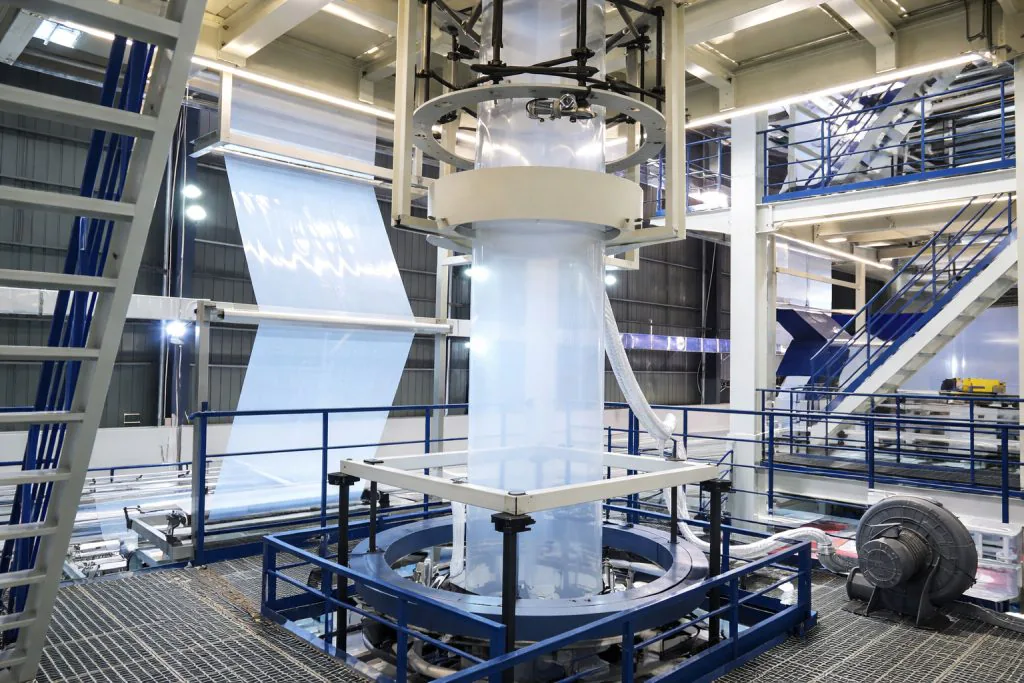 Interpack 2026 confirmed that the shift from experimental sustainability to mandatory regulatory compliance is now fully underway across the global packaging and film extrusion industry.
Overview: The Largest Interpack in History Just Closed
From May 7 to 13, 2026, the global processing and packaging industry gathered in Düsseldorf, Germany for interpack 2026 — and the numbers were historic. The trade show drew 2,804 exhibitors from 65 countries, with attendees representing 161 countries; 75% of visitors came from outside Germany and 28% from beyond Europe entirely. Organizers confirmed it as the largest edition in the show’s history. The turnout reflected both interpack’s established stature and a broader sense of urgency coursing through an industry navigating regulatory upheaval and shifting supply chain demands.
For plastic film extruders, compounders, and polymer processors watching from outside Europe, the show delivered a single, unmistakable message: the European Packaging and Packaging Waste Regulation (PPWR) has moved from policy discussion to operational reality, and it is restructuring what resins must be developed, what film architectures must be engineered, and what recycled-content levels every processor in the European supply chain must hit — with legally binding deadlines now within the planning horizon of any capital investment made today.
What Interpack Is — and Why It Matters to Compounders and Extruders
Interpack is held every three years in Düsseldorf and is the world’s largest trade fair for processing and packaging technology. Unlike annual sector shows, the three-year cycle means interpack functions as a strategic investment platform: buyers attend to finalize supplier shortlists, evaluate new technology against three-to-five-year capital expenditure plans, and make supplier qualification decisions that will govern purchasing through the next cycle.
Düsseldorf, Germany was the center of the packaging world as interpack 2026 attracted 2,804 exhibitors from 65 countries and visitors from 161 nations. The show covers the full processing and packaging value chain — from resin and film materials through extrusion, printing, converting, and filling machinery to end-of-life and recyclability solutions.
For compounders and extruders, interpack is the show where material decisions and machinery investments for the next three years are made simultaneously. A compounder developing a new monomaterial PE film compound and a film extruder investing in a new blown film line both attend interpack to validate their roadmaps against what the industry — and the regulators — are demanding. In 2026, what the industry is demanding is PPWR compliance, and the urgency on the show floor was unmistakable.
The Three Hot Topics That Defined the Show Floor
Interpack 2026 was organized around three official Hot Topics that structured the exhibition and conference program:
Smart Manufacturing: Automation, digitalization, and data-driven production moving from optional upgrade to operational requirement. Solutions exhibited included higher OEE (Overall Equipment Effectiveness) monitoring, predictive maintenance, connected lines, and in-line quality control supported by sensors, AI, and real-time analytics.
Innovative Materials: Material innovations, including recycled content and monomaterial designs, are advancing cost efficiency while supporting recyclability and operational performance. The materials race at Interpack centered on barrier innovation, lightweighting, monomaterial structures, and recycled-content strategies reshaping how packaging films are engineered and compounded.
Future Skills: Workforce development and knowledge transfer for increasingly automated, regulation-intensive processing environments — a theme that underscores the human capital investment required alongside capital equipment investment.
Rather than responding in isolation, exhibitors demonstrated systemic approaches to these challenges. Companies presented integrated solutions where materials, machinery, and processes are designed and coordinated as cohesive systems. This integration of material science, extrusion engineering, and regulatory compliance into unified product offerings was the defining characteristic of the 2026 show — and it represents a significant shift from previous editions where materials and machinery suppliers operated more independently.
PPWR: The Regulation Reshaping Every Plastic Film and Compound Decision in Europe
While demand for packaged products continues rising globally, the industry faces mounting pressure to transform materials, production systems, and supply structures. The European Packaging and Packaging Waste Regulation (PPWR) emerged as a central focus, representing a significant turning point that’s reshaping industry practices and compliance requirements.
The PPWR — formally adopted by the European Parliament and Council — introduces mandatory recycled content minimums for plastic packaging, recyclability requirements by design, restrictions on unnecessary packaging formats, and extended producer responsibility mechanisms. For processors supplying into the European market, the regulation creates hard deadlines that function as purchasing decisions: what compound formulations, what film architectures, and what production equipment will meet PPWR requirements by the applicable enforcement dates?
At interpack 2026, the conversation shifted from ‘experimental sustainability’ to ‘operational compliance’ — a move away from complex multi-layer plastics toward designs optimized for existing mechanical recycling streams. This is the most significant structural shift visible on the interpack show floor: two editions ago, sustainability was positioned as innovation and brand differentiation. At the 2026 edition, it was positioned as regulatory compliance — a legal floor, not a marketing ceiling.
The new EU packaging regulation PPWR stipulates a significant reduction in packaging waste, mandatory recycling quotas, and the increased use of recyclates. However, the use of recyclates in contact with food is considered a major challenge. For compounders developing recycled-content film compounds for food-contact applications — the largest single segment of flexible packaging — this challenge defines the entire R&D agenda: how to incorporate post-consumer recycled polyethylene or polypropylene into food-contact approved formulations without compromising barrier performance, odor profile, or mechanical properties.
Monomaterial Film Structures: What They Demand from Compounders and Extruders
The most consequential technical shift visible at interpack 2026 — for both film extruders and the compounders who supply them — is the transition from multi-layer, multi-material film structures toward monomaterial architectures. The driver is simple: one of the strongest themes at interpack was the acceleration of decision-making around recyclability and PPWR readiness, with brand owners moving from exploration into implementation.
Traditional flexible packaging films frequently combine polyethylene, polypropylene, polyester (PET), nylon (PA), EVOH barrier layers, adhesive tie layers, and printed ink systems in structures of 5 to 9 layers. These laminated structures deliver excellent performance — high barrier, good seal strength, good printability — but they are functionally unrecyclable in mainstream mechanical recycling streams because the different polymer types cannot be separated. The PPWR recyclability requirements, which tie to independently verified recyclability grades under European standards, mean that multi-material structures will increasingly fail compliance thresholds.
Monomaterial film — typically all-PE or all-PP structures — can be mechanically recycled in existing collection and sorting infrastructure. But achieving equivalent barrier performance, seal integrity, and mechanical strength in a monomaterial structure requires significantly more sophisticated polymer engineering than simply eliminating one material class:
Functional layer replacement through compounding. The barrier functionality previously provided by EVOH or PA layers must now be approximated through coatings, ultra-thin vapor-deposited barriers, or advanced polyolefin compound formulations with enhanced barrier properties. This is a compounding challenge — developing PE or PP grades with sufficient oxygen and moisture barrier performance to replace multilayer architecture.
Sealant layer optimization. Monomaterial PE films require sealant layers that perform across a wide temperature window — a property delivered in traditional structures by a dedicated LLDPE sealant layer but now requiring specific compound formulations across the full film cross-section.
Stiffness and puncture resistance without structural layers. The mechanical contribution of PET or nylon structural layers in traditional packaging films must be replaced through thicker monomaterial gauges, oriented film processing, or reinforced compound formulations. All of these approaches add cost — either in materials, processing energy, or equipment investment.
AC: Obviously the main burden for the film industry in Europe is the incoming PPWR regulation. To meet this we have our PP portfolio with the full suite of products. And of course, since we’re a large PET film producer we’re also showcasing our PET products. This candid acknowledgment from a film materials producer at the show floor captures the transition underway: even producers with legacy positions in multi-material film architectures are building monomaterial portfolios in parallel, because they understand where the regulatory trajectory leads.
Recycled Content Mandates: The Compounding Industry’s Biggest Structural Challenge
Beyond film architecture changes, the PPWR introduces mandatory minimum recycled content levels for plastic packaging placed on the European market. These minimums — phased in over time — apply to the packaging material itself, which means they flow directly into the compound specifications that film extruders purchase and that compounders must produce.
The compounding challenge is profound. Post-consumer recycled polyethylene (PCR-PE) and post-consumer recycled polypropylene (PCR-PP) vary significantly from virgin resin in their rheological properties, contamination profiles, odor characteristics, color consistency, and mechanical performance. Incorporating 30%, 50%, or higher PCR content into a functional packaging film compound while meeting the property targets required by film extruders — and meeting the food-contact safety requirements of PPWR — requires both formulation expertise and process control that many current compounding operations are not yet configured to deliver.
Large-load carriers and industrial packaging products are being redesigned with recycled materials. Cabka’s CabFold Hybrid uses 94% recyclate, while Werit’s Intrabox combines 60% new and 40% reclaimed PP. These industrial packaging applications lead the transition because food-contact requirements do not apply — they can achieve high PCR content levels immediately. The packaging film compounding challenge is harder precisely because food-contact requirements constrain the feedstock sources and processing methods available for incorporating PCR content.
The show floor at interpack 2026 demonstrated that leading compounders and material producers are investing heavily in analytical capability — in-line NIR spectroscopy for PCR feedstock quality monitoring, advanced deodorization systems for reducing volatile organic compounds from post-consumer resin, and formulation databases that map PCR feedstock variability to compound property outcomes.
Smart Manufacturing on the Show Floor: From Concept to Compliance Tool
The Smart Manufacturing theme at interpack 2026 was not primarily about efficiency — it was about compliance. The PPWR requires documentation and traceability of recycled content: processors must be able to demonstrate, through an auditable data trail, what percentage of recycled material is present in each batch of packaging placed on the European market.
This documentation requirement is pushing film extruders and compounders toward digital production management systems that can record batch provenance, PCR content level, supplier certification, and processing parameters in a format that satisfies regulatory audit requirements. Line connectivity, digital twins, and AI-assisted quality prediction tools exhibited at interpack are increasingly being evaluated not just for their yield improvement potential but for their compliance data generation capability.
For compounders in particular, the ability to issue certified recycled content declarations — backed by mass balance accounting or physical allocation — is becoming a commercial requirement for supplying European film converters. Compounders without the systems infrastructure to generate and maintain these declarations will find themselves excluded from the European market segment regardless of their formulation capability.
What Processors in Asia and the Americas Need to Understand About PPWR
PPWR is a European regulation — but its supply chain implications extend far beyond Europe’s borders, and processors in Asia, the Americas, and the Middle East who supply into European packaging value chains need to understand its reach now, not when enforcement begins.
Export packaging compliance. Any company that exports products into the European market must use PPWR-compliant packaging for goods sold in the EU. This flows upstream: Asian exporters of consumer goods, food products, or industrial components who use flexible plastic packaging must work with their packaging suppliers to verify PPWR compliance — and those packaging suppliers must verify compliance with their film extruder and compounder suppliers.
Machinery export and supply. Asian manufacturers of packaging machinery, film extrusion lines, and compounding equipment who sell into the European market will increasingly need to demonstrate that their machinery can produce PPWR-compliant output. This means monomaterial film capability, recycled-content processing capability, and data connectivity for compliance documentation.
Global regulatory cascade. The PPWR is being watched closely by regulators in Canada, the UK (post-Brexit, developing its own regime), and several Asian economies. The EU’s regulatory frameworks have historically been adopted and adapted by other jurisdictions on a 5-to-10-year lag. Processors investing in new compounding or extrusion lines today should evaluate PPWR-compatible capability as a future-proofing investment, not just a European market requirement.
Processing Equipment for PPWR-Ready Film and Compound Lines
Building a compounding or film extrusion line capable of consistently processing PCR feedstock and producing PPWR-compliant output requires specific equipment capabilities at every stage of the production line. The variability of post-consumer recycled resin — in moisture content, volatile loading, bulk density, particle size, and contamination profile — demands tighter process control upstream and downstream of the extruder than virgin resin processing requires.
Moisture and VOC control before extrusion — critical for PCR processing:
Post-consumer recycled polyethylene and polypropylene frequently carry higher moisture and volatile organic compound loads than virgin resin, due to their exposure history in end-use applications and collection and sorting processes. Processing PCR resin without adequate drying and deodorization produces film with surface defects, bubble instability in blown film operations, and odor characteristics that fail food-contact specifications. Nicety Machinery’s VOC Deodorizing Drying System is purpose-built for this challenge — removing both moisture and volatile organics from the resin stream before it reaches the extruder, protecting film quality and ensuring the deodorization performance required for PPWR food-contact compliance.
Precise pre-blending for PCR-virgin resin combinations:
PPWR recycled content mandates require defined minimum PCR percentages — and meeting these mandates requires precise, verifiable blending of PCR and virgin resin before extrusion. Inconsistent blending means batch-to-batch variability in PCR content, which creates compliance documentation problems as well as film property inconsistency. The High Speed Mixer Machine provides the high-shear dispersion needed to uniformly distribute functional additives — compatibilizers, odor scavengers, UV stabilizers, and nucleating agents — into PCR-virgin blends before compounding. For pellet-to-pellet blending of PCR and virgin resin at defined ratios, the Horizontal Mixer and Vertical Silo Mixer deliver consistent batch composition with minimal operator variation.
Masterbatch and additive let-down for monomaterial compound development:
Monomaterial PE and PP film compounds require carefully formulated additive packages — slip agents, antiblock, antistatic, processing aids — that must be precisely dosed and uniformly dispersed. The Plastic Color Mixer handles precision masterbatch let-down and additive blending, ensuring consistent additive distribution across production batches and supporting the formulation repeatability required for PPWR compliance declarations.
Gentle, segregation-free conveying for PCR blends:
PCR pellets frequently have less uniform size, shape, and bulk density than virgin resin pellets — creating segregation risks during conveying that can undermine the blend consistency achieved in the mixing step. The Screw Conveyor and Vibrating Spiral Elevator transfer pre-blended materials from the mixing stage to the extruder hopper while maintaining blend homogeneity, protecting the formulation accuracy needed for certified recycled-content documentation.
Post-extrusion pellet quality classification:
For compounders producing PCR-containing film compounds, pellet consistency is a direct quality and compliance variable. Fines and oversized pellets from PCR processing — which occurs at higher rates than with virgin resin due to feedstock variability — must be removed before the compound is shipped. The Linear Vibrating Screener classifies pellets to specification, ensuring every batch delivered to film extruders meets the dimensional requirements for consistent gravimetric feeding and film gauge control.
Surface drying after water-bath pelletizing:
For strand-pelletized film compounds, the Strand Line Centrifugal Dryer removes surface moisture from pellets immediately after the cooling water bath — preventing moisture reabsorption into the compound during handling and storage, which is particularly important for PCR-containing formulations where base moisture levels are already elevated.
Complete pelletizing line for new compound development:
As compounders invest in new monomaterial and high-PCR-content compound formulations to serve PPWR-driven demand, the Extrusion Pelletizing Line provides the complete downstream pelletizing infrastructure for converting compound melt into consistent, market-ready pellets suitable for blown film and cast film extrusion customers.
Sources
- Plastics Today: Interpack 2026 Breaks Records With Global Packaging Innovation — May 14, 2026
- Baking Business: Interpack 2026 Sees Record Number of Exhibitors — May 2026
- Canadian Packaging: Record-Breaking Interpack 2026 Signals More Connected, Innovative Packaging Industry — May 2026
- Frozen Food Europe: Interpack 2026 Draws Record Exhibitors as Packaging Industry Charts Path Forward — May 2026
- Packaging Europe: Live Updates From Interpack 2026 — May 7–13, 2026
- Packaging Insights: Interpack 2026 Preview — Industry Experts Highlight Efficiency & Regulatory Compliance — April 2026
- Interpack Official Website: Focus of Exhibitors at Interpack 2026
- Packaging Post: Interpack 2026 — Düsseldorf Sets the Pace for Packaging — March 2026
- Extrusion World: Sustainable Food Packaging Must Fulfil High Standards — Interpack 2026 Preview
- TecnoFood: Interpack 2026 — Industrial Goods in Safe, Sustainable Packaging

_画板-1-副本-3-pxeey2xejyohpkvf07tglhvew6ks2ts3pjvhagm60c.png "NICETY MACHINERY Co., LTD")