_画板-1-1.png)

Uneven color and unstable product properties create complaints, waste, and stress. I see this often when plants rely only on the extruder to mix everything.
Plastic mixer machines stabilize color and additive dispersion1 by pre-blending resin, regrind, and masterbatch into a uniform mix, lowering batch-to-batch variation2, reducing ΔE color drift3, and helping downstream extruders run with steadier load and more consistent melt.

I use mixer machines as a “buffer” between raw material variability and the extruder. The mixer absorbs the noise. Then the extruder can focus on melting and shaping, not fighting poor mixing4.
What happens when color and additives are not mixed correctly?
I still remember a line where each roll had a different shade. The team blamed the masterbatch, but the real problem was poor mixing and unstable feeding.
When color and additives are not mixed well, you see color streaks5, cloudy parts, plate-out, odor, and property swings. Scrap rises, complaints increase, and operators keep chasing setpoints instead of running the line calmly.
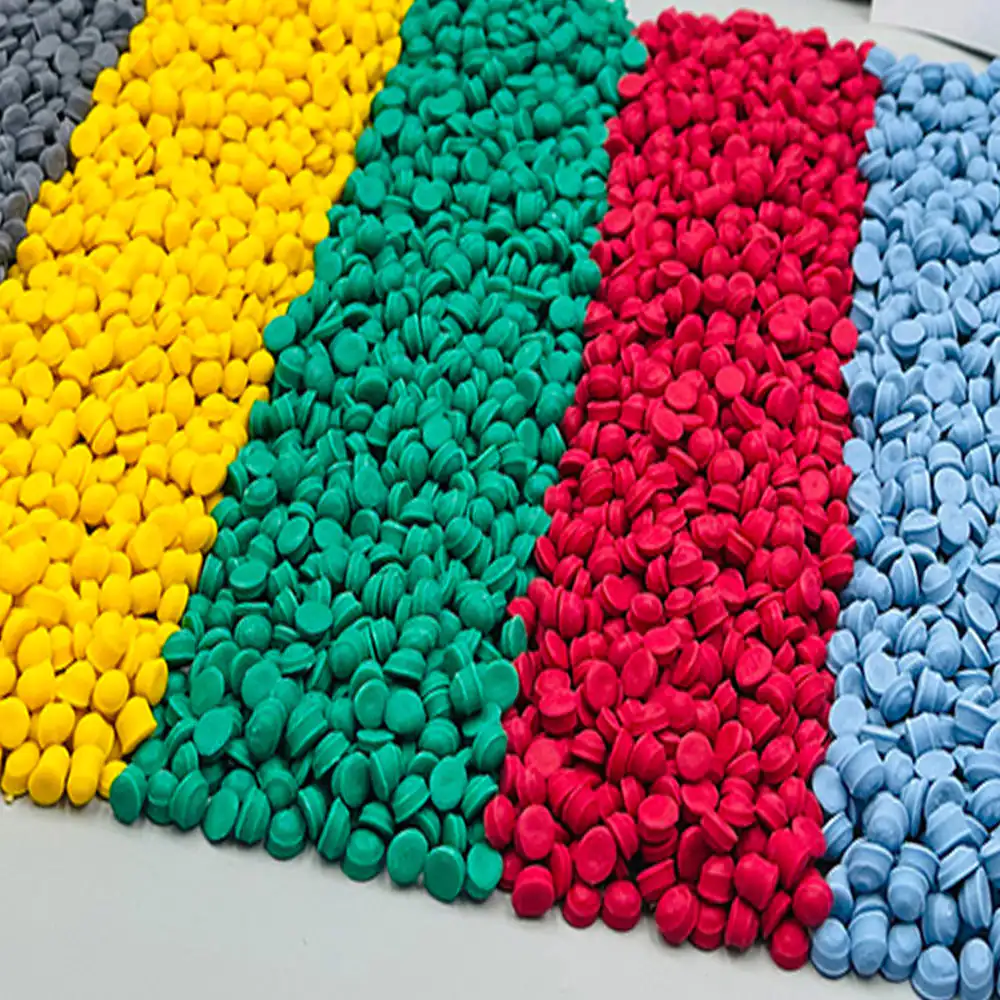
Typical defects in poorly mixed pellets
When I audit a plant, I look at finished parts and pellets first. Poor mixing leaves a clear “fingerprint”:
- Visible color streaks5 or patches
- Dull or cloudy appearance instead of clean gloss
- Black specks or unmelted masterbatch particles
- Warped parts or brittle corners on impact tests
- Surface deposits in mold, die, or calendar rolls
Most of these issues come from local zones with too high or too low additive levels. The average recipe on paper is correct. The problem is the variation around that average.
I like to show a simple table to the team to connect visual defects with mixing quality:
| Defect type | Likely root cause | How a mixer helps |
|---|---|---|
| Color streaks / tiger stripes | Poor pre-mix, pulse feeding | Homogenizes colorant before extrusion |
| Black specks | Local masterbatch overload | Breaks clumps, spreads masterbatch uniformly |
| Plate-out on die | Additive “hot spots” at surface | Lowers local additive concentration peaks |
| Brittle parts, rejects | Uneven impact modifier content6 | Reduces variation in additive distribution |
How I quantify mixing quality on a line
I do not trust my eyes alone. I ask the lab to measure variation across samples from the same batch. Two simple metrics work well for me:
- Coefficient of variation (CoV) of masterbatch percentage
- Color difference ΔE across samples from one batch
Here is a typical case I saw when we added a proper mixer before a recycling extrusion line7:
| Item | Before mixer | After mixer |
|---|---|---|
| Masterbatch CoV (10 samples) | 8–10% | 2–3% |
| ΔE between darkest and lightest | 2.5–3.0 | 0.6–0.8 |
| Visual complaints per month | 6–8 | 1–2 |
After we installed the mixer, operators stopped adjusting the feeder every hour. The line ran with the same feeder setpoints and still gave stable color. This is what good mixing should do.
How do plastic mixer machines8 actually improve color stability?
Many people think the extruder screws will “fix” everything. I learned the hard way that an extruder cannot fully correct a bad dry blend or pulsing feeders.
Plastic mixer machines improve color stability by creating a uniform, repeatable blend before extrusion. They reduce feed pulsation, even out regrind variation, and give the extruder a steady input with consistent colorant level.

Better pre-blending before extrusion
In many recycling and compounding plants, I see four streams going into the extruder throat:
- Virgin resin
- Regrind
- Color masterbatch
- Additive masterbatch
If these streams meet for the first time at the extruder throat, even a twin-screw will see local rich and lean zones. A mixer machine moves this “meeting point” upstream. The machine can be a vertical mixer9, a horizontal ribbon mixer, or a high-speed mixer10, depending on capacity and material.
Inside the mixer, paddles or screws lift and fold material many times. This action:
- Breaks small clumps of masterbatch
- Distributes regrind more evenly through virgin
- Reduces density segregation between light and heavy pellets
Here is how the process usually changes after adding a mixer:
| Parameter | Without mixer | With mixer upstream |
|---|---|---|
| Number of material streams at feed | 3–4 separate streams | 1 homogeneous premix |
| Color variation along the roll | Clearly visible shade shifts | Very small or none |
| Operator feeder adjustments | Every 30–60 minutes | Once per shift or less |
Lower variation in masterbatch dosing11
Even with good gravimetric feeders, short-term fluctuations happen. The feeder may overfeed for a few seconds and underfeed for the next few seconds. Without a mixer, the extruder sees those peaks and valleys directly, and the melt color follows.
A buffer mixer reduces the short-term variation. Material from a few minutes of feeding blends together. The peak from one moment mixes with the valley from the next. The result is a smoother concentration profile.
On one PP sheet line running 800 kg/h, I saw masterbatch dosing fluctuation of ±0.3% at the feeder. After adding a 2-ton vertical mixer with about 10–15 minutes residence time12, the effective variation at the extruder inlet dropped below ±0.1%. The lab confirmed that ΔE also dropped, and the client could run with 0.2–0.3% less masterbatch while meeting the same color spec. This is a direct cost saving from mixing.
How do mixers improve additive dispersion13 and not just color?
Many people focus only on color. In my projects with recycling plants, I see equal or bigger benefits from better dispersion of process aids, UV stabilizers, and anti-static agents.
Mixer machines help additives work as designed by spreading them evenly in every pellet. Each part then receives close to the same dosage, so properties stay within a narrow band.
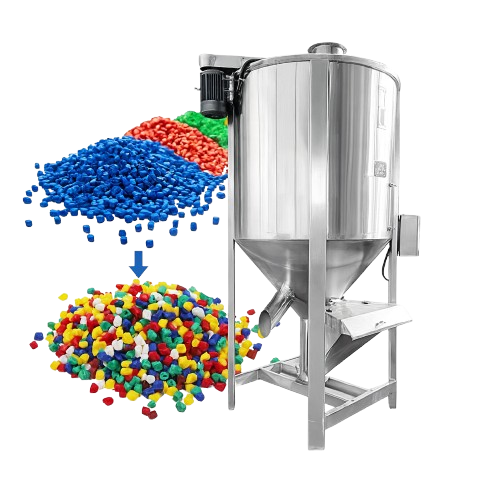
Why uniform additive dispersion matters
Additives often work at very low levels, sometimes below 1%. If mixing is poor, some pellets carry too much, some too little, and some almost none. This leads to:
- Unstable coefficient of friction for slip agents
- Yellowing or poor weathering for UV packages
- Slow dust attraction when anti-static is low
- Drip issues in flame-retarded grades
I once worked with a client using a HALS UV package. The average formulation was correct, but field complaints showed early chalking. When we checked pellets with FTIR and cross sections, we saw big local variation in stabilizer level. After we added a proper mixer and adjusted the feeding point, complaints dropped sharply.
Here is a simple way I explain this to teams:
| Additive type | Risk if mixing is poor | Effect of good pre-mixing |
|---|---|---|
| UV stabilizer | Yellowing, early chalking | Stable color and gloss outdoors |
| Slip / antiblock | Blocking, bag sticking | Predictable slip, smooth release |
| Anti-static | Dust build-up, handling issues | Cleaner surface, lower dust |
| Impact modifier | Brittle failure, cracking | Stable impact strength |
Mixer selection and process setup for additive control
I do not choose the same mixer for every plant. For Mohammed Ali’s profile, with PP, PE, PET, ABS, TPU, TPR, and PVC, I look at:
- Required batch size and hourly rate
- Bulk density and flowability of each polymer and additive
- Sensitivity of additive to heat and shear
For heat-sensitive additives, I avoid very high-speed mixer10s that raise temperature too fast. I prefer vertical screw mixers or horizontal ribbon mixers with gentle action and longer mixing time. For tough recycled flakes with moisture, I may combine a high-speed mixer for quick blending and drying with a secondary holding mixer for equalization.
I also check residence time12 carefully. Too short, and the mixer cannot equalize variation. Too long, and you create unnecessary delay and risk of material aging, especially for PVC or recycled PET. In many real plants, I target 5–20 minutes effective residence time in the mixer, based on throughput.
When we set up a new centralized feeding and mixing system, I like to run small trials and measure real variation at the extruder inlet. I then fine-tune mixer speed, fill level, and discharge cycle. This is how we reach stable production14, lower energy per ton, and less operator intervention.
Conclusion
Plastic mixer machines do not just “stir material.” They stabilize color, control additives, and give recycling and compounding lines a calmer, more efficient, and more profitable operation.

-
Learn about the importance of proper dispersion for achieving consistent product quality. ↩
-
Understand the factors contributing to variation and how to minimize them. ↩
-
Discover the significance of ΔE in maintaining color consistency in products. ↩
-
Find out how poor mixing can lead to defects and increased waste. ↩
-
Investigate the root causes of color streaks and how to prevent them. ↩ ↩
-
Investigate how impact modifiers contribute to the strength of plastic products. ↩
-
Discover the common issues faced in recycling extrusion and how to address them. ↩
-
Explore how plastic mixer machines enhance production efficiency and product quality. ↩
-
Learn about the applications and advantages of vertical mixers. ↩
-
Explore the benefits of high-speed mixers for efficient blending. ↩ ↩
-
Discover the importance of accurate dosing for maintaining color quality. ↩
-
Understand how residence time affects the quality of the final product. ↩ ↩
-
Learn how proper dispersion of additives ensures product reliability. ↩
-
Learn strategies for maintaining stability and efficiency in production. ↩

_画板-1-副本-3-pxeey2xejyohpkvf07tglhvew6ks2ts3pjvhagm60c.png "NICETY MACHINERY Co., LTD")