_画板-1-1.png)
The problem of uneven plastic granules keeps coming back because every batch behaves differently and slows down production.
A large-capacity vertical mixer improves uniformity because it lifts, circulates, and folds plastic pellets in a tall chamber, allowing every particle to move through a long mixing path in a short time.
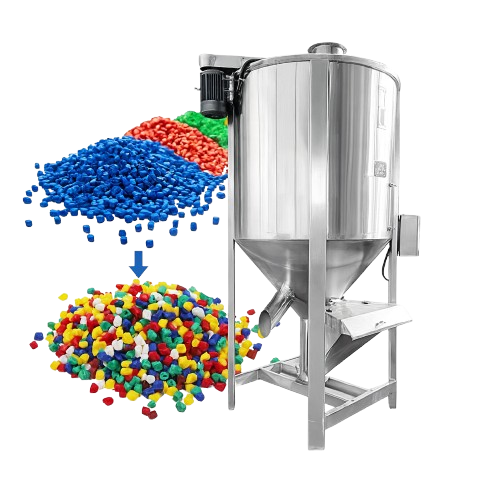
I first learned this when I struggled with unstable granulation results. I tried many methods, but only when I switched to a large vertical mixer did I see a clear change. This experience keeps reminding me why mixer choice matters.
Why is a large-capacity vertical silo mixer1 the best choice?
Uneven plastic pellets often pile up in layers inside small mixers. I watched this happen in my own plant. The material stayed where it fell, and the mixing process barely moved it.
A large-capacity vertical silo mixer is the best choice because its tall silo body creates a long internal circulation path and its strong screw-type mixing column2 can move several tons of pellets quickly. It handles up to 10–20 tons per batch with stable mixing efficiency3.
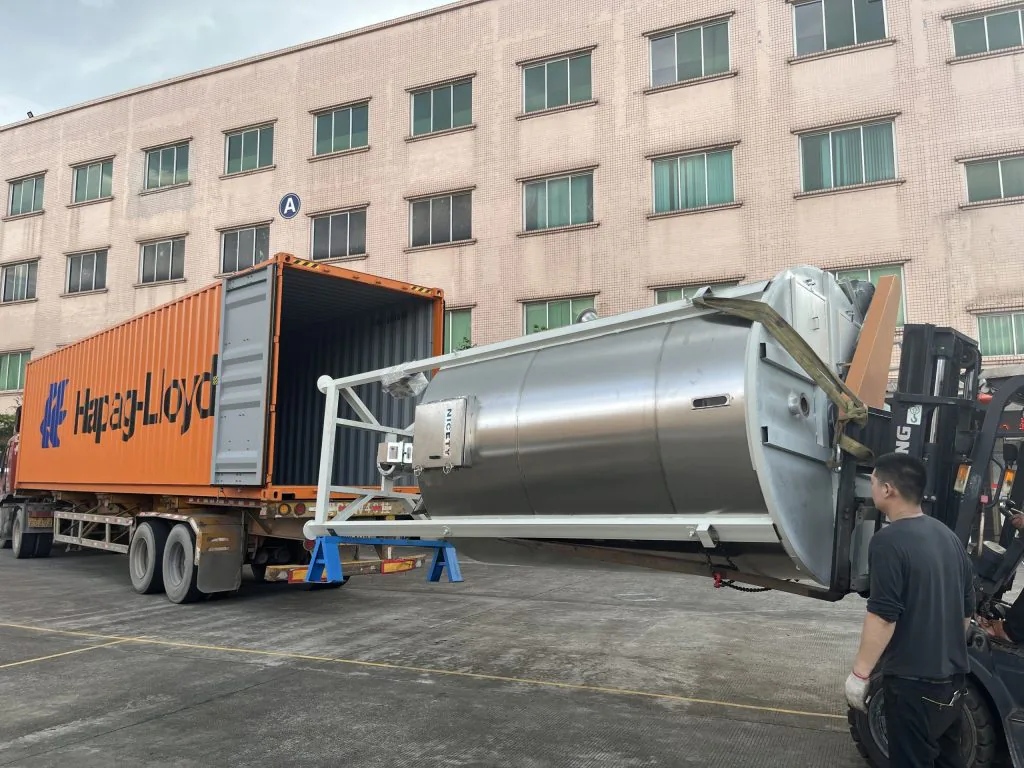
Deeper Look at Why a Large Silo Mixer Works Better
When I explain this to new factory owners, they often ask why height makes a difference. I show them how pellets fall and lift in a vertical chamber. The movement creates a natural “gravity-driven loop4.” The screw pushes the pellets up the tube, and they fall back from the top like a waterfall. This circulation repeats again and again. This simple movement is the key to stable uniformity.
To make this clearer, I break down the main reasons:
Height and Gravity Improve Mixing
| Feature | Effect | Why It Matters |
|---|---|---|
| Tall silo (3–6 meters) | Forms long circulation path | Pellets mix through repeated top-to-bottom movement |
| Central screw column | Lifts large volume at high speed | Improves blending even when batches exceed 10 tons |
| Large capacity (10–20 tons) | Reduces batch differences | One batch mixing prevents small-batch variation |
Strong Internal Flow Creates Uniformity
The mixer does not rotate a drum. Instead, it keeps lifting pellets. Every particle gets pushed upward, released, and blended. This removes separation between heavy and light pellets, which often occurs during conveying or silo storage.
High Mixing Speed Saves Time
I run these mixers daily. They complete circulation much faster than traditional mixers. The speed solves issues that used to take hours to fix.
Why not a horizontal ribbon blender mixer?
I tried using horizontal ribbon mixer5s in the early days. The results were slow and the pellets did not move much. I could see that the material just rolled from left to right, but it did not rise or fall.
A horizontal ribbon mixer is not suitable because it rotates slowly, has a small capacity (usually under 5 tons), and its mixing structure is ideal for powders rather than pellets.

Deeper Look at Why Ribbon Mixers Are Not Ideal for Pellets
Horizontal ribbon mixers were designed for powder blending. Pellets do not respond in the same way. Pellets need vertical movement6 to achieve uniformity. A ribbon mixer does not create this movement.
Comparison of Vertical vs Horizontal Mixers for Pellets
| Mixer Type | Capacity | Mixing Speed | Best Material | Main Weakness |
|---|---|---|---|---|
| Vertical silo mixer | 10–20 tons | Fast | Pellets and flakes | Not suitable for sticky powders |
| Horizontal ribbon mixer | 1–5 tons | Slow | Powder | Poor circulation for pellets |
Why Pellets Do Not Mix Well in Ribbon Mixers
The ribbon turns slowly. The pellets move sideways. The density difference between pellets causes layering. Heavy pellets sink and light pellets float. This leads to poor uniformity that directly impacts granulation.
Ribbon mixers also cost more per ton of capacity. They take up more floor space and consume more power for their size. These points became clear to me after several investment mistakes that I do not want others to repeat.
What is the typical mixing time per batch for a vertical silo mixer?
I used to think that mixing several tons of pellets would take hours. I learned later that the right mixer changes everything.
Most vertical silo mixers need about 5–15 minutes per batch to complete homogenization because the circulation path is long and the internal screw moves material quickly.
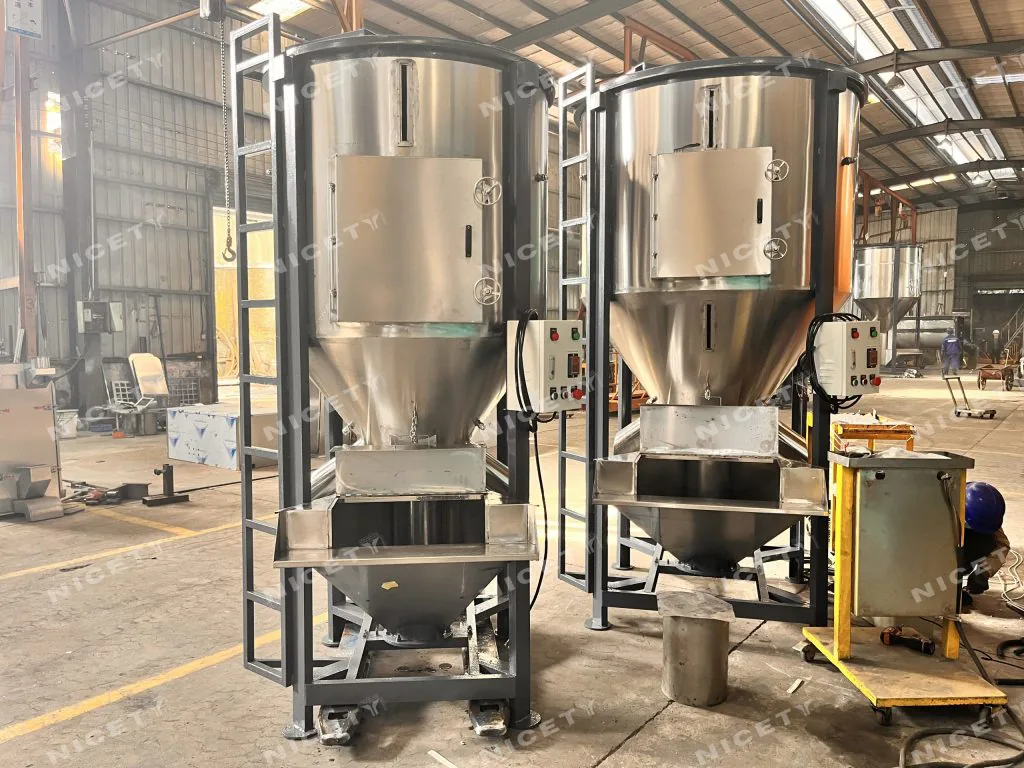
Deeper Look at Mixing Time and Performance
Large vertical mixers rely on fast circulation rather than slow rotation. Each full cycle of lifting and dropping takes only a few seconds. When this repeats many times, the entire batch blends evenly.
Main Factors That Affect Mixing Time
| Factor | Influence |
|---|---|
| Pellet size uniformity | Smaller variations mix faster |
| Screw speed | High RPM reduces mixing time7 |
| Moisture level | Wet pellets mix slower |
| Batch size | Full-capacity mixing is more efficient |
Why Time Matters in Real Production
Short mixing time reduces labor and improves line stability. I saw a factory cut two workers from a shift because the mixer worked fast enough to automate feeding. This kind of improvement matters a lot for plant owners like Mohammed Ali, who work with strict production schedules and need predictable output.
What problems can arise from low uniformity8 in plastic granules?
This problem caused many headaches for me. The extrusion lines kept producing unstable results. One batch melted faster, another slower. The customers complained about color shifts.
Low uniformity leads to unstable extrusion temperature, color variation, poor mechanical strength, and increased scrap rate. It also increases energy use and slows production.

Deeper Look at Real Production Problems
Low uniformity affects almost every step after granulation. Many plant owners underestimate this problem because it shows up only in quality checks or final product behavior.
Common Problems Caused by Poor Uniformity
| Problem | How It Appears | Why It Happens |
|---|---|---|
| Color streaks | Visible lines in products | Pigment not fully blended |
| Unstable MFI | Melt flow differs by batch | Density and additives vary |
| High scrap rate | Rejects increase | Uneven melting causes defects |
| Mechanical weakness | Cracks or breaks | Additives not evenly distributed |
The Long-Term Cost
A plant might waste 3–10% of material due to bad uniformity. Over a year, this becomes a large financial loss. I have seen owners realize this only after comparing energy and scrap costs before and after switching to a proper mixer.
Which types of plastics require this type of large vertical hopper mixer for homogenization and improved uniformity?
I meet many customers who process many kinds of plastics. They often think only powder materials need mixing. However, pellets also need it.
Large vertical mixers are ideal for PP, PE, ABS, PET, TPU, TPR, PVC, recycled materials, and any blends containing color masterbatch, UV additives, flame retardants, or fillers.

Deeper Look at Material Types and Why They Need Mixing
Different plastics behave differently in a granulation line. Recycled plastics have the biggest variation because the source material changes every day. This is where large-capacity mixers become critical.
Plastics That Benefit Most
| Material | Reason for Mixing |
|---|---|
| PP/PE | Density differences cause layering |
| PET | Sensitive to moisture; uniformity improves drying |
| ABS | Color variation appears easily |
| PVC | Additives must mix well |
| TPU/TPR | Soft pellets need consistent formula |
| Recycled pellets | Variation between batches is high |
Why Even High-Quality Virgin Pellets Need Mixing
Color masterbatch does not always disperse perfectly during extrusion. Large mixers help pre-blend the material. This reduces load on the extruder and stabilizes the melt.
I have seen factories shorten color-change time by half after using large mixers. This happens because pellets enter the extruder in a much more stable state.
Conclusion
A large vertical mixer fixes uniformity problems by moving pellets fast through a long circulation path, giving stable mixing results every time.
About me
Nicety Machinery Co., Ltd
Your consultant for material mixing and centralized feeding systems in the plastics processing industry.
www.nicetymachine.com
Our Mission
We are a knowledge-sharing platform dedicated to helping anyone involved or interested in the plastics processing industry deepen their understanding of the industry. Our goal is to enable everyone from beginners to seasoned professionals to find the right mechanical solution for them on our website.
Explore the advantages of large-capacity vertical silo mixers to understand their efficiency and effectiveness in industrial applications. ↩
Discover the benefits of a strong screw-type mixing column for improving mixing speed and efficiency in large-scale operations. ↩
Find out what influences stable mixing efficiency to optimize your mixing processes and reduce batch variations. ↩
Learn about the gravity-driven loop concept to see how it enhances mixing efficiency and uniformity in various applications. ↩
Explore this link to understand the limitations of horizontal ribbon mixers and why they may not be suitable for your needs. ↩
Learn about the significance of vertical movement in achieving uniformity in pellet mixing, which is crucial for effective processing. ↩
Learn about the impact of mixing time on production efficiency and labor costs, crucial for optimizing your manufacturing process. ↩
Understanding the effects of low uniformity can help you improve production quality and reduce costs. ↩

_画板-1-副本-3-pxeey2xejyohpkvf07tglhvew6ks2ts3pjvhagm60c.png "NICETY MACHINERY Co., LTD")