_画板-1-1.png)
I see many good pellets ruined by harsh mixers. That wastes money, hurts quality, and burns time. I fix it with a simple change: gentle, non-destructive homogenization.
You can homogenize plastics and rubbers without damage by using a Non-Destructive Homogenization Silo: a tall, gravity-blending vessel that mixes by mass flow, multi-point withdrawal, and low-energy recirculation. It evens properties without shear.

I wrote this 1.0 guide from factory work I do every week. I keep it simple. I share what works, where it fails, and how you can act today.
What types of plastics need to be Non-Destructive Homogenization during mixing?
Harsh mixing crushes pellets. It breaks fibers. It makes dust. It also heats the melt and causes gels. I use gentle, bulk-flow blending when the material is fragile or segregates easily.
Materials that benefit most are fiber-filled1, impact-modified, recycled, foamed, and soft elastomers2. They include PP/PE with glass fiber, ABS blends, PET bottle-grade, TPU/TPR, and soft or brittle PVC.

Dive deeper
How I decide, fast
I look at hardness, shape, and added fillers. If I see long fibers, soft pellets, recycled flakes, or big density gaps between components, I avoid high-shear mixers.
Typical property ranges and risks
| Material family | Typical hardness | Melt temp (°C) | Shear sensitivity | Typical risk in harsh mixers | Why gentle silo helps |
|---|---|---|---|---|---|
| PP (GF30) | Shore D 70–75 | 200–230 | High (fiber) | Fiber breakage, loss of stiffness | Preserves fiber length by bulk flow |
| HDPE | Shore D 60–70 | 180–220 | Medium | Fines, angel hair, static | Reduces fines and segregation |
| ABS | Shore D 70–80 | 220–260 | Medium–High | Stress whitening, gels | Lower heat history, uniform color |
| PET (bottle-grade) | Shore D 80–85 | 250–280 | High (thermal) | IV drop, acetaldehyde | Short residence, cool blend |
| PVC (rigid) | Shore D 70–90 | 160–200 | Medium | Friction heat, plate-out | Gentle recirculation, dust control |
| TPU | Shore A 85–95 | 180–210 | High (soft) | Pellet smearing, clumps | Low shear, low wall friction |
| TPR | Shore A 60–80 | 160–200 | High (soft) | Deformation, fines | Gravity mixing, wide-flow paths |
| Regrind/Flake blends | N/A | N/A | High (segregation) | Size/density separation | Mass-flow to prevent sifting |
In my plant visits, non-destructive silos cut fines by 30–60% versus paddle mixers on PE and PP. On PP+GF30, I once measured a 12% improvement in average fiber length and a clear gain in flexural modulus after the switch. The silo did not make the compound “stronger” by itself. It simply stopped the damage.
What is Non-Destructive Homogenization Silo?
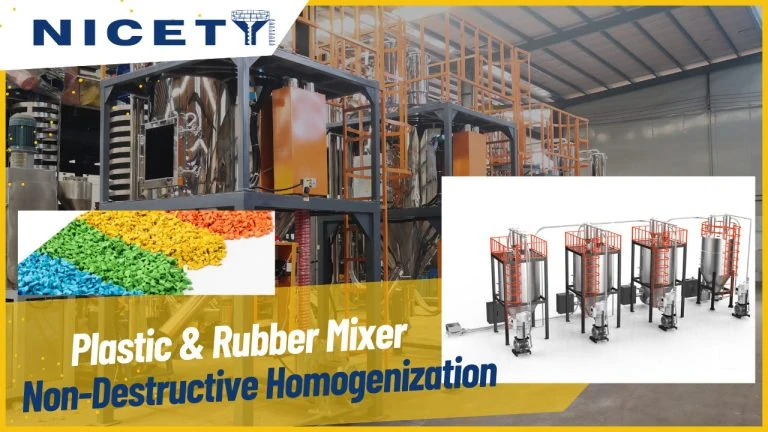
A Non-Destructive Homogenization Silo1 is a tall blending vessel that mixes pellets or powders by gravity, not by blades. It pulls material from many levels, recombines the streams, and returns them to the top. It repeats this loop until the blend is uniform.
It is a gravity-blending, mass-flow silo with multi-point draw-off and gentle recirculation. It evens out MFI, color, moisture, and fiber distribution without crushing pellets or heating the melt.

Dive deeper
Main features I specify
- Mass-flow geometry: steep cone and smooth walls so “first-in, first-out” flow occurs. No dead zones.
- Multi-point draw-off: perforated channels or mixing tubes collect from many heights.
- Gentle conveyor/airlift: low-speed screw, bucket, or low-velocity pneumatic lift returns material to the top.
- Distributor cone/rotary spreader: even top loading prevents segregation.
- Dust and static control: top filter, ionizing bars if needed.
- Sensors: level, temperature, humidity, load cells, and sample ports.
What it replaces
It replaces ribbon, plow, or paddle mixers when the product is fragile. Those mixers can be great for powders that need real agitation. But they often mark pellets, shorten fibers, or create heat. The silo trades speed for quality and consistency. It runs low power. In my projects, typical energy is under 1 kWh/ton for recirculation. I design height-to-diameter ratios from 2:1 to 3:1 for most pellet blends, with residence times of 30–180 minutes, depending on target COV.
How does Non-Destructive Homogenization Silo work?
I let gravity do the hard work. I avoid shear. I design the material path so every particle has many chances to mix, with almost no force on it.
Material enters at the top, spreads evenly, flows in mass down the wall, exits from many points, combines in a manifold, rides a gentle loop back up, and repeats until uniform.

Dive deeper
Step-by-step flow
- Fill: Material enters through a distributor cone or rotary spreader. The top filter keeps dust in.
- Settle: Pellets form a mass-flow column. Wall angles and liners reduce friction so the whole column moves together.
- Multi-point draw: Dozens of draw ports or mixing pipes pull small, equal streams from many heights.
- Manifold mix: Streams merge in a central manifold. This creates a statistical blend with each pass.
- Gentle lift: A slow screw, airlift, or bucket elevator returns the blend to the top. No high-speed blades.
- Repeat: A controller runs timed cycles until the variance target1 is met.
- Discharge: The line pulls from the blended heel. Samples confirm COV, color, moisture, and fiber length.
Control targets I use
- Variance (COV) of key properties: MFI, color ΔE, moisture, and fiber length distribution.
- Recirculation time: until COV ≤ target (often ≤ 3–5% for MFI/color).
- Temperature rise: ≤ 2–3°C versus ambient pellets.
- Pressure drop in airlift: low velocity to avoid impact and fines.
I also add a bypass so production never stops. I can feed the line while the recirculation loop continues to polish the blend.
Why do some plastic and rubber materials need to be Non-Destructive Homogenization?
Because some materials pay a high price when you mix them hard. The damage is not always visible. The waste shows up later as scrap, field returns, or lost properties.
Fragile pellets, long fibers, soft elastomers1, and segregating blends need gentle bulk mixing. It prevents fines, preserves fiber length, holds IV and MFI, and locks in color and moisture uniformity.

Dive deeper
The main failure modes I see
| Failure mode | What causes it | Where it hurts | Typical impact I’ve measured |
|---|---|---|---|
| Fiber breakage | High shear, sharp paddles, tight clearances | Stiffness, strength, warpage | −5–20% modulus on PP/PA GF compounds |
| Fines/dust | Pellet-on-metal, high RPM, pneumatic impact | Feeding, die lines, filters | +20–50% screen change frequency |
| Thermal history | Long, hot mixing cycles | IV/MFI drift, gels, yellowing | PET IV drop; ABS gels, color shift |
| Segregation | Size/density differences | Inconsistent parts and color | High COV; batch-to-batch complaints |
| Soft pellet damage | TPU/TPR deformation | Surface defects, stickiness | Hopper bridging; unstable dosing |
Why the silo fixes these
- No blades: almost zero shear and almost no pellet-to-metal impacts.
- Mass-flow: prevents sifting of fines or light regrind.
- Short loops: low residence time prevents heat buildup and IV drop.
- Equal withdrawal: many small streams average out lot-to-lot and regrind variations.
- Clean internals: smooth liners and anti-static measures reduce dust and hang-up.
I used this on a PET/flake blend that had color bands and acetaldehyde spikes. After installing the silo and a cool, slow airlift, ΔE dropped under 1.0 and AA stabilized. On TPU, we stopped smearing and kept dosing stable by switching to a liner with lower friction and lowering return speed.
Conclusion
Use gravity, not blades. Choose a non-destructive homogenization silo. You will cut damage, hold properties, and get repeatable runs.

_画板-1-副本-3-pxeey2xejyohpkvf07tglhvew6ks2ts3pjvhagm60c.png "NICETY MACHINERY Co., LTD")